T.rex's oldest ancestor identified
November 4, 2009 T.rex's oldest ancestor identified

Enlarge

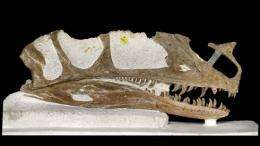
Fossil skull of Proceratosaurus, looked after in the Museum's collections. It is the oldest-known relative of T.rex and it lived 165 million years ago.

(PhysOrg.com) -- Remains of the oldest-known relative of T.rex have been identified, more than 100 years after being pulled out of a Gloucestershire reservoir, according to research published in the Zoological Journal of the Linnean Society today.

A near-complete 30cm skull in London’s Natural History Museum’s collection has been found to be a 165-million-year-old ancestor of T.rex, called Proceratosaurus.

Proceratosaurus was much smaller than T.rex, probably about 3m long, and lived 100 million years earlier. This new dinosaur gives scientists important clues about the early stages of the evolution of these fearsome predators.

A team of British and German scientists, including 2 fossil experts from London’s Natural History Museum, used computed tomography (CT) techniques to generate X-rays and then a 3D image of the delicate skull remains. This meant they could study its internal structure in minute detail.

They found that its teeth, jaws and braincase all closely resemble the structures found in the gigantic predator.

‘It was quite a surprise when our analysis showed we had the oldest known relative of T.rex,’ says Museum dinosaur expert, Dr Angela Milner.

‘We care for over 9 million fossils here at the Museum and this discovery highlights the importance of museum collections in current and future research. Fossils collected a century ago can now be studied again with the benefit of much greater knowledge of dinosaurs from around the world.’

The fossil is very well preserved, however, some of the bones were still covered in rock and had to be carefully cleaned before the skull could be fully examined.
T.rex's oldest ancestor identified

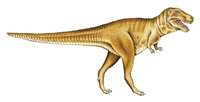
llustration of T.rex, the gigantic predator that lived 67-65 million years ago.

‘This is a very fragile skull,’ says Museum fossil expert, Scott More-Fay, ‘so removing the rock, especially from around the teeth, was a delicate and time-consuming task that had to be done under a microscope, using very fine tools.’

The skull was uncovered during excavations for a reservoir close to Minchinhampton in Gloucestershire. In 1910, it was described as a new species of Megalosaurus.

The fossil was presented to the Natural History Museum in 1922 by F L Bradley, but its links to the most famous dinosaur family of all remained undiscovered until now.

Tyrannosaurus rex lived around 67 to 65 million years ago at the end of the dinosaur era in the Cretaceous period, and is a member of a larger group, called Tyrannosauroidea, after its most famous member.

Dr Oliver Rauhut from the Bavarian State Collection for Palaeontology and Geology in Munich said, ‘This is still one of the best-preserved dinosaur skulls found in Europe. It is really surprising that it has received so little attention since its original description.’

And, there are many possibilities to discover and identify new species using techniques such as CT modelling, as Dr Rauhut explains, ‘I’m sure that many more tyrannosaurs are still out there to be found. I think we have just scratched the tip of the iceberg so far.’

More information: Zoological Journal of the Linnean Society

Provided by Natural History Museum


print this article email this article download pdf blog this article bookmark this article     Stumble it Digg this share on Facebook retweet share on Reddit add to delicious
Rate this story - 4.5 /5 (2 votes)


November 4, 2009 all stories

Comments: 0

4.5 /5 (2 votes)
  • Stumble this up

  • Digg this

  • share this

  • hide
  • Related Stories

  • Museum unveils world's largest T-rex skull
    created Apr 07, 2006 | popularity not rated yet | comments 0
  • Unusual fish-eating dinosaur had crocodile-like skull
    created Jan 14, 2008 | popularity not rated yet | comments 0
  • High-Tech X-Ray Equipment to Examine Dinosaur Skull
    created Jan 14, 2005 | popularity not rated yet | comments 0
  • Fused nasal bones helped tyrannosaurids dismember prey
    created May 18, 2007 | popularity not rated yet | comments 0
  • Chicken-hearted tyrants: Predatory dinosaurs as baby killers
    created Aug 06, 2009 | popularity not rated yet | comments 0


  • hide
  • Relevant PhysicsForums posts

  • Breeding program
    created 22 hours ago
  • How does a concentration gradient provide energy?
    created Nov 20, 2009
  • Eyesight and Neural Damage from Electronics
    created Nov 19, 2009
  • Quick question about the Golgi Apparatus?
    created Nov 19, 2009
  • The beginning of humans
    created Nov 18, 2009
  • Omega 3 questions
    created Nov 18, 2009
  • More from Physics Forums - Biology

Other News

Museum: Galileo's fingers, tooth are found (AP)

Museum: Galileo's fingers, tooth are found

Other Sciences / Archaeology & Fossils

created 7 hours ago | popularity not rated yet | comments 3

(AP) -- Two fingers and a tooth removed from Galileo Galilei's corpse in a Florentine basilica in the 18th century and given up for lost have been found again and will soon be put on display, an Italian museum ...


Researcher: Faint writing seen on Shroud of Turin (AP)

Researcher: Faint writing seen on Shroud of Turin (Update)

Other Sciences / Archaeology & Fossils

created 22 hours ago | popularity 1.8 / 5 (20) | comments 21

(AP) -- A Vatican researcher has rekindled the age-old debate over the Shroud of Turin, saying that faint writing on the linen proves it was the burial cloth of Jesus. Experts say the historian may be reading ...


Measure to change U. of Neb. stem-cell rule fails (AP)

Measure to change U. of Neb. stem-cell rule fails (Update 2)

Other Sciences / Other

created 7 hours ago | popularity 5 / 5 (1) | comments 0

(AP) -- The University of Nebraska's governing board on Friday voted not to place tighter restrictions on embryonic stem cell research than those outlined under federal guidelines, which were expanded after ...


Three of a kind

Three of a kind: Revealing language’s universal essence

Other Sciences / Social Sciences

created Nov 20, 2009 | popularity 3.5 / 5 (8) | comments 6

(PhysOrg.com) -- On the surface, English, Japanese, and Kinande, a member of the Bantu family of languages spoken in the Democratic Republic of Congo, have little in common. It is not just that the vocabularies ...


Maya

New insights into the life of the Maya

Other Sciences / Archaeology & Fossils

created Nov 16, 2009 | popularity 4.6 / 5 (15) | comments 7

(PhysOrg.com) -- Ancient artifacts are almost always concerned with rich and powerful religious and political leaders, but new excavations of an ancient Maya site have unearthed a pyramid decorated with murals ...