Study uses satellite imagery to identify active magma systems in East Africa's Rift Valley
November 4, 2009
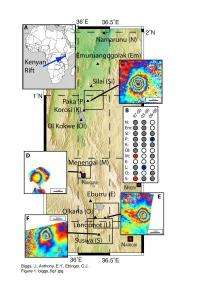
A team from University of Miami, University of El Paso and University of Rochester used Interferometric Synthetic Aperture Radar (InSAR) images compiled over a decade to study volcanic activity in the African Rift. A paper, published in the November issue of Geology, focuses on the section of the rift in Kenya. Surface deformation of four active volcanoes underscore possibility for human hazard, as well as the potential of geothermal resources. Credit: J. Biggs, E.Y. Anthony,C.J. Ebinger
A team from the University of Miami, University of El Paso and University of Rochester have employed Interferometric Synthetic Aperture Radar (InSAR) images compiled over a decade to study volcanic activity in the African Rift. The study, published in the November issue of Geology, studies the section of the rift in Kenya.
"The Kenyan Rift volcanoes are part of a larger Great Rift Valley complex that extends all the way from Mozambique to Djibouti; their presence in East Africa attests to the presence of magma reservoirs within the Earth's crust," said Lead Author Dr. Juliet Biggs, Rosenstiel Postdoctoral Fellow at the University of Miami. "Our study detected signs of activity in only four of the 11 volcanoes in the area -- Suswa, Menengai, Longonot and Paka -- all within the borders of Kenya."
Small surface displacements, which are not visible to the naked eye, were captured using InSAR, a sophisticated satellite-based radar technique. Using images from European Space Agency satellites ERS and Envisat, the team was able to detect the smallest ((<1 cm) of surface displacements at a very high resolution. from 1997 - 2000 they discovered that the volcanoes at suswa and menengai subsided 2 - 5 cm, and between 2004 and 2006 the longonot volcano experienced uplift of ~9 cm. however, the most dramatic uplift unfolded at paka, which had uplift of ~21 cm during a nine month period in 2006-2007. this pulse of activity was preceded by transient uplift and subsidence at a second source, associated with the magma flow through the complex underground plumbing system. overall the events were short in duration and episodic rather than continuous, which means discrete pulses of magma were arriving at the crust, similar to a stop valve that is being turned on and off intermittently.
"The fact that these areas are so close to a major metropolitan area pose a challenge in terms of a large volcanic or seismic event" says co-author Cindy Ebinger. Suswa, Menengai and Longonot are all located in densely populated areas within 100 km of Nairoibi.
The study also provides insight as to the geothermal potential of the region. Kenya was the first African country to build geothermal energy plants to generate this renewable, environmentally friendly alternative to coal and oil. The impact of harnessing such a resource could provide an important economic engine for the region.
Geothermal energy is generated by drilling deep holes into the Earth's crust, pumping cold water through one end so by the time it resurfaces it is steam, which is then used to fuel a turbine, which in turn drives a generator, and creates power.
"This study demonstrates the potential for using InSAR to measure active magmatic and tectonic phenomena in Africa, allowing us to watch the processes by which continents break apart" says lead author Juliet Biggs, who has just begun a 2-year project at the Univeristy of Oxford, funded by the European Space Agency, to map the pattern of volcanic activity, dike intrusion and active faulting along the whole of the East African Rift.
Source: University of Miami Rosenstiel School of Marine & Atmospheric Science
-
Tracking a hot spot
May 17, 2007 |
not rated yet |
0
-
Satellite reveals Yellowston's deep secret
Mar 09, 2006 |
not rated yet |
0
-
Team first to record key event that breaks continents apart
Dec 10, 2008 |
not rated yet |
0
-
Beneath the surface
Feb 11, 2009 |
not rated yet |
0
-
Scientists Install Seismic Sensors in Galapagos to Generate First 3-D Images of a Hotspot Magma Plumbing System
Sep 09, 2009 |
not rated yet |
0
-
Engineers build first sub-10-nm carbon nanotube transistor
Feb 01, 2012 |
4.9 / 5 (33) |
30
-
Something old, something new: Evolution and the structural divergence of duplicate genes
Jan 31, 2012 |
4.6 / 5 (7) |
1
-
The hidden nanoworld of ice crystals: Revealing the dynamic behavior of quasi-liquid layers
Jan 30, 2012 |
5 / 5 (4) |
1
-
Stock market network reveals investor clustering
Jan 27, 2012 |
3.9 / 5 (23) |
8
-
Of microchemistry and molecules: Electronic microfluidic device synthesizes biocompatible probes
Jan 26, 2012 |
5 / 5 (2) |
0
-
Do some geologists actually act a lot like Randy Marsh?
Feb 11, 2012
-
Discrepancy between oxygen and carbon-dioxide levels
Feb 09, 2012
-
where gems are found in the world
Feb 09, 2012
-
Wind Waves in Reservoir ~ Wind run-up and Wind set-up
Feb 08, 2012
-
Balance of oxygen in the atmosphere
Feb 01, 2012
-
The case for a methanol-based economy
Jan 30, 2012
- More from Physics Forums - Earth
More news stories
Latin America mining boom clashes with conservation
Latin America is experiencing a mining boom as prices rise fuelled by a hike in global demand, but the region is also being hit by a wave of violent protests, strikes and rallies by environmentalists.
21 hours ago |
5 / 5 (1) |
1
Salvage workers begin pumping fuel from Italian shipwreck
Salvage workers Sunday began pumping fuel from the shipwrecked Italian cruise liner Costa Concordia, a day ahead of schedule, officials said.
13 hours ago |
5 / 5 (2) |
0
Political leaders play key role in how worried Americans are by climate change: study
More than extreme weather events and the work of scientists, it is national political leaders who influence how much Americans worry about the threat of climate change, new research finds.
Feb 06, 2012 |
5 / 5 (8) |
75
NASA budget will axe Mars deal with Europe: scientists
US President Barack Obama's budget proposal to be submitted next week for 2013 will cut NASA's budget by 20 percent and eliminate a major partnership with Europe on Mars exploration, scientists said Thursday.
Space & Earth / Space Exploration
Feb 10, 2012 |
5 / 5 (4) |
58
Humans may have helped the decline of African rainforests 3000 years ago
(PhysOrg.com) -- Large areas of rainforests in Central Africa mysteriously disappeared over three thousand years ago, to be replaced by savannas. The prevailing theory has been that the cause was a change ...
Scientists discover molecular secrets of 2,000-year-old Chinese herbal remedy
For roughly two thousand years, Chinese herbalists have treated Malaria using a root extract, commonly known as Chang Shan, from a type of hydrangea that grows in Tibet and Nepal. More recent studies suggest that halofuginone, ...
New method to examine batteries -- MRI from the inside
There is an ever-increasing need for advanced batteries for portable electronics, such as phones, cameras, and music players, but also to power electric vehicles and to facilitate the distribution and storage of energy derived ...
A mitosis mystery solved: How chromosomes align perfectly in a dividing cell
Although the process of mitotic cell division has been studied intensely for more than 50 years, Whitehead Institute researchers have only now solved the mystery of how cells correctly align their chromosomes during symmetric ...
Google might launch Drive for cloud storage soon
(PhysOrg.com) -- Google's next big move, according to the Wall Street Journal, is a cloud storage service called Drive. Hardly first to the plate, Google is simply catching up to introducing its cloud reposi ...
Lab study raises questions over nano-particle impact
Tests involving chickens have raised questions about the impact on health from engineered nano-particles, the ultra-fine grains commonly used in drugs and processed foods, scientists said on Sunday.
Starve a virus, feed a cure? Findings show how some cells protect themselves against HIV
A protein that protects some of our immune cells from the most common and virulent form of HIV works by starving the virus of the molecular building blocks that it needs to replicate, according to research published online ...