An inexpensive 'dipstick' test for pesticides in foods
November 4, 2009 An inexpensive 'dipstick' test for pesticides in foods

Enlarge

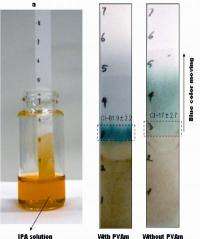
An experimental test strip shows a visible color change indicating the presence of pesticides in a test sample. In the future, similar strips may help detect these hidden toxins in foods and beverages. Credit: The American Chemical Society

Scientists in Canada are reporting the development of a fast, inexpensive "dipstick" test to identify small amounts of pesticides that may exist in foods and beverages. Their paper-strip test is more practical than conventional pesticide tests, producing results in minutes rather than hours by means of an easy-to-read color-change, they say.

The study is in the November 1 issue of ACS' Analytical Chemistry. John Brennan and colleagues note in the new study that conventional tests for detecting tend to use expensive and complex equipment and in some cases can take several hours to produce results. They cite a growing need for cheaper, more convenient, and more eco-friendly tests for pesticides, particularly in the .

The scientists describe the development of a new paper-based test strip that changes color shades depending on the amount of pesticide present. In laboratory studies using food and beverage samples intentionally contaminated with common pesticides, the test strips accurately identified minute amounts of pesticides. The test strips, which produced results in less than 5 minutes, could be particularly useful in developing countries or remote areas that may lack access to expensive testing equipment and electricity, they note.

More information: "Reagentless Bidirectional Lateral Flow Bioactive Paper Sensors for Detection of Pesticides in Beverage and Food Samples", Analytical Chemistry, http://pubs.acs.org/stoken/presspac/presspac/full/10.1021/ac901714h

Source: American Chemical Society (news : web)


print this article email this article download pdf blog this article bookmark this article     Stumble it Digg this share on Facebook retweet share on Reddit add to delicious
Rate this story - 5 /5 (1 vote)


November 4, 2009 all stories

Comments: 0

5 /5 (1 vote)
  • Stumble this up

  • Digg this

  • share this

  • hide
  • Related Stories

  • High pesticide levels found in fruit-based drinks in some countries outside U. S.
    created Dec 15, 2008 | popularity not rated yet | comments 0
  • Getting plants to rid themselves of pesticide residues
    created Sep 09, 2009 | popularity not rated yet | comments 0
  • Study: Pesticides found in wine
    created Apr 04, 2008 | popularity not rated yet | comments 0
  • Pesticides need sunscreen to beat the heat
    created Dec 18, 2006 | popularity not rated yet | comments 0
  • Pesticides found in tobacco smoke
    created Apr 18, 2006 | popularity not rated yet | comments 0


  • hide
  • Relevant PhysicsForums posts

  • Paint Technology
    created 1hour ago
  • About pH, Metallic electrodes
    created 10 hours ago
  • Goddard
    created Nov 21, 2009
  • Rate Laws
    created Nov 21, 2009
  • More from Physics Forums - Chemistry

Other News

A sticky solution for identifying effective probiotics

Chemistry / Biochemistry

created 4 hours ago | popularity 5 / 5 (1) | comments 0

Scientists have crystallised a protein that may help gut bacteria bind to the gastrointestinal tract. The protein could be used by probiotic producers to identify strains that are likely to be of real benefit to people.


Sandia CR5

Machine Converts CO2 into Gasoline, Diesel, and Jet Fuel

Chemistry / Biochemistry

created Nov 23, 2009 | popularity 4.6 / 5 (28) | comments 18

(PhysOrg.com) -- Researchers at Sandia National Laboratories have built a machine that uses the sun's energy to convert carbon dioxide waste from power plants into transportation fuels such as gasoline, diesel, ...


New hydrogen-storage method discovered

New hydrogen-storage method discovered

Chemistry / Materials Science

created Nov 22, 2009 | popularity 4.3 / 5 (41) | comments 14

Scientists at the Carnegie Institution have found for the first time that high pressure can be used to make a unique hydrogen-storage material. The discovery paves the way for an entirely new way to approach ...


Accidental discovery produces durable new blue pigment for multiple applications

Accidental discovery produces durable new blue pigment for multiple applications

Chemistry / Biochemistry

created Nov 16, 2009 | popularity 4.5 / 5 (32) | comments 6

An accidental discovery in a laboratory at Oregon State University has apparently solved a quest that over thousands of years has absorbed the energies of ancient Egyptians, the Han dynasty in China, Mayan ...


Rescuing male turkey chicks

Chemistry / Biochemistry

created 23 hours ago | popularity not rated yet | comments 0

A novel approach to classify the gender of six-week-old turkey poults could save millions of male chicks from being killed shortly after birth, according to Dr. Gerald Steiner from the Dresden University of Technology in ...