Deciphering the regulatory code: Scientists take new approach to predict gene expression
November 4, 2009
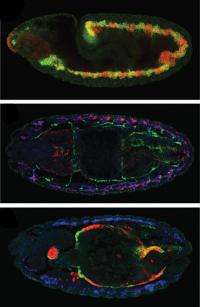
These fluorescence microscopy images of fruit fly embryos demonstrate that the scientists’ computer predictions were correct. As predicted, during the early stages of development (left) a CRM called 1070 is active (red) in the mesoderm (green) - the tissue which will give rise to all muscle types. At a later developmental stage (right, top), the same CRM is active (red/pink) in the embryo’s body wall muscle (blue), but not in its gut muscle (green). At the same time (right, bottom), another CRM, called 5570 (red), drives development in the gut muscle (green) but not in the body wall muscle (blue). Image credit: Furlong/EMBL
Embryonic development is like a well-organised building project, with the embryo's DNA serving as the blueprint from which all construction details are derived. Cells carry out different functions according to a developmental plan, by expressing, i.e. turning on, different combinations of genes. These patterns of gene expression are controlled by transcription factors: molecules which bind to stretches of DNA called cis-regulatory modules (CRMs), and, once bound, switch the relevant genes on or off.
Thanks to scientists at the European Molecular Biology Laboratory (EMBL) in Heidelberg, Germany, it is now possible to accurately predict when and where different CRMs will be active. The study, published today in Nature, is a first step towards forecasting the expression of all genes in a given organism and demonstrates that the genetic regulation that is crucial for correct embryonic development is more flexible than previously thought.
Through an interdisciplinary collaboration between biologist Robert P. Zinzen, computer scientist Charles Girardot and statistician Julien Gagneur, a novel, integrated approach was possible. They combined detailed experimental data about where and when transcription factors are binding to CRMs with a computational approach, and were able to forecast CRM activity.
“Going from global binding data to CRM activity was a big challenge in the field - one which we have now begun to overcome”, says Eileen Furlong, who headed the study.
Using a comprehensive, systematic approach, the scientists identified and recorded the binding profiles - i.e. the combinations of transcription factors binding at different times and places - of approximately 8000 CRMs involved in regulating muscle development in the fruit fly Drosophila. The activity of a number of such CRMs had been previously studied, and the EMBL team used this information to group them into classes according to the type of muscle and developmental stages they were active in.
The scientists then trained a computer to unravel the binding profiles for each of these groups, and search the 8000 newly identified CRMs for ones whose binding profiles fitted that picture. Such CRMs were predicted to have similar activity patterns, implying they are involved in regulating the development of the same muscle type.
When the scientists tested their predictions experimentally, the results were not only accurate but also enlightening. It turns out that the regulatory code, in which one binding profile leads to one pattern of CRM activity, is actually not that straightforward. CRMs with strikingly different binding profiles can have similar patterns of activity. This plasticity was unexpected, but makes sense in evolutionary terms, the researchers say. The fact that different combinations of transcription factors, or binding codes, can regulate the same developmental process means that even if some transcription factors or CRMs change or are lost during an organism’s evolution, it can still develop a gut muscle, for instance.
“What’s exciting for me is that this study shows that it is possible to predict when and where genes are expressed, which is a crucial first step towards understanding how regulatory networks drive development”, Furlong concludes.
More information: Zinzen, R.P., Girardot, C., Gagneur, J., Braun, M. & Furlong, E.E.M. Combinatorial binding predicts spatio-temporal cis-regulatory activity. Nature, 5 November 2009.
Provided by European Molecular Biology Laboratory (news : web)
-
Gene regulators bind promiscuously, but often do nothing
Feb 12, 2008 |
not rated yet |
0
-
Gene regulation in humans is closer than expected to simple organisms
Aug 29, 2007 |
not rated yet |
0
-
Model unravels rules that govern how genes are switched on and off
Dec 04, 2008 |
not rated yet |
0
-
Honey bee genome holds clues to social behavior
Oct 23, 2006 |
not rated yet |
0
-
Evolution is driven by gene regulation
Aug 09, 2007 |
not rated yet |
0
-
Engineers build first sub-10-nm carbon nanotube transistor
Feb 01, 2012 |
4.9 / 5 (32) |
30
-
Something old, something new: Evolution and the structural divergence of duplicate genes
Jan 31, 2012 |
4.6 / 5 (7) |
1
-
The hidden nanoworld of ice crystals: Revealing the dynamic behavior of quasi-liquid layers
Jan 30, 2012 |
5 / 5 (4) |
1
-
Stock market network reveals investor clustering
Jan 27, 2012 |
3.9 / 5 (23) |
8
-
Of microchemistry and molecules: Electronic microfluidic device synthesizes biocompatible probes
Jan 26, 2012 |
5 / 5 (2) |
0
-
Factors affecting beet root cell membrane
4 hours ago
-
Stem cell question.
Feb 10, 2012
-
Protease cleavage
Feb 10, 2012
-
Pertubance in a model
Feb 10, 2012
-
Cancer drugs and Alzheimer's, Oh my!
Feb 09, 2012
-
Squishing cells
Feb 09, 2012
- More from Physics Forums - Biology
More news stories
A mitosis mystery solved: How chromosomes align perfectly in a dividing cell
Although the process of mitotic cell division has been studied intensely for more than 50 years, Whitehead Institute researchers have only now solved the mystery of how cells correctly align their chromosomes during symmetric ...
59 minutes ago |
5 / 5 (2) |
0
|
The proteins ensuring genome protection
Researchers from the University of Geneva (UNIGE), Switzerland, have discovered the crucial role of two proteins in developing a cell 'anti-enzyme shield'. This protection system, which operates at the level of molecular ...
59 minutes ago |
5 / 5 (1) |
0
|
Researchers find extensive RNA editing in human transcriptome
In a new study published online in Nature Biotechnology, researchers from BGI, the world's largest genomics organization, reported the evidence of extensive RNA editing in a human cell line by analysis of RNA-seq data, demons ...
59 minutes ago |
5 / 5 (2) |
0
|
Entire genome of extinct human decoded from fossil
(PhysOrg.com) -- In 2010, Svante Pääbo and his colleagues presented a draft version of the genome from a small fragment of a human finger bone discovered in Denisova Cave in southern Siberia. The ...
Feb 07, 2012 |
4.7 / 5 (58) |
48
|
Why are there so few fish in the Earth's oceans?
(PhysOrg.com) -- A Stony Brook University researcher has found that, contrary to popular belief, there are not plenty of fish in the sea.
Feb 08, 2012 |
4.3 / 5 (17) |
27
|
Scientists discover molecular secrets of 2,000-year-old Chinese herbal remedy
For roughly two thousand years, Chinese herbalists have treated Malaria using a root extract, commonly known as Chang Shan, from a type of hydrangea that grows in Tibet and Nepal. More recent studies suggest that halofuginone, ...
New method to examine batteries -- MRI from the inside
There is an ever-increasing need for advanced batteries for portable electronics, such as phones, cameras, and music players, but also to power electric vehicles and to facilitate the distribution and storage of energy derived ...
Starve a virus, feed a cure? Findings show how some cells protect themselves against HIV
A protein that protects some of our immune cells from the most common and virulent form of HIV works by starving the virus of the molecular building blocks that it needs to replicate, according to research published online ...
Lab study raises questions over nano-particle impact
Tests involving chickens have raised questions about the impact on health from engineered nano-particles, the ultra-fine grains commonly used in drugs and processed foods, scientists said on Sunday.
Iran blocks email, restricts net access: reports
Iran has further restricted access to the Internet and blocked popular email services for the past few days, in a move a top lawmaker said could "cost the regime dearly," media reports said on Sunday.
Salvage workers begin pumping fuel from Italian shipwreck
Salvage workers Sunday began pumping fuel from the shipwrecked Italian cruise liner Costa Concordia, a day ahead of schedule, officials said.