Reducing Agriculture's Climate Change Footprint
November 4, 2009 By Dennis O'Brien Reducing Agriculture's Climate Change Footprint

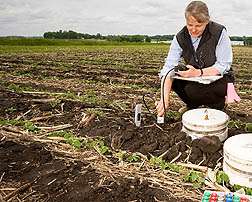
ARS soil scientist Jane Johnson is looking for practical ways to keep carbon in the soil and reduce greenhouse gas emissions from agricultural production.

(PhysOrg.com) -- Curbing greenhouse gas emissions from cultivated fields may require going beyond cutting back on nitrogen fertilizer and changing crop rotation cycles, according to research by Agricultural Research Service (ARS) scientists.

Jane Johnson, a soil scientist at the ARS North Central Soil Conservation Research Laboratory in Morris, Minn., is looking for practical ways to keep carbon in the soil and reduce greenhouse gas emissions.

In a comprehensive study, she raised corn, soybean, wheat and alfalfa in rotation so that each crop grew in the same year, on plots treated with and without fertilizer. She also used a less-aggressive tillage system known as strip tillage, in which only narrow bands of soil are tilled instead of an entire field. For comparison, she replicated the adopted by many Minnesota farmers-raising corn and soybeans in a two-year cycle on fertilized plots tilled with a chisel or moldboard plow.

She used a hydraulic soil probe to measure the organic carbon sequestered in the soil, and closed-vented chambers to measure emissions of , methane, and nitrous oxide. She found that when measured over the course of a year, greenhouse gas releases were largely the same under two-year and four-year rotation systems, and that applying nitrogen fertilizer had less overall impact than anticipated on nitrous oxide emissions. emissions peaked during spring thaws when the sun warmed the , regardless of which tillage or rotation system was used.

Chisel and moldboard plowing increased carbon dioxide emissions for a short time. But measured over the course of a year, carbon dioxide emissions were no different from plots with intensive tillage than plots without it. She also found no consistent patterns to methane releases.

Johnson's work is part of a five-year ARS project known as GRACEnet ( Reduction through Agricultural Carbon Enhancement network) in which researchers at more than 32 sites are examining strategies to help reduce agriculture's climate change footprint. The project supports the U.S. Department of Agriculture priority of responding to climate change.

More information: Read more about this research in the November/December 2009 issue of Agricultural Research magazine.

Provided by USDA Agricultural Research Service


print this article email this article download pdf blog this article bookmark this article     Stumble it Digg this share on Facebook retweet share on Reddit add to delicious
Rate this story - 2.3 /5 (4 votes)


November 4, 2009 all stories

Comments: 0

2.3 /5 (4 votes)
  • Stumble this up

  • Digg this

  • share this

  • hide
  • Related Stories

  • Nitrous oxide emissions respond differently to no-till depending on the soil type
    created Oct 22, 2008 | popularity not rated yet | comments 0
  • Biofuel from Corn Stover
    created Sep 22, 2009 | popularity not rated yet | comments 0
  • Soil carbon storage is not always influenced by tillage practices
    created Feb 25, 2009 | popularity not rated yet | comments 0
  • Compost can turn agricultural soils into a carbon sink, thus protecting against climate change
    created Feb 25, 2008 | popularity not rated yet | comments 0
  • Before selling carbon credits, read this
    created May 18, 2007 | popularity not rated yet | comments 0


  • hide
  • Relevant PhysicsForums posts

  • HadleyCru data hacked
    created Nov 20, 2009
  • Younger Dryas Caused by Ice Dam Collapse?
    created Nov 17, 2009
  • Modeling rainfall and flooding
    created Nov 15, 2009
  • Is there any scientific explanation for increasingly violent natural disasters?
    created Nov 14, 2009
  • More from Physics Forums - Earth

Other News

Cassini's Big Sky: The View from the Center of Our Solar System

Cassini's Big Sky: The View from the Center of Our Solar System

Space & Earth / Space Exploration

created 20 hours ago | popularity 4.7 / 5 (10) | comments 1

(PhysOrg.com) -- When NASA's Cassini spacecraft began orbiting Saturn five years ago, a dozen highly-tuned science instruments set to work surveying, sniffing, analyzing and scrutinizing the Saturnian system.


Some 6,000 families were affected by the drought in the Chaco region of Paraguay, particularly indigenous populations

El Nino intensifies Latin America drought

Space & Earth / Earth Sciences

created 23 hours ago | popularity 5 / 5 (2) | comments 0

From a devastating food crisis in Guatemala to water cuts in Venezuela, El Nino has compounded drought damage across Latin America this year.


More than 18 million cubic metres of sand are set to be poured onto the new coastal band of dunes until 2011

Dutch build more dunes against rising seas

Space & Earth / Environment

created 15 hours ago | popularity 4.2 / 5 (5) | comments 0

On the beach at Monster, bulldozers painstakingly turn sand dredged from the bottom of the North Sea bed into dunes in an ambitious effort to safeguard the Netherlands from flooding.


New Method to Measure Snow, Soil Moisture With GPS May Benefit Meteorologists, Farmers

Space & Earth / Earth Sciences

created 15 hours ago | popularity not rated yet | comments 1

(PhysOrg.com) -- A research team led by the University of Colorado at Boulder has found a clever way to use traditional GPS satellite signals to measure snow depth as well as soil and vegetation moisture, a technique expected ...


Astronauts await word of baby girl on Earth (AP)

Astronauts await word of baby girl on Earth

Space & Earth / Space Exploration

created 17 hours ago | popularity 5 / 5 (1) | comments 0

(AP) -- Atlantis' astronauts anxiously awaited word on the birth of one crewman's daughter Friday, as they moved more supplies into the International Space Station and geared up for another spacewalk.