Unsettled Youth: Spitzer Observes a Chaotic Planetary System
November 4, 2009 Unsettled Youth: Spitzer Observes a Chaotic Planetary System

Enlarge

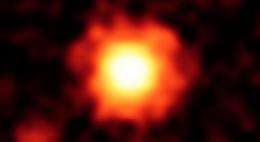
NASA's Spitzer Space Telescope captured this infrared image of a giant halo of very fine dust around the young star HR 8799. Image credit: NASA/JPL-Caltech/Univ. of Ariz.

(PhysOrg.com) -- Before our planets found their way to the stable orbits they circle in today, they wiggled and jostled about like unsettled children. Now, NASA's Spitzer Space Telescope has found a young star with evidence for the same kind of orbital hyperactivity. Young planets circling the star are thought to be disturbing smaller comet-like bodies, causing them to collide and kick up a huge halo of dust.

The star, called HR 8799, was in the news last November 2008, for being one of the first of two stars with imaged planets. Ground-based telescopes at the W.M. Keck Observatory and the Gemini Observatory, both in Hawaii, took images of three planets orbiting in the far reaches of the system, all three being roughly 10 times the mass of . Another imaged planet was also announced at the same time around the star Fomalhaut, as seen by NASA's . Both HR 8799 and Fomalhaut are younger and more massive than our sun.

Astronomers had previously used both Spitzer and Hubble to image a rotating disk of planetary debris around Fomalhaut, which is 25 light-years from Earth. HR 8799 is about five times farther away, so scientists weren't sure if Spitzer would be able to capture a picture of its disk. To their amazement and delight, Spitzer succeeded.

The Spitzer team, led by Kate Su of the University of Arizona, Tucson, says the giant cloud of fine dust around the disk is very unusual. They say this dust must be coming from collisions among small bodies similar to the comets or icy bodies that make up today's Kuiper Belt objects in our solar system. The gravity of the three large planets is throwing the smaller bodies off course, causing them to migrate around and collide with each other. Astronomers think the three planets might have yet to reach their final stable orbits, so more violence could be in store.
Unsettled Youth: Spitzer Observes a Chaotic Planetary System
Enlarge

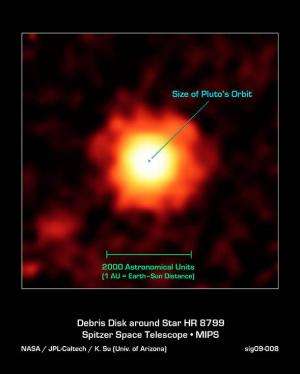
NASA's Spitzer Space Telescope captured this infrared image of a giant halo of very fine dust around the young star HR 8799, located 129 light-years away in the constellation Pegasus. The brightest parts of this dust cloud (yellow-white) likely come from the outer cold disk similar to our own Kuiper belt (beyond Neptune's orbit). The huge extended dust halo is seen as orange-red. Astronomers think that the three large planets known to orbit the star are disturbing small comet-like bodies, causing them to collide and kick up dust. The extended dust halo has a diameter of about 2,000 astronomical units, or 2,000 times the distance between Earth and the sun. For reference, the size of Pluto's orbit is tiny by comparison, with a diameter of about 80 astronomical units. This image was captured by Spitzer's multiband imaging photometer at an infrared wavelength of 70 microns in Jan. 2009.

"The system is very chaotic and collisions are spraying up a huge cloud of fine dust," said Su. "What's exciting is that we have a direct link between a planetary disk and imaged planets. We've been studying disks for a long time, but this star and Fomalhaut are the only two examples of systems where we can study the relationships between the locations of and the disks."

When our solar system was young, it went through similar planet migrations. Jupiter and Saturn moved around quite a bit, throwing comets around, sometimes into Earth. Some say the most extreme part of this phase, called the late heavy bombardment, explains how our planet got water. Wet, snowball-like comets are thought to have crashed into Earth, delivering life's favorite liquid.

The Spitzer results were published in the Nov. 1 issue of Astrophysical Journal. The observations were made before Spitzer began its "warm" mission and used up its liquid coolant.

Provided by JPL/NASA (news : web)


Rate this story - 4.1 /5 (7 votes)


November 4, 2009 all stories

Comments: 0

4.1 /5 (7 votes)

  • hide
  • Related Stories

  • Spitzer Team Says Debris Disk Could Be Forming Infant Terrestrial Planets
    created Dec 14, 2005 | popularity not rated yet | comments 0
  • Making Jupiters
    created Aug 21, 2009 | popularity not rated yet | comments 0
  • Spitzer Finds Evidence for Planets with Four Parents
    created Jul 24, 2007 | popularity not rated yet | comments 0
  • Planets Living on the Edge
    created Dec 17, 2008 | popularity not rated yet | comments 0
  • Spitzer Finds Possible Comet Dust Around Dead Star
    created Jan 11, 2006 | popularity not rated yet | comments 0


  • hide
  • Relevant PhysicsForums posts

  • Spreading Life in the Universe
    created 17 hours ago
  • Force of Gravity in terms of Density
    created Feb 08, 2010
  • what is the relation between gravity and light?
    created Feb 08, 2010
  • Does the Thermoelectric effect apply in sun?
    created Feb 07, 2010
  • More from Physics Forums - General Astronomy

Other News

India announces long-range nuclear-capable missile test

Space & Earth / Space Exploration

created 37 minutes ago | popularity 5 / 5 (1) | comments 0

India will test a nuclear-capable missile with a range of over 5,000 kilometres (3,000 miles) within a year, its top military scientist said Wednesday, risking a rise in regional tensions.


Space shuttle Endeavour pulls in at space station (AP)

Space shuttle Endeavour pulls in at space station

Space & Earth / Space Exploration

created 6 hours ago | popularity 5 / 5 (1) | comments 0

(AP) -- Shuttle Endeavour arrived to a warm welcome at the International Space Station early Wednesday, delivering a new room and observation deck that will come close to completing construction 200 miles ...


Climate 'Tipping Points' May Arrive Without Warning, Says Top Forecaster

Space & Earth / Environment

created 16 hours ago | popularity 3.5 / 5 (11) | comments 11 | with audio podcast

(PhysOrg.com) -- A new University of California, Davis, study by a top ecological forecaster says it is harder than experts thought to predict when sudden shifts in Earth's natural systems will occur -- a worrisome finding ...


38 percent of world's surface in danger of desertification

38 percent of world's surface in danger of desertification

Space & Earth / Environment

created 12 hours ago | popularity 2 / 5 (4) | comments 6

A team of Spanish researchers has measured the degradation of the planet's soil using the Life Cycle Assessment (LCA), a scientific methodology that analyses the environmental impact of human activities, and ...


A new 3-D map of the interstellar gas within 300 parsecs from the sun

A new 3D map of the interstellar gas within 300 parsecs from the Sun

Space & Earth / Astronomy

created 18 hours ago | popularity 5 / 5 (6) | comments 0 | with audio podcast

(PhysOrg.com) -- Astronomy & Astrophysics is publishing new 3D maps of the interstellar gas in the local area around our Sun. A French-American team of astronomers presents new absorption measurements toward ...