Archaeologists uncover prehistoric landscape beneath Oxford
November 4, 2009
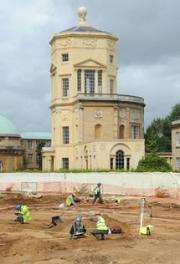
(PhysOrg.com) -- Archaeologists excavating the former Radcliffe Infirmary site in Oxford have uncovered evidence of a prehistoric monumental landscape stretching across the gravel terrace between the Thames and Cherwell rivers.
The work was carried out over the summer in preparation for Oxford University’s proposed Radcliffe Observatory Quarter - plans for which were revealed earlier this month.
In addition to these findings, the work has also uncovered evidence of a 6th century Saxon settlement, including a sunken featured craft hut known as a Grübenhauser and a pit containing unfired clay loom weights.
A team from Museum of London Archaeology (MOLA) has been excavating parts of the 3.7 hectare site. The excavation has revealed evidence of three large prehistoric ‘ring ditches’ along with some evidence of possible associated cremation burials and an enigmatic rectangular enclosure, finds from which are currently being subjected to radio carbon dating.
Mike Wigg, Head of Capital Projects at Oxford University, said: 'The University was delighted to provide the opportunity for an investigation of Oxford heritage to be carried out in advance of any development work.'
The River Thames was an important focus for monument building in the Neolithic and Bronze Age periods when monuments used for burial, ritual and social purposes were constructed along the gravel terraces of the river.
A spokesperson from MOLA explained: ‘Ring ditches are, as the name suggests, circular ditches, which are often the remains of ploughed out barrows, that may be associated with burials of high status individuals in the later Neolithic or Bronze Age, about 4000 years ago.’
The archaeologists had suspected the presence of prehistoric remains because a 12th century documentary source records ‘the croft of the three barrows’ in this area. Parch marks of a possible sequence of ring ditches in University Parks had indicated that similar remains might be present on the Radcliffe site.
The Saxon activity around the much earlier barrow cemetery is not uncommon and is recorded at other similar sites along the Thames. However, this is the first evidence for such a relationship in Oxford. The archaeologists are now working on the post-excavation phase of the project.
A Museum of London spokesperson said: 'We are grateful to the University for enabling this unusually large site to be archaeologically investigated. The knowledge obtained should make a significant contribution to public appreciation of this important part of Oxford’s past, when the landscape was very different from that seen today.'
-
Cut marks on bone suggest burial rituals of Early Britons
Aug 07, 2009 |
not rated yet |
0
-
Age of earliest human burial in Britain pinpointed
Oct 30, 2007 |
not rated yet |
0
-
Burials held at Stonehenge for hundreds of years: research
May 29, 2008 |
not rated yet |
0
-
Ancient tombs discovered by Kingston University-led team
Jun 09, 2009 |
not rated yet |
0
-
London's earliest timber structure found during Belmarsh prison dig
Aug 12, 2009 |
not rated yet |
0
-
Engineers build first sub-10-nm carbon nanotube transistor
Feb 01, 2012 |
4.9 / 5 (28) |
26
-
Something old, something new: Evolution and the structural divergence of duplicate genes
Jan 31, 2012 |
4.6 / 5 (7) |
1
-
The hidden nanoworld of ice crystals: Revealing the dynamic behavior of quasi-liquid layers
Jan 30, 2012 |
5 / 5 (3) |
1
-
Stock market network reveals investor clustering
Jan 27, 2012 |
4 / 5 (22) |
8
-
Of microchemistry and molecules: Electronic microfluidic device synthesizes biocompatible probes
Jan 26, 2012 |
5 / 5 (1) |
0
-
What are the limits of learning?
4 hours ago
-
Neuroscientists: What is a Principal Cell Layer?
15 hours ago
-
How does slime mould grow?
Feb 04, 2012
-
Why are mosquitoes and bedbugs successful?
Feb 04, 2012
-
Amazon fungi found to eat plastic
Feb 01, 2012
-
Tips Picking up TEM grids?
Feb 01, 2012
- More from Physics Forums - Biology
More news stories
Fossil cricket: Jurassic love song reconstructed
Some 165 million years ago, the world was host to a diversity of sounds. Primitive bushcrickets and croaking amphibians were among the first animals to produce loud sounds by stridulation (rubbing certain body parts together). ...
Other Sciences / Archaeology & Fossils
12 hours ago |
5 / 5 (2) |
1
|
Do we no longer care about the collective good?
The Transformation of Solidarity, a book co-edited by University of Queensland sociologist Dr Mara Yerkes, tackles the subject of globalisation of national economies and societies where we put a high value ...
Other Sciences / Social Sciences
21 hours ago |
3.9 / 5 (8) |
34
East views the world differently to West
Cultural differences between the West and East are well documented, but a study shows that concrete differences also exist in how British and Chinese people recognise people and the world around them. Easterners really do ...
Other Sciences / Social Sciences
17 hours ago |
5 / 5 (5) |
7
Namibia sponge fossils are world's first animals: study
Scientists digging in a Namibian national park have uncovered sponge-like fossils they say are the first animals, a discovery that would push the emergence of animal life back millions of years.
Other Sciences / Archaeology & Fossils
19 hours ago |
4.6 / 5 (10) |
0
Spectator rage: The dark side of professional sports
Preventing violent outbreaks of "spectator rage", similar to the deadly riots that broke out following a soccer game in Egypt, requires assessment and action by sports team owners and stadium managers, according to a report ...
Other Sciences / Social Sciences
10 hours ago |
not rated yet |
0
Nicira promises virtual networks will transform networking
(PhysOrg.com) -- For the past four years, founders of the start-up company Nicira have been developing cutting-edge software that they predict will transform the networking technology underlying the Internet. ...
Navy to begin tests on electromagnetic railgun prototype launcher
The Office of Naval Research (ONR)'s Electromagnetic (EM) Railgun program will take an important step forward in the coming weeks when the first industry railgun prototype launcher is tested at a facility ...
Study of diving beetles suggest sperm evolution may be driven by changes in female reproductive organs
Studying female reproductive tracts and sperm in diving beetles (Dytiscidae), researchers from the University of Arizona and Syracuse University have obtained a glimpse into a bizarre and amazing world of spe ...
New insight from whole-genome sequencing of Europe's 2011 E. coli outbreaks
Using whole-genome sequencing, a team led by researchers from Harvard School of Public Health (HSPH) and the Broad Institute has traced the path of the E. coli outbreak that sickened thousands and killed over 50 people in Ger ...
Redder ladybirds more deadly, say scientists
A ladybird's colour indicates how well-fed and how toxic it is, according to an international team of scientists. Research led by the Universities of Exeter and Liverpool directly shows that differences between ...
After Megaupload closure, BTJunkie shuts down
BTJunkie, a popular file-sharing indexing site, said Monday it was voluntarily shutting down, less than three weeks after the US closure of Megaupload in a crackdown on piracy of music, films and other materials.