UCI robot to aid brain research
November 4, 2009 UCI robot to aid brain research

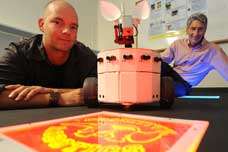
UCI cognitive scientist Jeffrey Krichmar (right) and former Hollywood animatronics engineer Brian Cox designed CARL to think and act like a human being. The small, squat robot is central to a new $1.6 million joint study with UC San Diego. Photo by Daniel A. Anderson / University Communications

(PhysOrg.com) -- A robot powered by a computerized model of a rodent brain will help researchers from UC Irvine and UC San Diego understand how people recognize and adapt to change.

The $1.6 million joint study is expected to provide neuron-level insight about the specific areas responsible for decision-making and attention, advancing robotic design as well as knowledge of human behavior.

“Little is known about the areas of the brain involved in making decisions when faced with uncertainty,” said Jeffrey Krichmar, a UCI cognitive scientist and one of the study’s lead researchers.

Krichmar specializes in neurorobotics, or programming robots with real-life organic and neural data to simulate thinking, moving beings. His work with CARL - a with a biologically plausible controlled by a realistic model of the human brain - has led to several advances in the field, the most recent of which are featured in the September issue of IEEE Robotics & Automation Magazine.

Collaborating with Krichmar are UCSD researchers Andrea Chiba, Douglas Nitz and Angela Yu, who will develop the data for the study by testing the abilities of rodents during a task in which the locations of stimuli that predict food rewards change abruptly, requiring the rats to adapt to the new environment in order to receive food rewards.

Brain recordings taken from the rodents during the task will be digitally analyzed and programmed into CARL’s software-controlled “brain,” enabling the to replicate the same behavior.

“We know the areas of the brain supposedly involved in predicting and adapting to uncertainty, but getting a complete picture of what happens in a real human brain isn’t technically feasible,” Krichmar said.

“As the robot navigates the same challenging situations the rats faced, though, we’ll be able to actually see the areas of the simulated human brain being utilized to make decisions and the physical changes taking place.”

In addition to potential health applications, study findings are expected to advance the field of robotics, facilitating development of a brain-based algorithm letting robots behave effectively in complex and variable environments.

Provided by UC Irvine


print this article email this article download pdf blog this article bookmark this article     Stumble it Digg this share on Facebook retweet share on Reddit add to delicious
Rate this story - 5 /5 (2 votes)


November 4, 2009 all stories

Comments: 0

5 /5 (2 votes)
  • Stumble this up

  • Digg this

  • share this

  • hide
  • Related Stories

  • New sequential decision making model could be key to artificial intelligence
    created Nov 08, 2006 | popularity not rated yet | comments 0
  • Predictive powers: a robot that reads your intention? (w/Video)
    created Jun 05, 2009 | popularity not rated yet | comments 0
  • Eyes on the prize
    created Dec 24, 2008 | popularity not rated yet | comments 0
  • New robot to adopt human thought processes
    created May 04, 2005 | popularity not rated yet | comments 0
  • Scientists unveil the 'face' of a new memory
    created Jul 24, 2007 | popularity not rated yet | comments 0


  • hide
  • Relevant PhysicsForums posts

  • Aspiring Engineering major looking for general answers
    created Nov 19, 2009
  • Calculating max load of square tube (steel)
    created Nov 19, 2009
  • Passive Chemical Heating
    created Nov 19, 2009
  • Shortening Boat Trailer
    created Nov 18, 2009
  • More from Physics Forums - General Engineering

Other News

Qualcomm's next e-book to use a mirasol display

Qualcomm's next e-book to use a mirasol display

Electronics / Consumer & Gadgets

created 18 hours ago | popularity 4.6 / 5 (8) | comments 2

(PhysOrg.com) -- Qualcomm subsidiary Mirasol is developing a new e-book reader with a color display that uses ambient light. The reader will be capable of displaying video smoothly, but the new features will ...


B&N Nook sells out, too late for holiday orders

Electronics / Consumer & Gadgets

created 9 hours ago | popularity not rated yet | comments 0

(AP) -- Consumers who haven't yet ordered Barnes & Noble's electronic book reader, the Nook, won't see one before Christmas.


More than powerful: German research computer QPACE is the most energy efficient in the world

Electronics / Hardware

created 12 hours ago | popularity not rated yet | comments 0

At the 2009 Supercomputing Conference in Portland, Oregon, the high-performance computer QPACE (QCD Parallel Computing on the Cell) was recognized today as the most energy-efficient supercomputer in the world.


'Rationalizer' bracelet tells traders when they're stressed

'Rationalizer' bracelet tells traders when they're stressed

Electronics / Consumer & Gadgets

created Nov 17, 2009 | popularity 4.3 / 5 (6) | comments 4

(PhysOrg.com) -- Philips Electronics and the Dutch bank ABN AMRO have joined forces to develop a "Rationalizer" bracelet system that detects stress levels and displays a warning to help day-traders avoid making ...


Oak Ridge 'Jaguar' supercomputer is World's fastest

Oak Ridge 'Jaguar' supercomputer is World's fastest

Electronics / Hardware

created Nov 16, 2009 | popularity 4.5 / 5 (13) | comments 2

An upgrade to a Cray XT5 high-performance computing system deployed by the Department of Energy has made the "Jaguar" supercomputer the world's fastest. Located at Oak Ridge National Laboratory, Jaguar is ...