Study shows cell phone users miss the obvious, like a unicycling clown
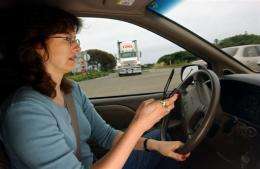
How blind to their surroundings can people be when they're talking on their cell phones?
Enough to miss seeing a clown -- wearing bright purple and yellow clothes, with a red nose and big red shoes -- riding a unicycle near them as they walked across Red Square on the Western Washington University campus, according to a study conducted by a WWU professor and his students.
"That cell phone really disrupts things," said Ira Hyman, psychology professor.
So much so that 75 percent of the people who were walking and talking on their phones didn't see the clown -- until he was pointed out to them.
"The interesting thing is they turned back around and they were surprised they missed the unicycling clown," Hyman said.
While the idea of cell phone users being so oblivious they fail to see a unicycling clown is humorous, Hyman said the implications are serious and show that people shouldn't be talking on their cell while driving.
His work will be published in December in the print edition of Applied Cognitive Psychology, although it already is on the journal's Web site.
Numerous studies already have shown that people fail to notice things while they're talking on cell phones, Hyman said.
But many of those studies were conducted in a laboratory setting, typically in driving simulators.
"They're very nice, but we wanted to make sure the effects would apply to real-world settings," Hyman said.
The unicycling clown effect actually grew out of two studies conducted by Hyman and his students.
In both studies, they observed people crossing Red Square, a big open plaza at WWU.
And they watched the same groups:
• People walking alone while talking on a cell phone.
• People walking and listening to a portable music player.
• Those walking alone and not using electronics of any kind.
• Those walking in pairs.
Researchers observed 317 people in the first study, and found that cell phone users were the most distracted walkers.
"They're slow and they're zigzagging," Hyman said.
Hyman and his students also noticed that people on cell phones were less likely to acknowledge others and wondered if they had a harder time walking because they were not as plugged into the world around them.
To test the idea, they came up with a unicycling clown.
So on a spring day in 2008, student Dustin Randall donned his clown suit and rode his unicycle -- he just happened to have both -- for an hour as part of the second study.
In this second study, the researchers interviewed 151 people and found that:
• 71 percent of the people walking in pairs said they saw the clown.
• 51 percent of people walking by themselves saw him, while 60 percent of those walking alone while listening to a music player saw the clown.
• But just 25 percent of people talking on their cell phones reported noticing a unicycling clown.
"It's a big difference. It's a whopping big effect," Hyman said of what most cell phone users failed to see while doing something as simple as walking.
___
(c) 2009, The Bellingham (Wash.) Herald.
Visit The Bellingham Herald on the World Wide Web at www.bellinghamherald.com/
Distributed by McClatchy-Tribune Information Services.


