Measuring distances in microseconds
November 5, 2009 Measuring distances in microseconds

Enlarge

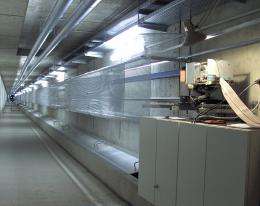
In a measurement channel the laser radar (on the right) determines the distance of an object up to 80 meters away every two microseconds or faster. (© Fraunhofer IPM)

(PhysOrg.com) -- Standard laser devices are fast enough for measuring the size of a room, but they need to be faster for outdoor mobile applications. Researchers have brought these scanners up to speed -- they can measure ten times faster than usual scanners.

Will the massive truck be able to pass under the bridge or should it take another route? Do the houses lining the street leave enough room for the oversized vehicle to pass through? Such questions are answered by sending out a car fitted with distance measuring equipment to check the route the heavy load will take. A mounted on the car scans bridges, buildings, signs and trees along the way.

Working on the time-of-flight principle, the scanner sends out short laser pulses which are reflected by the obstacles they encounter. The time the light needs to travel to the obstacle and back to the integrated sensor provides the distance measurement. The results are coupled with the car’s GPS position.

Unfortunately, the car has to travel very slowly to pick up enough points on the objects for accurate measurements. Using scanners of this type in airplanes or helicopters to determine terrain elevations and objects on the ground is also problematic, as high plane speed means the resolution is low and the resulting image incomplete.

Researchers at the Fraunhofer Institute for Physical Measurement Techniques IPM in Freiburg have now substantially increased the speed of distance measurement, which is the key to more efficient laser scanning. “We can either measure ten times faster or retain the scanner speed but analyze ten times as many points of an object - for instance from an airplane,” explains Dr. Ilia Bourovoi, project manager at the IPM. The laser measures the distance several million times per second. Dr. Bourovoi reveals how the researchers achieve this speed: “We have developed new electronic circuits and special software to process the data. In addition we have optimized the laser pulse rate.”

While conventional scanners need several pulses for one measurement, the new pulse laser radar can determine the on the basis of each individual transmitted pulse. Apart from higher measurement speed, this offers the further advantage that the measured values do not depend on the speed at which the scanner is moving - for instance when mounted on a car or airplane. Scanners requiring several per point produce blurred images as the scanner has already moved when the next pulses are transmitted.

The new pulse laser radar device has already been built on a laboratory scale. In future, cars equipped with it will be able to travel at regular traffic speed as they record 3D data along roads. From aircraft too the pulse laser radar will deliver a high measurement point density.

Provided by Fraunhofer-Gesellschaft (news : web)


print this article email this article download pdf blog this article bookmark this article     Stumble it Digg this share on Facebook retweet share on Reddit add to delicious
Rate this story - 5 /5 (1 vote)


November 5, 2009 all stories

Comments: 0

5 /5 (1 vote)
  • Stumble this up

  • Digg this

  • share this

  • hide
  • Related Stories

  • Can a laser scanner drive a car?
    created Mar 28, 2008 | popularity not rated yet | comments 0
  • Catching the wave -- Researchers measure very short laser pulses
    created Dec 04, 2006 | popularity not rated yet | comments 0
  • Mirror Measures Vortex Drag
    created Jul 28, 2004 | popularity not rated yet | comments 0
  • Japanese Device Uses Laser Plasma to Display 3D Images in the Air
    created Feb 27, 2006 | popularity not rated yet | comments 0
  • Engineers use 'shaped' laser pulses in 'ultra-wideband' research
    created Apr 05, 2005 | popularity not rated yet | comments 0


  • hide
  • Relevant PhysicsForums posts

  • help in discrete model reference adaptive control
    created 19 hours ago
  • Our responsibility
    created Dec 13, 2009
  • Charge electric car from dryer plug?
    created Dec 13, 2009
  • Career Switch to Engineering
    created Dec 12, 2009
  • More from Physics Forums - General Engineering

Other News

Researcher studying ways to handle huge quantities of biomass

Researcher studying ways to handle huge quantities of biomass

Technology / Energy

created 8 minutes ago | popularity not rated yet | comments 0

(PhysOrg.com) -- As scientists scramble to develop ways to generate enormous amounts of energy from cleaner-burning, renewable fuels to replace coal and oil, promising agricultural crops such as switchgrass ...


Pandemic toolkit offers flu with a view

Pandemic toolkit offers flu with a view

Technology / Computer Sciences

created 1hour ago | popularity not rated yet | comments 0

(PhysOrg.com) -- As communities brace for rising wintertime influenza cases, scientists are developing a mathematical and visual analytic toolkit to help health officials quickly analyze pandemics and craft ...


Lithium

Lithium to be extracted from geothermal waste

Technology / Energy

created 9 hours ago | popularity 5 / 5 (11) | comments 3

(PhysOrg.com) -- A technique developed by a Californian company, Simbol Mining, will enable the valuable mineral lithium, widely used in high-density batteries, to be reclaimed from the hot waste water produced ...


The world's biggest car-maker Toyota Motor has said it plans to begin commercial sales of its first plug-in hybrid car

Toyota aims to roll out plug-in Prius in two years

Technology / Energy

created 11 hours ago | popularity 4.4 / 5 (7) | comments 5

Toyota Motor said Monday that it plans to begin commercial sales of its first plug-in hybrid vehicle in about two years, aiming to meet growing demand for fuel-efficient cars.


TeliaSonera launches first commercial 4G/LTE network

Technology / Telecom

created 10 hours ago | popularity 5 / 5 (2) | comments 2

Nordic telecom operator TeliaSonera announced Monday the launch in Stockholm and Oslo of the world's first commercial 4G/LTE mobile network, up to 10 times faster than current networks.