Spread of Western Juniper Seeds Studied
November 5, 2009 By Marcia Wood Spread of Western Juniper Seeds Studied

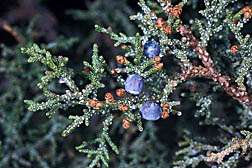
ARS ecologist William S. Longland is trying to determine what gives western juniper a competitive advantage in the environment. Photo courtesy of Joseph M. DiTomaso, University of California - Davis, Bugwood.org

(PhysOrg.com) -- Aromatic, evergreen foliage and plump, dusty-blue to nearly purple berries make western juniper appealing, whether it's a small shrub or a lofty tree. The trouble is, during the past 100 years or so, some once-open western juniper woodlands in this species' native range of California, Oregon, Nevada, Idaho and Washington have become dense stands.

The result is that fire-danger ratings can skyrocket, according to Agricultural Research Service (ARS) ecologist William S. Longland at the agency's Exotic and Invasive Weeds Research Unit in Reno, Nev. What's more, the stands crowd out tasty, nutritious understory plants that cattle and wildlife could otherwise graze or browse.

This year, Longland developed new studies to determine whether a natural process known as diplochory gives western juniper a competitive advantage. In published research, Longland explains that diplochory is a two-step process in which seeds are handily dispersed by two different sets of "agents."

In the first step of what could turn out to be diplochory in western juniper, birds such as robins and Townsend's solitaires pluck western juniper's chunky berries from its branches, then fly away to places where they can safely eat their prize—the berry's fleshy fruit that surrounds its small, hard seed. This feeding helps survival of the seed by moving it away from the competition of the parent trees.

Seeds that birds swallow may pass through their digestive systems, land on the ground, and, in what may be the second phase of diplochory, be carried away and buried by small mammals like deer mice or kangaroo rats. Burying hides the seeds from other seed-eaters and helps the seeds germinate.

In a preliminary study, Longland's network of motion- or heat-sensor-activated cameras captured real-time snapshots of birds and mammals holding juniper berries or seeds in their beaks or paws. Though these caught-in-the-act candids strongly suggest diplochory at work, more evidence is needed. That might come from follow-up research by Longland and co-investigators Steve Vander Wall of the University of Nevada-Reno and Diana Hiibel of the Reno-based Animal Ark Wildlife Sanctuary.

Provided by USDA Agricultural Research Service


print this article email this article download pdf blog this article bookmark this article     Stumble it Digg this share on Facebook retweet share on Reddit add to delicious
Rate this story - 2.5 /5 (2 votes)


November 5, 2009 all stories

Comments: 0

2.5 /5 (2 votes)
  • Stumble this up

  • Digg this

  • share this

  • hide
  • Related Stories

  • Natural enemies wanted for poisonous vines
    created Feb 16, 2006 | popularity not rated yet | comments 0
  • Mode of seed dispersal greatly shapes placement of rainforest trees
    created Nov 28, 2006 | popularity not rated yet | comments 0
  • Brown tree snake could mean Guam will lose more than its birds
    created Aug 08, 2008 | popularity not rated yet | comments 0
  • Rooted plants move mysteriously down greenways, scientists say
    created Dec 03, 2008 | popularity not rated yet | comments 0
  • Frankincense trees overexploited for Christmas scent
    created Dec 12, 2006 | popularity not rated yet | comments 0


  • hide
  • Relevant PhysicsForums posts

  • Human Leukocyte Antigen (HLA) typing
    created 2 hours ago
  • Breeding program
    created Nov 20, 2009
  • How does a concentration gradient provide energy?
    created Nov 20, 2009
  • Eyesight and Neural Damage from Electronics
    created Nov 19, 2009
  • More from Physics Forums - Biology

Other News

The Monarchs' annual migration ritual has yet to be scientifically explained

Tree-eating bugs threaten Monarch butterfly in Mexico

Biology / Ecology

created 4 hours ago | popularity 4 / 5 (1) | comments 0

The mysterious Monarch butterfly, which migrates en masse annually between Canada and Mexico, is now facing a new peril: another insect thriving in Western Mexican forests.


Extinct goat Myotragus balearicus

Extinct goat was cold-blooded

Biology / Plants & Animals

created Nov 18, 2009 | popularity 4.9 / 5 (31) | comments 10

(PhysOrg.com) -- An extinct goat that lived on a barren Mediterranean island survived for millions of years by reducing in size and by becoming cold-blooded, which has never before been discovered in mammals.


Bigger not necessarily better, when it comes to brains

Bigger not necessarily better, when it comes to brains

Biology / Plants & Animals

created Nov 17, 2009 | popularity 4.5 / 5 (17) | comments 11

(PhysOrg.com) -- Tiny insects could be as intelligent as much bigger animals, despite only having a brain the size of a pinhead, say scientists at Queen Mary, University of London.


Right-handed chimpanzees provide clues to the origin of human language

Biology / Plants & Animals

created Nov 16, 2009 | popularity 3 / 5 (1) | comments 7

Most of the linguistic functions in humans are controlled by the left cerebral hemisphere. A study of captive chimpanzees at the Yerkes National Primate Research Center (Atlanta, Georgia), reported in the January 2010 issue ...


The creature was found at a depth of 161 metres

Japanese researchers film rare baby fish 'fossil'

Biology / Plants & Animals

created Nov 17, 2009 | popularity 4.7 / 5 (7) | comments 4

Japanese marine researchers said Tuesday they had found and successfully filmed a young coelacanth -- a rare type of fish known as "a living fossil" -- in deep water off Indonesia.