November 5, 2009 weblog
Solar power generation around the clock
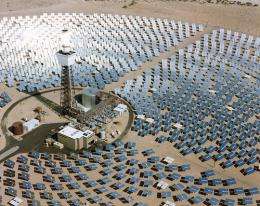
(PhysOrg.com) -- A Californian company, SolarReserve, is developing a solar power system that can store seven hours' worth of solar energy by focusing mirrors onto millions of gallons of molten salt, allowing the plant to provide electricity 24 hours a day.
The company has applied to regulators in California for permission to build the 150-megawatt Rice Solar Energy Project solar farm near the abandoned town of Rice in San Bernadino County, California.
The solar energy is stored using a massive circular array of up to 17,500 mirrors (heliostats), each measuring 24 by 28 feet and attached to a 12-foot pedestal. The heliostat field encircles a concrete Solar Power Tower 538 feet high, with a 100-foot high receiver on top, which holds 4.4 million gallons of molten salt. When the heliostats focus the sunlight onto the receiver the salt is heated to over 1,000 degrees Fahrenheit.
When it is needed, such as at night or at peak times, the heat is released by passing the molten salt through a steam generator that drives a turbine to produce electricity. The cooled salt is then recirculated to the receiver for re-heating. The project brings the dream of a solar system that generates electricity in the dark to a reality, and avoids the need to use fossil fuel plants for backup electricity generation.
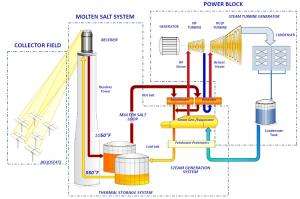
The salt used is a mixture of sodium and potassium nitrate (the same as that used in fertilizers), which is cheap, reliable, and environmentally friendly. It will be mixed on site with no additives. Apart from a few unique components such as the high heat flux hardware in the tower, the system uses existing technologies such as turbines and steam generators. This means SolarReserve can produce electricity at prices equivalent to or below fossil fuel burning plants.
The system was proven over a four-year period in the 1990s at the 10-megawatt Solar Two demonstration project near Barstow in California. The solar salt technology was originally developed by Rocketdyne, a subsidiary of United Technologies, and many of SolarReserve's scientists are former employees of Rocketdyne. United Technologies has licensed the system to SolarReserve and guarantees its performance.
Chief Executive at SolarReserve, Kevin Smith, said other solar systems also use salt as storage, but they use synthetic oil in the steam generation. Using salt for both means the system is more efficient, since it can produce steam at higher temperatures and can harvest three times as much energy for the same amount of salt.
The Rice Solar Energy Project solar farm will be constructed on now privately-owned land that used to belong to a World War II Army air base to the east of Palm Springs. The system will be air cooled, thus avoiding criticisms about water use, but its height, at 653 feet (with a maintenance crane on top), could spark other criticisms, as did a previously proposed SolarReserve project in Nevada.
SolarReserve expects the solar farm to go online late in 2013, and is in negotiations with utility companies in California to buy the generated electricity.
Video: official trailer by SolarReserve.
More information:
www.solar-reserve.com/
www.energy.ca.gov/sitingcases/ricesolar/index.html
© 2009 PhysOrg.com


