Space hotel taking bookings for 2012 opening
November 5, 2009 by Lin Edwards
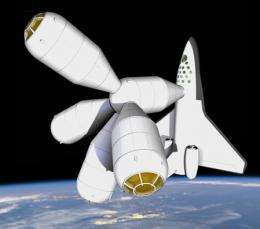
Galactic Suite Space Resort. Image credit: Galactic Suite.
(PhysOrg.com) -- The first orbiting space hotel is on track to open for its first customers in 2012, but hurry, as bookings are filling fast.
The cost of three nights on the Galactic Suite Space Resort (plus a two-month training course on a Caribbean island beforehand) will be $4.4 million US. At least 43 people have already reserved their place, with over 200 expressing an interest.
Guests would circumnavigate the globe every 80 minutes and see the sun rise 15 times a day. They would get around their "pod" rooms by wearing Velcro suits that stick them to the walls to enable them to crawl.
CEO of the Barcelona-based company Galactic Suite Ltd, Xavier Claramunt, said the hotel would make his company a leader in the fledgling industry, which he believes has a great future, with space tourism becoming commonplace. Claramunt, formerly an aerospace engineer, said that within perhaps only 15 years, it could be quite normal to spend a weekend in space.
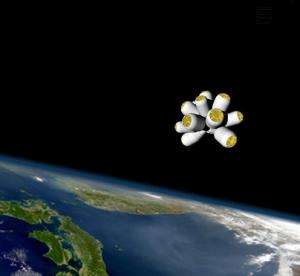
Galactic Suite Space Resort. Image credit: Galactic Suite.
The Galactic Suite Space Resort plans to start with one pod holding four passengers and two astronaut pilots. The pod would orbit 280 miles (450 km) above the earth and travel at 18,640 mph (30,000 kph). Passengers would take a day and a half to reach the pod by Russian-built rocket, after blasting off from a spaceport on a Caribbean island. The rocket would dock with the pod for their entire stay to give the guests a sense of security. At the end of their stay the passengers would return to the rocket for the trip back to earth.Claramunt said the project had received an anonymous grant of $3 billion given to the company by a space enthusiast billionaire. Critics have questioned the timeframe, but the company is confident it is on track for the 2012 opening.
Another space tourism project under construction is Spaceport America, being built in Mexico. This will be the first facility for space flights for commercial and private passengers. Virgin Galactic, Richard Branson's space tour company will offer rides to suborbital space from the spaceport for $200,000. Bookings are pouring in, with 300 people already having signed up or paid in advance.
This video is not supported by your browser at this time.
© 2009 PhysOrg.com
-
Sir Richard Branson All Fired Up With Latest Rocket Motor Test
May 31, 2009 |
not rated yet |
0
-
Video: Swine flu health tips
Apr 30, 2009 |
not rated yet |
0
-
Security Alert: Beware of SMS Messages That Can Take Control of Your Phone
Apr 20, 2009 |
not rated yet |
0
-
RocketShip Tours Teams Up With XCOR Aerospace To Offer A $95,000 Right Stuff Experience
Dec 04, 2008 |
not rated yet |
0
-
Endeavour's Orbiting Tool Bag Can Be Seen Using 10 x 50 Binoculars
Nov 27, 2008 |
not rated yet |
0
-
Engineers build first sub-10-nm carbon nanotube transistor
Feb 01, 2012 |
4.9 / 5 (29) |
30
-
Something old, something new: Evolution and the structural divergence of duplicate genes
Jan 31, 2012 |
4.6 / 5 (7) |
1
-
The hidden nanoworld of ice crystals: Revealing the dynamic behavior of quasi-liquid layers
Jan 30, 2012 |
5 / 5 (3) |
1
-
Stock market network reveals investor clustering
Jan 27, 2012 |
3.9 / 5 (23) |
8
-
Of microchemistry and molecules: Electronic microfluidic device synthesizes biocompatible probes
Jan 26, 2012 |
5 / 5 (1) |
0
-
Real pictures of black hole eating a star?
3 hours ago
-
Hypothetical way to travel faster than light, but not technically exceed lightspeed
Feb 06, 2012
-
How do scientists monitor the Sun's activity?
Feb 05, 2012
-
Search patterns in observational studies
Feb 05, 2012
-
Derivation of Pogson's law
Feb 03, 2012
-
Landing on comet by Rosetta probe in 2014 (YouTube)
Feb 02, 2012
- More from Physics Forums - General Astronomy
More news stories
Astronomy team discovers nearby dwarf galaxy
(PhysOrg.com) -- A team led by UCLA research astronomer Michael Rich has used a unique telescope to discover a previously unknown companion to the nearby galaxy NGC 4449, which is some 12.5 million light years ...
5 hours ago |
5 / 5 (1) |
3
|
Amasia: As next supercontinent forms, Arctic Ocean, Caribbean will vanish first
(PhysOrg.com) -- Geologists at Yale University have proposed a new theory to describe the formation of supercontinents, the epic process by which Earths major continental blocks combine into a single ...
Space & Earth / Earth Sciences
5 hours ago |
4.1 / 5 (7) |
0
|
Chandra finds Milky Way's black hole grazing on asteroids
(PhysOrg.com) -- The giant black hole at the center of the Milky Way may be vaporizing and devouring asteroids, which could explain the frequent flares observed, according to astronomers using data from NASA's ...
6 hours ago |
5 / 5 (1) |
4
|
In scientific coup, Russians reach Antarctic lake
After more than two decades of drilling in Antarctica, Russian scientists have reached a gigantic freshwater lake hidden under miles of ice for some 20 million years - a pristine body of water that may hold ...
Space & Earth / Earth Sciences
6 hours ago |
4.8 / 5 (5) |
4
New images capture 'stealth merger' of dwarf galaxies
New images of a nearby dwarf galaxy have revealed a dense stream of stars in its outer regions, the remains of an even smaller companion galaxy in the process of merging with its host. The host galaxy, known ...
6 hours ago |
not rated yet |
0
|
Why are there so few fish in the Earth's oceans?
(PhysOrg.com) -- A Stony Brook University researcher has found that, contrary to popular belief, there are not plenty of fish in the sea.
Scientists strengthen memory by stimulating key site in brain
Ever gone to the movies and forgotten where you parked the car? New UCLA research may one day help you improve your memory.
Transparent iron? For the first time, an experiment shows that atomic nuclei can become transparent
At the high-brilliance synchrotron light source PETRA III, a team of DESY scientists headed by Dr. Ralf Röhlsberger has succeeded in making atomic nuclei transparent with the help of X-ray light. At the ...
Physicists build highly efficient 'no-waste' laser
A team of University of California, San Diego researchers has built the smallest room-temperature nanolaser to date, as well as an even more startling device: a highly efficient, "thresholdless" laser that ...
Most stretchable spider silk reported
The egg sac silk of the cocoon stalk of the cave spider Meta menardi is the most stretchable egg sac silk yet tested, according to a study published Feb. 8 in the open access journal PLoS ONE.
Study shows how DNA finds its match
It's been more than 50 years since James Watson and Francis Crick showed that DNA is a double helix of two strands that complement each other. But how does a short piece of DNA find its match, out of the millions ...

Nov 05, 2009
Rank: 4 / 5 (3)
Nov 05, 2009
Rank: 4.5 / 5 (4)
Nov 05, 2009
Rank: 5 / 5 (1)
I see the above comment, but that doesn't mean I didn't laugh ;D
Nov 05, 2009
Rank: 1 / 5 (2)
Nov 05, 2009
Rank: 5 / 5 (6)
Nov 05, 2009
Rank: 1 / 5 (2)
Well, Mexico is in the Americas, the name could be used anywhere from Cape Horn to Kaffeklubben Island. And incidentally, the easy orbits from those particular launch points would be great for space tourists.
Nov 05, 2009
Rank: not rated yet
I'd really love to do this, even in the first round, before they 'iron things out'. I just need to get started on earning that 4.4 million.
Nov 05, 2009
Rank: 5 / 5 (2)
Nov 05, 2009
Rank: not rated yet
I already got started...finishing is the hard part. ;-)
Nov 05, 2009
Rank: 4.2 / 5 (5)
Nov 07, 2009
Rank: 5 / 5 (1)