New Digital 'Electronics' Concept May Continue Moore's Law
November 5, 2009 By Lisa Zyga
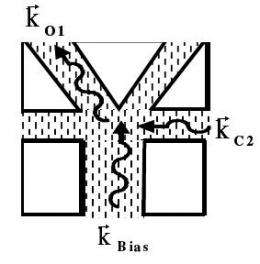
In the NFL logic device, the first SPW (kBias) is launched, followed by the launch of a second SPW (kC2), which steers the first SPW into the left drain terminal for detection, where it’s identified as a logic “1”. Image copyright: De Los Santos. ©2009 IEEE.
(PhysOrg.com) -- Computers of the future could be operating not on electrons, but on tiny waves traveling through an electron "fluid," if a new proposal is successful. The new circuit design, recently introduced by Dr. Héctor J. De Los Santos, CTO of NanoMEMS Research, LLC, in Irvine, California, may be a promising candidate to replace CMOS-based circuits, and ultimately continue the circuit density growth described by Moore's Law.
As Gordon Moore predicted more than 40 years ago, the number of transistors able to fit on a computer chip has doubled approximately every 18 months. But if the trend is to continue for the years to come, it will have to be with technology other than the conventional CMOS design. As the size of transistors gets down to the nanoscale, CMOS devices begin suffering from several issues, such as increased resistance, decreased channel mobility, and increased manufacturing costs.
To overcome the challenges involved with scaling, researchers from around the world have begun to look for alternatives to CMOS technology. De Los Santos’ concept, called nano-electron-fluidic logic (NFL), is based on the flow of plasmons in a fluid-like electron gas (basically an electron fluid). He predicts that logic gates with the NFL design offer the potential for femtosecond switching speeds and sub-femtojoule power dissipations at room temperature - numbers that would be extremely capable of continuing Moore’s Law beyond CMOS. De Los Santos’ paper will be published in a future issue of IEEE Transactions on Nanotechnology.
As De Los Santos explains, the NFL concept takes advantage of the properties of surface plasma waves (SPWs). These waves propagate on the inversion layer at the insulating gate-semiconductor interface (which, in this case, embodies an electric fluid) and behaves as an SPW waveguide. When two SPWs collide, they repel each other. In the device set-up, one SPW is launched from a particular direction to collide with another SPW, causing it to scatter in one of two directions, where it is detected and interpreted as a “1” or, if not detected, a “0.”
To begin the process, an SPW is launched into a channel filled with electron fluid that forks into two channels, each with a detector at the end. Under no external forces, the SPW will be split equally so that equal portions will be detected at the two end terminals. But when a second SPW is launched into the main channel from the left or right, it will cause the original SPW to deflect into the opposite fork. For example, a second SPW coming from the right would steer the original SPW down the left fork. When the SPW is detected at the left end terminal, and not the right, the NFL device forms the basis of a logic flip-flop, having the ability to store one bit of memory.
The SPW design is conceptually different from the CMOS design in the sense that it is based on waves rather than particles. De Los Santos compares the SPW concept to a wave in a pond that occurs when a pebble is dropped in the water. In this analogy, the water is the electron fluid, the disturbance is a departure from charge neutrality at a given point in the electron fluid (rather than the departure from the position of equilibrium of a particle moving up and down), and the disturbance carrying the departure from charge neutrality is the SPW.
“Notice that, while the disturbance moves away from its point of origin, a particle at the water surface stays at the same place; it only moves up and down,” De Los Santos told PhysOrg.com. “Thus, the propagation of the disturbance does not involve the transport of mass. In fact, the disturbance [SPW] moves at a speed faster than that at which the massive water particles [electrons] could be transported. This establishes, qualitatively, why the speed of an SPW is greater than that of an electron.”
In comparison, a conventional CMOS logic is based on transporting electrons through a channel by establishing an electron current. As De Los Santos explains, the electron current is made up of an assembly of individual electrons that individually suffer collisions with impurities and the vibrating background semiconductor lattice. These collisions limit the maximum speed, and the minimum power dissipation, attainable to effect a logic function.
“So, NFL is fundamentally based on wave (SPW) launching, propagation and manipulation, and CMOS is based on channel conductivity modulation and particle transport,” he said.
In the case of the NFL device, the key to optimizing its density is to find an optimal device length for the desired operating frequency.
“Once launched, SPWs have a lifetime that depends on the distance they propagate,” De Los Santos said. “If the point at which they are detected is too far away from the point of origin, the SPWs will die before getting there; no logic operation can be performed. The distance being too large, the device size will be too large, and the device density will be small. Now, if the detection point is too close to the origin, the SPWs will bounce/be reflected at the detection point, and propagate back to the point of origin, where they will be reflected again and propagate back to the detection point and so forth; this is a resonance condition. In this case, the device is small, the density is large, but what we have is an oscillator. However, if the point of detection is located at such a distance that the SPW is detected before it dies, so that the round trip back to the launching point is such that it dies before getting there, then we have the right device size, and the right device density for NFL.”
With the resonance limitation in mind, De Los Santos predicts that the ultimate device density would be that of the smallest possible plasmon, which is an electric dipole. Since the smallest electric dipole is an atom, the density would be equal to the areal atomic density of the type of atom used. Compared to current CMOS feature sizes, the NFL logic could potentially perform the same function in just one-fourth the area.
In addition to its potential for high density, the NFL logic has other advantages, such as a quick operation speed and a small energy requirement. SPWs have a propagation velocity of about 1 billion cm/sec, which is two orders of magnitude greater than electrons. On the nanoscale, this velocity enables switching times on the order of femtoseconds, or switching frequencies of approximately 6 THz at room temperature. As for energy, the only power required is that needed to excite an SPW, which can be done by any nonzero DC current. Maintaining the electron fluid requires negligible power consumption, so that the device’s overall power consumption is determined by the minimum detectable current.
In addition, the NFL concept is compatible with current lithographic capabilities, allowing it to take advantage of established semiconductor manufacturing infrastructure. NFL logic gates could also be interfaced with conventional electronics. In the future, De Los Santos plans to continue investigating the possibilities of NFL logic.
“Research and development is underway to address NFL-based design, in particular, asynchronous logic design styles, and interfacing with electrons, photonic and plasmonic systems,” De Los Santos said. “NFL-based digital logic circuit functions are expected to displace CMOS as a technology that will permeate from the computers, laptops, and cell phones to the communications satellites, instrumentation equipment and automobiles of the future.”
More information: Héctor J. De Los Santos. “Theory of Nano-Electron-Fluidic Logic (NFL): A New Digital ‘Electronics’ Concept.” IEEE Transactions on Nanotechnology. To be published.
Copyright 2009 PhysOrg.com.
All rights reserved. This material may not be published, broadcast, rewritten or redistributed in whole or part without the express written permission of PhysOrg.com.
-
Nanodevices could use quantized current to operate future electronics
Nov 26, 2007 |
not rated yet |
0
-
UC San Diego physicists devise viable design for spin-based electronics
Jun 01, 2007 |
not rated yet |
0
-
New design for transistors powered by single electrons
Feb 02, 2006 |
not rated yet |
0
-
Nantero, Inc. Announces Carbon Nanotube Technology Development Project with LSI Logic
Jun 08, 2004 |
not rated yet |
0
-
Detecting the spin of a single electron in a standard silicon transistor
Aug 10, 2004 |
not rated yet |
0
-
Fast photon control brings quantum photonic technologies closer
7 hours ago |
5 / 5 (4) |
0
-
Engineers build first sub-10-nm carbon nanotube transistor
Feb 01, 2012 |
4.9 / 5 (33) |
30
-
Something old, something new: Evolution and the structural divergence of duplicate genes
Jan 31, 2012 |
4.6 / 5 (7) |
1
-
The hidden nanoworld of ice crystals: Revealing the dynamic behavior of quasi-liquid layers
Jan 30, 2012 |
5 / 5 (5) |
1
-
Stock market network reveals investor clustering
Jan 27, 2012 |
3.9 / 5 (23) |
8
-
Compressible vs. Incompressible Flow Equations
2 hours ago
-
How fast, on average, does the gas come out of a rocket's nozzle?
7 hours ago
-
Projectile Arrow Angle Transformation Equation
8 hours ago
-
What are the chemical reaction happen indise lamp in tungsten
12 hours ago
-
What is the number of significant digits in a integer with trailing 0's ?
13 hours ago
-
Forces of Magnets Attraction>Repulsion?
13 hours ago
- More from Physics Forums - General Physics
More news stories
ORNL microscopy explores nanowires' weakest link
Individual atoms can make or break electronic properties in one of the world's smallest known conductorsquantum nanowires. Microscopic analysis at the Department of Energy's Oak Ridge National Laboratory ...
3 hours ago |
5 / 5 (2) |
0
|
Nanostructured electrodes for rechargeable sodium-Ion batteries
Highly efficient 3V cathodes for rechargeable sodium-ion batteries have been developed by users from Argonne National Laboratory's Materials Science, Chemical Sciences & Engineering, and X-ray Sciences Divisions, ...
Nanotechnology / Nanomaterials
8 hours ago |
5 / 5 (2) |
0
|
'Smart' microcapsules in a single step
(PhysOrg.com) -- A new, single-step method of fabricating microcapsules, which have potential commercial applications in industries including medicine, agriculture and diagnostics, has been developed by researchers ...
Nanotechnology / Nanomaterials
8 hours ago |
5 / 5 (2) |
1
|
NDSU nano research could impact flexible electronic devices
A discovery by a research team at NDSU and the National Institute of Standards and Technology shows the flexibility and durability of carbon nanotube films and coatings are intimately linked to their electronic properties. ...
Nanotechnology / Nanomaterials
9 hours ago |
5 / 5 (1) |
0
New kind of solar cell could capture significantly more energy than current cells
New solar cells could increase the maximum efficiency of solar panels by over 25%, according to scientists from the University of Cambridge.
Feb 08, 2012 |
4.3 / 5 (14) |
14
|
Neuron memory key to taming chronic pain
For some, the pain is so great that they can't even bear to have clothes touch their skin. For others, it means that every step is a deliberate and agonizing choice. Whether the pain is caused by arthritic joints, an injury ...
Brain-imaging technique predicts who will suffer cognitive decline over time
Cognitive loss and brain degeneration currently affect millions of adults, and the number will increase, given the population of aging baby boomers. Today, nearly 20 percent of people age 65 or older suffer ...
Researchers illuminate link between sodium, calcium and heartbeat
Using the Canadian Light Source synchrotron, researchers from the University of British Columbia have revealed, for the first time, one of the molecular mechanisms that regulates the beating of heart cells by controlling ...
Music service gives Myspace second wind
Faded online social network Myspace said Monday it was getting a second wind due to the popularity of a freshly launched online music player.
First prospective analysis links breast and pancreatic cancer risk with Lynch syndrome
A new prospective study of patients with Lynch syndrome an inherited disorder of cancer susceptibility caused by mutations in specific DNA repair genes provides the first strong evidence that people with Lynch ...
Patients' online hospital reviews reflect data on hospital outcomes
Patients' ratings of hospitals tally with objective measures of the hospital's performance, according to an independent study published today in Archives of Internal Medicine.
Nov 05, 2009
Rank: 3 / 5 (2)
So we are talking about a computer that is roughly 2-3 million times faster than todays machines (2-3 GHz -- 10^9) if femtosecond frequencies could be realized.
Nov 05, 2009
Rank: 1.7 / 5 (3)
I wonder though, if it might not be possible to design the detector part so that resonance could not be achieved? (In terms of the water ripples analogy, something along the lines of a convex stone in the pond that bounces the waves but not back to the origin, or at least not significantly due to the damping effect from the "bounce".) Could this allow even smaller scale components?
Nov 06, 2009
Rank: 2.5 / 5 (2)
In this case, however, they can not only shrink the CPU down more, but apply this technology to other areas where optimizations are needed so that one could actually benefit from a higher clock speed.
Nov 06, 2009
Rank: 1 / 5 (1)
A similar idea on the design of electromagnetic passive gates was published some years ago (G. Kouzaev). The problems which can be encountered are the signal restoration and the isolation of the gate input/outputs.
Nov 06, 2009
Rank: 1 / 5 (5)
"Just because something is doable, does not mean that it should necessarily be applied."
In the case of the new wave resonance processor, any CPU designed aropund the concept would be very prone to deliberate interference from surreptitious outside sources. In fact, it would be a very simple feat to reprogram the CPU remotely, leading to potentially catastrophic results in sensitive applciations.
Fascinating concept, but I wouldn't invest in it.
Nov 06, 2009
Rank: 5 / 5 (1)
Current detectors rely on the photoelectric effect for a photon to dislodge an electron -- I see potential areas of inquiry where one could measure the passage of a photon nondestructively, or to measure the energy of the photon directly by the degree of disturbance (NF Wave propogation distance) in the electron fluid.
This technology appears to open the door to single photon detection and measurement in the visible and infrared domains.
Another thought: what are the contributors to noise in this system and what are the sensitivities?
Nov 06, 2009
Rank: not rated yet
A similar idea on the design of electromagnetic passive gates was published some years ago (G. Kouzaev). The problems which can be encountered are the signal restoration and the isolation of the gate input/outputs. http://wpclassifi.../contact
Nov 06, 2009
Rank: not rated yet
Could this principle be used for increase cable/bus transfer speeds, maybe that would be out of range of the wave before it dissipate. The mother board my then limit speeds through tradition electron transfer rates.
What do other readers think about the possibility of fiber optic or light based mother boards? Is that ridiculous...
Nov 08, 2009
Rank: 1 / 5 (2)
Nov 13, 2009
Rank: not rated yet
"wouldnt something that operated in femtoseconds be on a PetaHertz (PHz) scale we are talking 10 ^ 15 correct?"
Incorrect. Femtosecond period corresponds to Terahertz frequency: 1 fs = 0.001 ns, so we are talking 10 ^ 12, not 10 ^ 15.
Still, that's roughly 2 orders of magnitude faster than today's fastest experimental transistors. Not to mention, higher density and significantly diminished thermal losses (and much smaller power draw per compute operation.)
Boy oh boy, I wish it proved to be a practical direction, and I wish I was born another couple of decades later. If/when these babies become mainstream, you'll be carrying the power of today's mainframes in a portable gadget the size of a watch...
Nov 16, 2009
Rank: not rated yet
Have you never heard of an EMP? Modern electronics are vulnerable to tampering by even a small EMP burst. One not need a nuclear bomb to do it, either. A homemade device could be built that can fry all the cell phones in a room. Granted, it wouldn't exactly be portable. But it can be done. I can't see how this technology would be much more vulnerable.
Nov 23, 2009
Rank: not rated yet