Babies' language learning starts from the womb
November 5, 2009
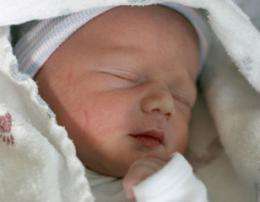
Photo by Chris Meyer, Indiana University
(PhysOrg.com) -- From their very first days, newborns' cries already bear the mark of the language their parents speak, reveals a new study published online on November 5th in Current Biology, a Cell Press publication. The findings suggest that infants begin picking up elements of what will be their first language in the womb, and certainly long before their first babble or coo.
"The dramatic finding of this study is that not only are human neonates capable of producing different cry melodies, but they prefer to produce those melody patterns that are typical for the ambient language they have heard during their fetal life, within the last trimester of gestation," said Kathleen Wermke of the University of Würzburg in Germany. "Contrary to orthodox interpretations, these data support the importance of human infants' crying for seeding language development."
Human fetuses are able to memorize sounds from the external world by the last trimester of pregnancy, with a particular sensitivity to melody contour in both music and language, earlier studies showed. Newborns prefer their mother's voice over other voices and perceive the emotional content of messages conveyed via intonation contours in maternal speech (a.k.a. "motherese"). Their perceptual preference for the surrounding language and their ability to distinguish between different languages and pitch changes are based primarily on melody.
Although prenatal exposure to native language was known to influence newborns' perception, scientists had thought that the surrounding language affected sound production much later, the researchers said. It now appears that isn't so.
Wermke's team recorded and analyzed the cries of 60 healthy newborns, 30 born into French-speaking families and 30 born into German-speaking families, when they were three to five days old. That analysis revealed clear differences in the shape of the newborns' cry melodies, based on their mother tongue.
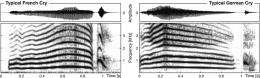
The cry melody of french (left) and german (right) babies differs considerably with respect to the accentuation. Image: MPI für Kognitions- und Neurowissenschaften
Specifically, French newborns tend to cry with a rising melody contour, whereas German newborns seem to prefer a falling melody contour in their crying. Those patterns are consistent with characteristic differences between the two languages, Wermke said.The new data show an extremely early impact of native language, the researchers say. Earlier studies of vocal imitation had shown that infants can match vowel sounds presented to them by adult speakers, but only from 12 weeks on. That skill depends on vocal control that just isn't physically possible much earlier, the researchers explain.
"Imitation of melody contour, in contrast, is merely predicated upon well-coordinated respiratory-laryngeal mechanisms and is not constrained by articulatory immaturity," they write. "Newborns are probably highly motivated to imitate their mother's behavior in order to attract her and hence to foster bonding. Because melody contour may be the only aspect of their mother's speech that newborns are able to imitate, this might explain why we found melody contour imitation at that early age."
-
Babble Of Baby Reveals Language Skills
Nov 03, 2009 |
not rated yet |
0
-
Scientist unveils secret of newborn's first words
Aug 26, 2008 |
not rated yet |
0
-
When do babies develop a love of speech?
Feb 20, 2006 |
not rated yet |
0
-
Practice builds brain connections for babies learning language, how to speak
Jul 11, 2006 |
not rated yet |
0
-
Linguist tunes in to pitch processing in brain
Feb 16, 2008 |
not rated yet |
0
-
Engineers build first sub-10-nm carbon nanotube transistor
Feb 01, 2012 |
4.9 / 5 (31) |
30
-
Something old, something new: Evolution and the structural divergence of duplicate genes
Jan 31, 2012 |
4.6 / 5 (7) |
1
-
The hidden nanoworld of ice crystals: Revealing the dynamic behavior of quasi-liquid layers
Jan 30, 2012 |
5 / 5 (3) |
1
-
Stock market network reveals investor clustering
Jan 27, 2012 |
3.9 / 5 (23) |
8
-
Of microchemistry and molecules: Electronic microfluidic device synthesizes biocompatible probes
Jan 26, 2012 |
5 / 5 (1) |
0
-
Is Everyday Technology Killing Us?
Feb 08, 2012
-
Exercise and weight loss
Feb 08, 2012
-
Why do we have head aches? Our brains can't feel anything.
Feb 07, 2012
-
"The end of diseases" by David Agus, interview from Daily Show with Jon Stewart
Feb 04, 2012
-
Oncolytic adenovirus
Feb 04, 2012
-
Nutrition label stuffs and diets
Feb 02, 2012
- More from Physics Forums - Medical Sciences
More news stories
Curry spice component may help slow prostate tumor growth
Curcumin, an active component of the Indian curry spice turmeric, may help slow down tumor growth in castration-resistant prostate cancer patients on androgen deprivation therapy (ADT), a study from researchers ...
4 hours ago |
5 / 5 (3) |
0
|
Team isolates nerve cells involved in storing long term memory and gene proteins associated with them
(Medical Xpress) -- A research team in Taiwan has succeeded in isolating two nerve cells in fruit fly brains that are believed to be the major players in allowing for the formation of long term memories. Furthermore, ...
Both maternal and paternal age linked to autism
Older maternal and paternal age are jointly associated with having a child with autism, according to a recently published study led by researchers at The University of Texas Health Science Center at Houston (UTHealth).
Medicine & Health / Psychology & Psychiatry
3 hours ago |
not rated yet |
0
|
Seeing colors in music, tasting flavors in shapes may happen in life's early months
Famed violinist Itzhak Perlman sees a deep forest green whenever he plays a B-flat on his Stradivarius' G string. The A on the E string is red.
Medicine & Health / Psychology & Psychiatry
6 hours ago |
5 / 5 (1) |
0
|
Antidepressants and pregnancy: Women must consider the impact of drugs on baby, and of depression on baby, themselves
Upon learning they are pregnant, most women dutifully nix the alcohol, sushi and caffeine. But what about antidepressants?
Medicine & Health / Medications
3 hours ago |
not rated yet |
0
Putting the squeeze on planets outside our solar system
(PhysOrg.com) -- Using high-powered lasers, scientists at Lawrence Livermore National Laboratory and collaborators discovered that molten magnesium silicate undergoes a phase change in the liquid state, abruptly ...
Employers feel no love for unscrupulous practice of 'service sweethearting'
A new study led by two Florida State University marketing professors finds that some frontline service employees who are rewarded for hikes in customer loyalty and satisfaction also may engage in "service ...
Expat French get Internet vote for first time
French citizens will for the first time this year be able to vote in a parliamentary election over the Internet, an experiment that could be extended to other elections if successful.
"Twisted Metal" gamers get shot at real gunplay
Fans of "Twisted Metal" will get to welcome a long-awaited sequel of the car-battle videogame with a real-world bang by blasting an ice cream truck to bits with a machine gun.
The power of estrogen -- male snakes attract other males
A new study has shown that boosting the estrogen levels of male garter snakes causes them to secrete the same pheromones that females use to attract suitors, and turned the males into just about the sexiest ...
New error-correcting codes guarantee the fastest possible rate of data transmission
Error-correcting codes are one of the triumphs of the digital age. Theyre a way of encoding information so that it can be transmitted across a communication channel such as an optical fiber o ...
