Team tracks infamous conquistador through southeast
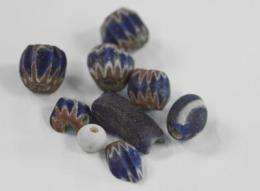
Archaeologists at Atlanta's Fernbank Museum of Natural History have discovered unprecedented evidence that helps map Hernando de Soto's journey through the Southeast in 1540. No evidence of De Soto's path between Tallahassee and North Carolina has been found until now, and few sites have been located anywhere.
Fernbank's Curator of Native American Archaeology, Dennis Blanton, has amassed an impressive collection of objects that reveal a probable stop in today's Telfair County, Ga., a location important not only for its critical mass of de Soto-era artifacts but also for its position off the previously predicted route. He'll present a scholarly paper before colleagues at the Southeastern Archaeological Conference on November 5 in Mobile, Ala.
"When we first started this excavation, I was surprised to learn there is no concrete evidence in Georgia of De Soto's path from Tallahassee to North Carolina. A single bead has been found here, a bead has been found there, but nothing of this nature," he said. "What we have now is the best-documented collection of Spanish artifacts in Georgia. Many are unique and they are the only examples of certain artifacts ever found outside Florida."
The most significant findings—rare glass beads, metal artifacts and other objects—add up to a heap of evidence that De Soto came calling near McRae, Ga. over 450 years ago. Because Native Americans did not have glass or metal before the arrival of Europeans, archaeologists look for these materials when documenting early explorers. Fernbank's site has both. Until now, many scholars expected De Soto's path to veer farther west, toward Macon.
"Archaeologists have a pretty good handle now on what a De Soto site would look like. I think it's a good working hypothesis that this was a De Soto contact site. It's close enough to the [estimated] route. It's got the right kind of materials," said Dr. Charles Ewen, an archaeologist at East Carolina University who co-directed the excavation of De Soto's 1539 winter encampment in Tallahassee, Fla. "Sometimes a hypothesis is as good as it gets in archaeology. Right now this looks like De Soto went through there. Without going back in time, this evidence may be as close as you are going to get [to identifying De Soto's path]. No matter what, it's a great site."
Among Fernbank's rare finds are two types of glass beads never found outside Florida and several chevron beads that date to the Spanish exploration—the types of artifacts often seen as "calling cards" of De Soto due to their distinctive patterns and limited production.
Blanton has meticulously recorded the context of the artifacts, something missing from most other Georgia finds as a result of treasure hunters and looters.
"The fact that it [Fernbank's research] is being carried out in a controlled, scientific fashion is absolutely essential for correctly interpreting the site and its contents," said Dr. Jeffrey M. Mitchem, an archaeologist and De Soto scholar at the Parkin Archaeological State Park in Arkansas, which many scholars believe to be the Native American village of Casqui visited by De Soto's expedition in the summer of 1541. "So many of the archaeological sites that have yielded bits and pieces of evidence for early Spanish contact were destroyed by uncontrolled digging and looting. In those cases we end up with a bunch of pretty objects but little else."
The rarest artifacts were recovered within the context of a large structure that Blanton believes was a "council house," typically established in major communities for ceremonies and other business within the territory.
"Applying the logic that De Soto targeted prominent Native communities raises the odds that he visited our site," Blanton said. "This research is a bit controversial because we found evidence of De Soto where we weren't supposed to…all this evidence might just be saying 'Hernando de Soto slept here.'"
Blanton sees "a certain amount of serendipity" in his monumental findings because he didn't set out to search for De Soto when he began the archaeology program in 2006. Blanton's initial hope was to find the lost Spanish Mission settlement of Santa Isabel de Utinahica, a site that would have dated to the early-1600s. As the excavation began producing only objects that pre-dated the mission system, Blanton devoted himself to the process of accounting for the unanticipated findings.
The research isn't over, though. Blanton intends to continue excavations—in Telfair County and beyond—in an effort to establish concrete stops along De Soto's journey. Tracking the infamous conquistador's journey through Native communities reveals how he affected Native populations. The research helps provide a bridge between the historic and prehistoric periods.
Dr. Ewen said he hopes to see more evidence of what the link to De Soto could offer about what life was like for Native Americans before the arrival of Europeans.
"I don't think the public understands how complex the societies were that De Soto came into contact with. We tend to have a simplistic view of what the Indians were before the Spanish," he said. "We're now starting to get a handle on what the Indians were thinking as the Europeans arrived."
Blanton agrees that a big part of establishing De Soto's path is the window it opens into the indigenous landscape of the area.
"Until we know De Soto's path, we won't fully understand Native populations or the changes that took place after European contact. This is where the Spanish story and the Native story become one," Blanton said.
Source: Fernbank Museum of Natural History


