The last European hadrosaurs lived in the Iberian Peninsula
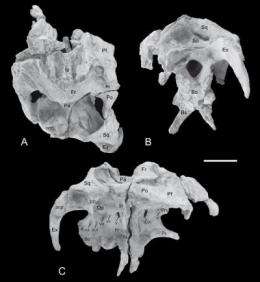
Spanish researchers have studied the fossil record of hadrosaurs, the so-called 'duck-billed' dinosaurs, in the Iberian Peninsula for the purpose of determining that they were the last of their kind to inhabit the European continent before disappearing during the K/T extinction event that occurred 65.5 million years ago. Most notable among these fossils is the discovery of a new hadrosaur, the Arenysaurus ardevoli, found in Huesca, Spain.
A few million years before the catastrophic event that led to the extinction of dinosaurs (with the exception of birds), several species of hadrosaurs coexisted in the Iberian Peninsula. This is what a Spanish team of paleontologists have demonstrated in a research article published in the Journal of Vertebrate Paleontology.
"The Iberian archeological record is important from an European context due to the quantity and quality of the fossil material discovered," explains Xavier Pereda-Suberbiola, one of the study's authors and a researcher at the University of the Basque Country (UPV / EHU), in an interview with SINC.
The researcher, collaborating with paleontologists from the University of Zaragoza, Valencia, Complutense of Madrid, Autonoma de Barcelona and the Jurassic Museum of Asturias, specifies that the presence of evolved hadrosaurs in Europe could be due to migration from Asia and North America.
"In Europe, primitive hadrosaurs coexist with evolved hadrosaurs, and the persistence of basal members could be due to the insular palaeobiogeography of Europe during the Upper Cretaceous," states the scientist. In addition to the fossils found in the Iberian Peninsula, hadrosaur fossils have been found in the Netherlands, which date back to Late Cretaceous, "although the material is more fragmented than those found in Huesca and Lleida," adds Pereda-Suberbiola.
During that time period, Europe was isolated from other continents and this may have led to the survival of certain lineages. "The European hadrosaur faunas are different from those seen in North America and Asia, which are both dominated by evolved species," explains Pereda-Suberbiola.
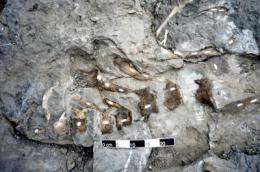
Next to the hadrosaurs, identifiable by the fossilized mandibles found in the arechological sites of La Solana (Valencia) and Fontllonga (Lleida), were a lambeosaurine hadrosaurs yet to be defined, and a newly discovered lambeosaurine, the Arenysaurus ardevoli.
An articulated cranium of great value
The study of the last hadrosaurs that lived in the Iberian Peninsula has been possible thanks to the discovery by the Aragosaurus-IUCA Group of the University of Zaragoza, led by Jose Ignacio Canudo, of the first articulated hadrosaur skull found in southern Europe, from the archeological sites of Arén, in Huesca, Spain.
The skull belongs to an Arenysaurus ardevoli, a lambeosaurine (hadrosaur with a hollow cranial crest), whose description was recently published in the French journal Comptes Rendus Palevol, and was part of the Spanish fossil record.
According to paleontologists, the new lambeosaurine lived between 65.5 and 68 million years ago, had a very prominent frontal dome, and its biogeographical relationships suggest a paleobiogeographical connection between Asia and Europe during the Late Cretaceous.
Researchers have found, in addition to the partially articulated skull, the mandibular remains and postcranial elements such as vertebrae, girdle and limb bones.
The Spanish archaeological record of hadrosaurs is the largest in Europe. Out of the 50 locations where dinosaur remains were discovered since 1984, nearly half have been found in Lleida and Huesca. These archeological sites stand out for containing fossils pertaining to several species of duck-billed dinosaurs.
More information:
Pereda-Suberbiola, Xabier; Canudo, José Ignacio; Company, Julio; Cruzado-Caballero, Penélope; Ruiz-Omenaca, José Ignacio. "Hadrosauroid dinosaurs from the latest Cretaceous of the Iberian Peninsula" Journal of Vertebrate Paleontology 29(3): 946-951, 12 de septiembre de 2009.
Pereda-Suberbiola, Xabier; Canudo, José Ignacio; Cruzado-Caballero, Penélope; Barco, José Luis; López-Martínez, Nieves; Oms, Oriol; Ruíz-Omenaca, José Ignacio. Comptes Rendus Palevol 8(6): 559-572 septiembre de 2009.
Source: FECYT - Spanish Foundation for Science and Technology


