Hubble Image Showcases Star Birth in M83, the Southern Pinwheel
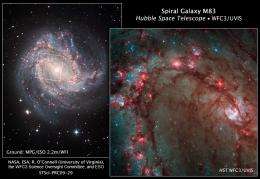
November 5, 2009 Hubble Image Showcases Star Birth in M83, the Southern Pinwheel

Enlarge

Credit for Hubble Image: NASA, ESA, R. O'Connell (University of Virginia), B. Whitmore (Space Telescope Science Institute), M. Dopita (Australian National University), and the Wide Field Camera 3 Science Oversight Committee. Credit for Ground-based Image: European Southern Observatory

(PhysOrg.com) -- The spectacular new camera installed on NASA's Hubble Space Telescope during Servicing Mission 4 in May has delivered the most detailed view of star birth in the graceful, curving arms of the nearby spiral galaxy M83.

Nicknamed the Southern Pinwheel, M83 is undergoing more rapid star formation than our own galaxy, especially in its nucleus. The sharp "eye" of the 3 (WFC3) has captured hundreds of young star clusters, ancient swarms of globular star clusters, and hundreds of thousands of individual stars, mostly blue supergiants and red supergiants.

The image at right is Hubble's close-up view of the myriad stars near the galaxy's core, the bright whitish region at far right. An image of the entire galaxy, taken by the European Southern Observatory's Wide Field Imager on the ESO/MPG 2.2-meter telescope at La Silla, Chile, is shown at left. The white box outlines Hubble's view.

WFC3's broad wavelength range, from ultraviolet to near-infrared, reveals stars at different stages of evolution, allowing astronomers to dissect the galaxy's star-formation history.

The image reveals in unprecedented detail the current rapid rate of star birth in this famous "grand design" spiral galaxy. The newest generations of stars are forming largely in clusters on the edges of the dark dust lanes, the backbone of the spiral arms. These fledgling stars, only a few million years old, are bursting out of their dusty cocoons and producing bubbles of reddish glowing hydrogen gas.

The excavated regions give a colorful "Swiss cheese" appearance to the spiral arm. Gradually, the young stars' fierce winds (streams of charged particles) blow away the gas, revealing bright blue star clusters. These stars are about 1 million to 10 million years old. The older populations of stars are not as blue.

A bar of stars, gas, and dust slicing across the core of the galaxy may be instigating most of the star birth in the galaxy's core. The bar funnels material to the galaxy's center, where the most active star formation is taking place. The brightest star clusters reside along an arc near the core.

The remains of about 60 supernova blasts, the deaths of massive stars, can be seen in the image, five times more than known previously in this region. WFC3 identified the remnants of exploded stars. By studying these remnants, astronomers can better understand the nature of the progenitor stars, which are responsible for the creation and dispersal of most of the galaxy's heavy elements.

M83, located in the Southern Hemisphere, is often compared to M51, dubbed the Whirlpool galaxy, in the Northern Hemisphere. Located 15 million light-years away in the constellation Hydra, M83 is two times closer to Earth than M51.

Provided by European Space Agency (news : web)


Rate this story - 4.6 /5 (10 votes)

Rank Filter

Move the slider to adjust rank threshold, so that you can hide some of the comments.


Display comments: newest first

  • omatumr - Nov 08, 2009
    • Rank: 1 / 5 (1)
    Why Star Birth in M83?

    This is an interesting story, but why is no reason given for so much star birth activity in M83?

    With kind regards,
    Oliver K. Manuel

November 5, 2009 all stories

Comments: 1

4.6 /5 (10 votes)

  • hide
  • Related Stories

  • Hubble photographs grand spiral galaxy Messier 81
    created May 29, 2007 | popularity not rated yet | comments 0
  • Antennae Galaxies
    created May 19, 2008 | popularity not rated yet | comments 0
  • Hubble's view of barred spiral galaxy NGC 1672
    created Apr 03, 2007 | popularity not rated yet | comments 0
  • Largest ever galaxy portrait - stunning HD image of Pinwheel Galaxy
    created Feb 28, 2006 | popularity not rated yet | comments 0
  • The thousand-ruby galaxy
    created Sep 02, 2008 | popularity not rated yet | comments 0


  • hide
  • Relevant PhysicsForums posts

  • Spreading Life in the Universe
    created 14 hours ago
  • Force of Gravity in terms of Density
    created Feb 08, 2010
  • what is the relation between gravity and light?
    created Feb 08, 2010
  • Does the Thermoelectric effect apply in sun?
    created Feb 07, 2010
  • More from Physics Forums - General Astronomy

Other News

Space shuttle Endeavour pulls in at space station (AP)

Space shuttle Endeavour pulls in at space station

Space & Earth / Space Exploration

created 3 hours ago | popularity not rated yet | comments 0

(AP) -- Shuttle Endeavour arrived to a warm welcome at the International Space Station early Wednesday, delivering a new room and observation deck that will come close to completing construction 200 miles ...


Climate 'Tipping Points' May Arrive Without Warning, Says Top Forecaster

Space & Earth / Environment

created 13 hours ago | popularity 3 / 5 (8) | comments 9 | with audio podcast

(PhysOrg.com) -- A new University of California, Davis, study by a top ecological forecaster says it is harder than experts thought to predict when sudden shifts in Earth's natural systems will occur -- a worrisome finding ...


38 percent of world's surface in danger of desertification

38 percent of world's surface in danger of desertification

Space & Earth / Environment

created 10 hours ago | popularity 2.3 / 5 (3) | comments 5

A team of Spanish researchers has measured the degradation of the planet's soil using the Life Cycle Assessment (LCA), a scientific methodology that analyses the environmental impact of human activities, and ...


A new 3-D map of the interstellar gas within 300 parsecs from the sun

A new 3D map of the interstellar gas within 300 parsecs from the Sun

Space & Earth / Astronomy

created 16 hours ago | popularity 5 / 5 (5) | comments 0 | with audio podcast

(PhysOrg.com) -- Astronomy & Astrophysics is publishing new 3D maps of the interstellar gas in the local area around our Sun. A French-American team of astronomers presents new absorption measurements toward ...


URI researcher calls for global effort to monitor marine pollutants

Space & Earth / Environment

created 14 hours ago | popularity 3 / 5 (2) | comments 1

A University of Rhode Island researcher who studies chemical pollutants in the marine environment has called on colleagues around the world to establish a global monitoring network to verify that the chemicals banned by the ...