Approved Lymphoma Drug Shows Promise in Early Tests Against Bone Cancer
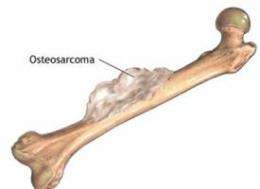
(PhysOrg.com) -- A drug already approved for the treatment of lymphoma may also slow the growth of the most deadly bone cancer in children and teens, according to an early-stage study published online today in the International Journal of Cancer. The study drug, Bortezomib, was found to be effective against bone cancer in human cancer cell studies and in mice. While key experiments were in animals, the cancer studied closely resembled the human form and the drug has already been proven to be safe in human patients.
In the current study, researchers sought to use Bortezomib (Velcade®) against osteosarcoma, an aggressive cancer that starts in bone, spreads quickly and responds poorly to current chemotherapies. The drug, a proteasome inhibitor developed by Millennium Pharmaceuticals and Johnson & Johnson, was approved by the FDA for the treatment of a rare, aggressive form of non-Hodgkin's lymphoma in 2006 and for multiple myeloma in 2008.
“Our most clinically relevant finding is that a drug already proven safe and effective in treating the most common cancers of the blood may be equally effective in suppressing bone cancer,” said Roman Eliseev, M.D., Ph.D., research assistant professor within the Center for Musculoskeletal Research and the James P. Wilmot Cancer Center, both within the University of Rochester Medical Center. “Bortezomib caused osteosarcoma cells to self destruct, and prevented their spread. While further studies are needed, our findings suggest that this drug may represent a new treatment option for a devastating disease and an effective complement to current chemotherapies.”
Reason to Hope
Eliseev’s lab and others have shown that a protein complex called Runx2 both blocks the growth of bone cancer cells and triggers a quality control mechanism that causes abnormal cells to self-destruct. For some reason, however, Runx2 levels are dramatically reduced in bone cancer cells.
In the current study, researchers found that Bortezomib shuts down cellular machines that destroy Runx2, machines that become overactive in bone cancer patients. Bortezomib restored Runx2 levels in osteosarcoma cell lines and in osteosarcoma tumors in mice. In addition, tests found a three-fold increase in the bortezomib-treated group in the number of cancer cells testing positive for an enzyme (caspase-3) known to drive them to self-destruct. Experiments also showed that the average size of osteosarcoma tumors in bortezomib-treated mice was only 30 percent of that in the control group.
The new findings also provide the first explanation of why Runx2 levels are lower in bone cancer cells. Researchers found that Runx2, which encourages abnormal cells to self destruct, may itself become the target of cellular machines called proteosomes that break down and recycle unneeded proteins.
Specifically, the team found in osteosarcoma cells high levels of a protein called Smurf1, known to tag aging proteins for attention by protein-devouring proteosomes. The team is now looking at why levels of Smurf1 are higher in osteosarcoma. In addition, Eliseev and colleagues plan to launch a pilot study later in 2010 using bortezomib to treat osteosarcoma.
Along with Eliseev, the work was led by Yuriy Shapovalov, David Benavidez and Daniel Zuch within the Center for Musculoskeletal Research at the Medical Center. The study was funded in part by the Karen D’Amico Foundation, the James P. Wilmot Foundation and the National Institutes of Health.
“These data argue that bortezomib treatment not only caused bone cancer cells to signal for their own self-destruction, but also suppressed the ability of osteosarcoma cells to grow, in a two-fold effect,” Eliseev said. “The study results also give us reason to hope that the treatment will avoid side effects, because bortezomib induces cell death in osteosarcoma cells but not in normal bone-making cells.”
Provided by University of Rochester (news : web)


