Early scents really do get 'etched' in the brain
November 5, 2009 Brain

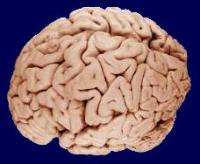
Image source: University of Wisconsin and Michigan State Comparative Mammalian Brain Collections and the National Museum of Health and Medicine.

Common experience tells us that particular scents of childhood can leave quite an impression, for better or for worse. Now, researchers reporting the results of a brain imaging study online on November 5th in Current Biology show that first scents really do enjoy a "privileged" status in the brain.

"We found that the first pairing or association between an object and a smell had a distinct signature in the ," even in adults, said Yaara Yeshurun of the Weizmann Institute of Science in Israel. "This 'etching' of initial memories in the brain was equal for good and bad smells, yet was unique to odor." Sounds did not have the same effect, the research showed.

In the study, the researchers presented adults with a visual object together with one, and later with a second, set of pleasant and unpleasant odors and sounds while their brains were imaged by (fMRI). A week later, the researchers presented the same objects inside the fMRI and tested participants' associations of those images with the scents and smells.

The researchers found that people remembered early associations more clearly when they were unpleasant, regardless of whether they were smelled or heard. The images, however, revealed a unique activation in particular in the case of their first olfactory (but not auditory) associations. That signature held regardless of whether the odors or sounds were pleasant or unpleasant. The researchers even found that they could predict what a person would remember later based on the activity in their brains on day 1.

Yeshurun explained that it makes good sense to remember unpleasant memories as a kind of evolutionary "risk management." But the findings show that there is also something particularly special about early memories of smells.

That wasn't really unexpected, Yeshurun said—it is after all a phenomenon that has long fascinated authors, poets, and scientists alike. Still, the results did hold some surprises.

"We expected a unique representation of initial or 'first' olfactory associations but did not expect that it would materialize even in cases where the behavioral evidence did not indicate a stronger memory," Yeshurun said. "In our paradigm, initial and later olfactory associations were remembered equally well, but only first associations had the unique brain representation."

In terms of understanding the brain, the findings suggest that activity in two regions, known as the hippocampus and amygdala, together can render a memory "special."

Although any application of the findings would be far off, Yeshurun said the results could suggest ways to strengthen particular memories. "Perhaps more importantly, it may help us generate methods to better forget early and powerful memories, such as trauma," she said.

Source: Cell Press (news : web)


print this article email this article download pdf blog this article bookmark this article     Stumble it Digg this share on Facebook retweet share on Reddit add to delicious
Rate this story - 3 /5 (2 votes)


November 5, 2009 all stories

Comments: 0

3 /5 (2 votes)
  • Stumble this up

  • Digg this

  • share this

  • hide
  • Related Stories

  • The brain is more adept at using the nose than previously realized
    created Apr 28, 2007 | popularity not rated yet | comments 0
  • Memory trick shows brain organization
    created Aug 28, 2008 | popularity not rated yet | comments 0
  • New method enables scientists to see smells
    created Dec 24, 2007 | popularity not rated yet | comments 0
  • Two 'noses' are necessary for flies to navigate well
    created Dec 26, 2007 | popularity not rated yet | comments 0
  • How learning influences smell
    created Dec 20, 2006 | popularity not rated yet | comments 0


  • hide
  • Relevant PhysicsForums posts

  • West's zone 2 starling resistor respiratory physiology
    created Nov 18, 2009
  • 50-0-50 rule
    created Nov 18, 2009
  • What is the evidence in support of the anti-vaccine movement?
    created Nov 17, 2009
  • Chemical Burns
    created Nov 16, 2009
  • More from Physics Forums - Medical Sciences

Other News

smoking, cigarette

Vaccine being developed to help smokers quit

Medicine & Health / Medications

created 21 hours ago | popularity 4.6 / 5 (5) | comments 5

(PhysOrg.com) -- Glaxo-SmithKline has joined forces with Nabi Pharmaceuticals to produce a vaccine to help smokers give up their addiction permanently.


Therapy 32 times more cost effective at increasing happiness than money

Medicine & Health / Psychology & Psychiatry

created 22 hours ago | popularity 2 / 5 (4) | comments 2

(PhysOrg.com) -- Research by the University of Warwick and the University of Manchester finds that psychological therapy could be 32 times more cost effective at making you happy than simply obtaining more money. The research ...


Possible link studied between childhood abuse and early cellular aging

Possible link studied between childhood abuse and early cellular aging

Medicine & Health / Psychology & Psychiatry

created 16 hours ago | popularity 5 / 5 (1) | comments 0

Children who suffer physical or emotional abuse may be faced with accelerated cellular aging as adults, according to new research from Butler Hospital and Brown University.


Mutation found in swine flu virus: WHO

Medicine & Health / Diseases

created 17 hours ago | popularity 3.3 / 5 (3) | comments 0

The World Health Organisation said Friday that a mutation had been found in samples of the swine flu virus taken following the first two deaths from the pandemic in Norway.


Researchers identify role of gene in tumor development, growth and progression

Medicine & Health / Cancer

created 17 hours ago | popularity 5 / 5 (1) | comments 0

Virginia Commonwealth University Massey Cancer Center and VCU Institute of Molecular Medicine researchers have identified a gene that may play a pivotal role in two processes that are essential for tumor development, growth ...