Mom was right: Why nice guys usually get the girls
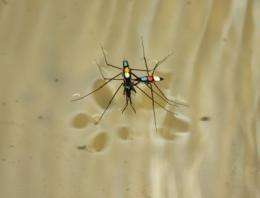
(PhysOrg.com) -- Female water striders often reject their most persistent and aggressive suitors and prefer the males who aren't so grabby, according to new research. Water striders are insects commonly seen skittering across the surface of streams.
Groups of low-key male water striders mated with more females than did groups of highly sexually aggressive males, according to a study led by Omar Tonsi Eldakar of the University of Arizona's Arizona Research Laboratories.
The research contradicts previous laboratory studies that found the most sexually aggressive males are the most successful at reproducing, said Eldakar, who conducted the experiments while an instructor at Binghamton University in N.Y. He is now a postdoctoral research associate in UA's Center for Insect Science.
"Nice guys don't always finish last," he said. "In this study we've shown that it's possible for non-aggressive males to have the advantage."
His co-author John W. Pepper said, "If the early laboratory studies were a realistic representation of nature, nature should be overrun by hyperaggressive males -- and it's not. So something was wrong with that idea, and now we know what."
In the previous studies, the females were not able to leave areas populated by sexually aggressive males.
By simulating a more natural situation, the current study showed that female water striders moved away from areas where they were being harassed by males. The females preferred to hang out in locations where the males did not pursue females relentlessly.
The new research explains why hyperaggressive males are a minority in the water strider world, said Pepper, a UA assistant professor of ecology and evolutionary biology. The groups of water striders that were composed of females and less aggressive males had more overall mating success.
The finding supports the idea that natural selection simultaneously acts on individuals and on groups of individuals, he said.
"Omar's work says that what happens between groups is important," Pepper said. "Individually, less aggressive males may get a smaller piece of the pie. But a group of less aggressive males has a bigger pie, because the males don't drive away females or harass them so much they don't reproduce."
Eldakar, Pepper and their co-authors Michael J. Dlugos and David Sloan Wilson of Binghamton University in N.Y. will publish their paper, "Population Structure Mediates Sexual Conflict in Water Striders," in the Nov. 6 issue of the journal Science. The Edmund Niles Huyck Preserve in Rensselaerville, N.Y., the National institutes of Health and the National Science Foundation funded the study.
Eldakar and his colleagues studied Aquarius remigis, a species of stream-dwelling water striders common throughout North America.
The team collected the insects from the wild during the breeding season. To tell the individuals apart, the researchers marked each one with a unique combination of colored dots by using toothpicks dipped in model airplane paint.
The scientists observed the water striders and categorized each male in terms of his degree of sexual aggressiveness toward females. The team then placed various combinations of six male and six female water striders into six individual chambers within a tank of water 12 feet by 4 feet. The researchers then recorded the insects' behaviors.
Each water strider was observed for at least an hour, Eldakar said.
When hyperaggressive males were present in the same chamber as less aggressive males, the hyperaggressive males monopolized the females.
However, when the researchers opened gates between the chambers so they were all connected and the insects could range more freely, things changed. Females left areas where they were harassed and congregated in regions of the tank that had only non-aggressive males. As a group, those males had significantly more successful matings than did the hyperaggressive males.
In a natural setting, water striders are free to move between different areas of a stream.
"You can't see the advantage (of being non-aggressive) until you see the females move toward the areas where the non-aggressive males congregate," Eldakar said. "In natural settings, the aggressive males are not going to have access (to females), because the females are going to gather where the males are non-aggressive."
Pepper is interested in how cooperation functions in nature. He defines cooperation as behavior that helps the group.
"The non-cooperator tries to get a bigger piece of the pie, but the cooperator helps the pie be bigger," Pepper said.
"The naive view of Darwinian evolution is that it always favors the most savage, brutal and selfish behaviors. It doesn't -- and this is one example of that. In nature, groups of cooperative individuals are more successful than groups of selfish individuals."
Provided by University of Arizona (news : web)


