Unusual meteorite found by time-lapse camera observatory
November 5, 2009
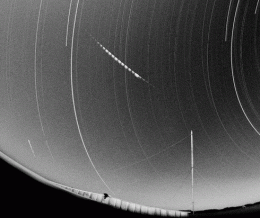
Time-lapse image taken over one night of a fireball travelling across the sky. It was taken from a fireball camera network or observatory in Western Australia. © Phil Bland, Imperial College
(PhysOrg.com) -- An unusual meteorite with an interesting orbit has been tracked to the ground using a photographic observatory that records time-lapse images of fireballs traveling across the sky.
The network of cameras is in the Nullabor Desert in Western Australia. It allows scientists to track a fireball path, formed by a meteorite as it travels through Earth's atmosphere, and then work out where the meteorite comes to rest.
The fireball camera network project was set up by Dr Phil Bland from Imperial College London and scientific associate of the Natural History Museum, along with colleagues from Ondrejov Observatory in the Czech Republic, and the Western Australia Museum, in 2006. This is the first meteorite recovered using the network.
The cameras recorded the fireball that ultimately produced the meteorite in 2007, and the fragments that fell to Earth were named Bunburra Rockhole after a local landscape feature near to where they landed.
The meteorite was found within 100m of the predicted fall line. It was collected and samples were given to the Natural History Museum where mineral experts Dr Gretchen Benedix and Dr Kieren Howard helped examine and classify it. They produced data about the meteorite’s composition and the types of minerals within it.
Most meteorites found on Earth are believed to be fragments of asteroids - ancient rocks that formed during the creation of the solar system about 4.56 billion years ago.
Using complex calculations, the team were able to work out the meteorite's path to Earth and its orbit, and from that, where in the solar system the meteorite most likely came from.
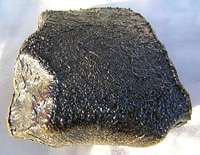
The Bunburra Rockhole meteorite is made from an usual type of basaltic igneous rock © Phil Bland, Imperial College
The Bunburra meteorite is about the size of a cricket ball and is an unusual type of basaltic igneous rock. Most basaltic meteorites are thought to come from one asteroid. However, the composition of Bunburra Rockhole means that it comes from a different asteroid.This means that the process required to form this type of rock was happening in more than one place in the early solar system.
‘It's vital to have a meteorite with information about where it comes from in the solar system,’ says Dr Benedix.
‘We've known for a long time that most meteorites are from the asteroid belt, but we don't know exactly where. This kind of information helps us fit one more piece in the puzzle of how the solar system formed and evolved.
‘The fact that this meteorite is compositionally unusual increases it's value even more. It helps us to uncover more information about the conditions of the early solar system.’
The team says that the meteorite had an unusual orbit. Using modeling techniques, it was determined that Bunburra Rockhole began as part of an asteroid in the innermost main asteroid belt between Mars and Jupiter.
Its orbit gradually evolved into one very similar to Earth's. Other meteorites for which data exist have orbits that take them into the main asteroid belt.
Dr Howard says, ‘I consider myself lucky to handle rocks from space when usually I only know that they come from the curators’ cupboard!
‘The chance to study a meteorite with a known orbit and source, so soon after if falls to Earth, is really exciting.’
Dr Bland concludes, 'It was amazing to find a meteorite that we could track back to its origin in the asteroid belt on our first expedition using our small trial network.
'We're cautiously optimistic that this find could be the first of many and if that happens, each find may give us more clues about how the solar system began.'
-
Researchers make rare meteorite find using new camera network in Australian desert
Sep 17, 2009 |
not rated yet |
0
-
Discovery of the source of the most common meteorites
Jul 10, 2008 |
not rated yet |
0
-
Unusual meteorite found in Antarctica
Sep 19, 2006 |
not rated yet |
0
-
One-of-a-kind meteorite unveiled
Apr 22, 2006 |
not rated yet |
0
-
University of Western Ontario cameras capture 'fireball'
Oct 24, 2008 |
not rated yet |
0
-
Engineers build first sub-10-nm carbon nanotube transistor
Feb 01, 2012 |
4.9 / 5 (30) |
30
-
Something old, something new: Evolution and the structural divergence of duplicate genes
Jan 31, 2012 |
4.6 / 5 (7) |
1
-
The hidden nanoworld of ice crystals: Revealing the dynamic behavior of quasi-liquid layers
Jan 30, 2012 |
5 / 5 (3) |
1
-
Stock market network reveals investor clustering
Jan 27, 2012 |
3.9 / 5 (23) |
8
-
Of microchemistry and molecules: Electronic microfluidic device synthesizes biocompatible probes
Jan 26, 2012 |
5 / 5 (1) |
0
-
Titan's lack of impact craters
22 hours ago
-
Real pictures of black hole eating a star?
Feb 08, 2012
-
Hypothetical way to travel faster than light, but not technically exceed lightspeed
Feb 06, 2012
-
How do scientists monitor the Sun's activity?
Feb 05, 2012
-
Search patterns in observational studies
Feb 05, 2012
-
Derivation of Pogson's law
Feb 03, 2012
- More from Physics Forums - General Astronomy
More news stories
Clam fields found at deep, low-temperature Mariana vents
(PhysOrg.com) -- Scientists have marveled at the unusual life forms thriving at high temperature hydrothermal vents of the deep ocean.
Space & Earth / Earth Sciences
48 minutes ago |
not rated yet |
0
|
Could Venus be shifting gear?
(PhysOrg.com) -- ESAs Venus Express spacecraft has discovered that our cloud-covered neighbour spins a little slower than previously measured. Peering through the dense atmosphere in the infrared, the ...
Space & Earth / Space Exploration
16 minutes ago |
5 / 5 (1) |
0
|
Streams need trees to withstand climate change
(PhysOrg.com) -- More than twenty years of biological monitoring have confirmed the importance of vegetation for protecting Australia's freshwater streams and rivers against the ravages of drought and climate ...
57 minutes ago |
not rated yet |
0
The turbulent birth of super star clusters in galaxy mergers
By combining two of the most advanced telescopes in the world -- the new Atacama Large Millimeter Array (ALMA) and the Very Large Telescope (VLT) of ESO -- a team of French astronomers from the Institut d'astrophysique ...
39 minutes ago |
not rated yet |
0
What does a nebula sound like?
What do things sound like out in the cosmos? Of course, sound waves cant travel through the vacuum of space; however, electromagnetic waves can. These electromagnetic waves can be recorded by devices called spectrographs ...
Space & Earth / Space Exploration
23 minutes ago |
5 / 5 (1) |
0
Seeing colors in music, tasting flavors in shapes may happen in life's early months
Famed violinist Itzhak Perlman sees a deep forest green whenever he plays a B-flat on his Stradivarius' G string. The A on the E string is red.
Is that sleepiness during pregnancy normal or a sign of sleep apnea?
(Medical Xpress) -- Most pregnant women complain of being tired. Some of them however, could be suffering more than normal fatigue associated with their pregnancy; they may have developed obstructive sleep apnea (OSA), a ...
Engineering images bring life to submerged city
(PhysOrg.com) -- Photo-realistic 3D mapping and digital reconstruction of an ancient underwater city in Greece have earned a team from the University of Sydney's Faculty of Engineering and Information Technologies ...
Numeracy: The educational gift that keeps on giving?
(Medical Xpress) -- Cancer risks. Investment alternatives. Calories. Numbers are everywhere in daily life, and they figure into all sorts of decisions. A new article published in Current Directions in Psychological Science, a journal of the Association for Psychological Science, examin ...
New power source discovered
(PhysOrg.com) -- Researchers at the Massachusetts Institute of Technology (MIT) and RMIT University have made a breakthrough in energy storage and power generation.
Measurements from high-energy collisions lead to better understanding of why meson particles disappear
For several years, physicists at the Relativistic Heavy Ion Collider (RHIC) at Brookhaven National Laboratory (BNL), USA, have studied an unusual state of matter called the quarkgluon plasma, which they ...
Nov 06, 2009
Rank: 5 / 5 (1)
Nov 07, 2009
Rank: not rated yet
Here is an example of a time-lapse film. It shows seven days of action and is compressed into four minutes of viewing time:
http://www.vimeo.com/6739275
Nov 10, 2009
Rank: not rated yet