Humans, Other Mammals Similarly Voice Frustrations
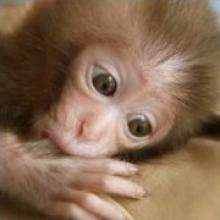
Pet owners and scientists who spend a lot of time in the wild say that they can tell when an animal is upset by the sound of its voice. Now new analyses of animal calls may offer an explanation; humans seem to express frustration in the same way as other mammals.
At a recent meeting of the Acoustical Society of America, several groups of scientists presented evidence that humans, bats, elephants and shrews all speak faster and with a higher pitch when stressed. Along with other studies of primates, marmots and rats, the findings suggest that humans inherited the way we communicate when feeling anxious from animal ancestors that lived millions of years ago.
Studying animal emotions can be a challenge because unlike humans, animals cannot describe their emotions -- at least, not to us. Unable to interview animals, scientists look instead for signs of emotion through visible behaviors and in the ways they communicate.
"We're obviously at a disadvantage when studying non-humans," said Michael Owren of Georgia State University in Atlanta.
Some emotional behaviors seem to be uniquely human. Monkeys shed tears to keep their eyes clean, but only Homo sapiens weep during distressing situations.
Laughter, on the other hand, is a way of communicating emotion shared by both humans and monkeys, something that Charles Darwin wrote about more than a century ago. He catalogued hundreds of facials expressions used by people and animals and noticed that monkeys -- like humans -- wrinkle their cheeks and grin with bright eyes when they laugh.
"We may confidently believe that laughter, as a sign of pleasure or enjoyment, was practiced by our progenitors long before they deserved to be called human," wrote Darwin, who believed that human beings inherited some of our emotions from our animal ancestors.
Recent studies into how animals communicate frustration have continued to explore Darwin's hypothesis of emotional continuity between species.
Zoologist Sabine Schmidt from the University of Veterinary Medicine in Hannover, Germany, studies vampire bats. She has found evidence of frustration in the ultrasonic screeches the bats produce when quarreling over a favorite perching spot. When one bat stole another's favorite spot, the ousted animal screeched at the squatter, flapped its wings and opened its mouth aggressively. As a bat became more aggressive, the type of call it used remained the same -- but the pitch rose, and the clicks happened faster.
"The clicks are like when a woman gets hysterical and the voice goes up," said Schmidt. "It codes for urgency."
Elke Zimmerman, also from the University of Veterinary Medicine, found a similar change in the calls of tree shrews, small insect-eating mammals native to Southeast Asia.
"Where they live, there are lots of bushes," said Zimmerman. "It is not always easy for them to see each other, so acoustic communication is of special relevance."
When the female tree shrews she observed were approached by a male, they often screamed in protest. And the closer the male got, the higher and faster the scream became. Zimmerman said that the rise in pitch is similar to changes in human speech that indicate intensifying anger.
Other data about how elephants talk to each other in groups has shown that the large mammals raise the pitch of their calls when talking to a herd member of higher status.
Zimmerman said that millions of years ago, mammals may have started to raise the pitch of their voices not to communicate, but because of stress on their bodies.
"You breathe at higher rate when you are stressed," said Zimmerman. "It might be that raising the pitch was a byproduct of the breath rate in our ancestral mammals that evolved into a signal to avoid danger."
"The central question we are dealing with is how far back do the evolutionary roots of emotional communication go in the mammals," said Schmidt. "This pushes us farther back in evolution than ever before, 85 to 95 million years back."
The research is the latest is a series of experiments that continue to uncover examples of emotional behaviors shared by humans and other animals. Magpies seem to hold funerals for fallen comrades, according to biologist Marc Bekoff from the University of Colorado at Boulder. Other research has suggested that elephants can suffer from post-traumatic stress disorder and that rats appear to laugh with joy when tickled.
"Most scientists accept that the real question is not if animals have emotions, but why they have evolved," said Bekoff.
© 2009 Inside Science News Service