New 'smart' electrical meters raise privacy issues
November 6, 2009 by Daniel Silva
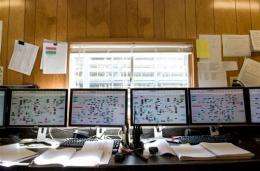
The control room at a power plant is pictured in this file photo. The new "smart meters" utilities are installing in homes around the world to reduce energy use raise fresh privacy issues because of the wealth of information about consumer habits they reveal, experts said Friday.
The new "smart meters" utilities are installing in homes around the world to reduce energy use raise fresh privacy issues because of the wealth of information about consumer habits they reveal, experts said Friday.
The devices send data on household energy consumption directly to utilities on a regular basis, allowing the firms to manage demand more efficiently and advise households when it is cheaper to turn on appliances.
But privacy experts gathered in Madrid for a three-day conference which wraps up Friday warned that the meters can also reveal intimate details about customers' habits such as when they eat, what time they go to sleep or how much television they watch.
With cars expected to be fuelled increasingly by electricity in the coming years, the new meters could soon be used to gather information on consumer behaviour beyond the home, they added.
"The collection and storage and retention of the data makes it vulnerable to security breaches as well as to government access," Christopher Wolf, the co-chairman and founder of the Washington-based Future of Privacy Forum, told AFP.
"It is really an issue of how much information about us can be collected by a third party, how much do they really need, how long do they need to keep it, what should the rules be on retention and when should destruction of it occur."
More than eight million "smart meters" have already been installed in the United States and the number is projected by the government to rise to 52 million by 2012.
Last month US President Barack Obama announced 3.4 billion dollars (2.3 billion euros) in grants to modernise the country's electricity grid, part of which will pay for about 18 million "smart meters."
The European Parliament passed an energy package in April which proposed that 80 percent of electricity consumers have "smart meters" by 2020.
In Italy 85 percent of homes already have smart meters installed, the highest penetration rate in Europe, according to the Future of Privacy Forum. France is second with a 25 percent penetration rate.
"This is certainly the next stage, the new frontier, in the potential for privacy invasion," Elias Quinn, a senior policy analyst at the Center for Energy and Environmental Security at the University of Colorado, told AFP.
"The potential is great for privacy invasion depending on who can have access to this information. We are kind of walking into 'smart meter' development blindly. There is no general informed consent."
Utilities could be tempted to sell the data on their customers' behaviour to marketers who use it to pitch advertising geared to their habits, said Quinn.
A restless sleeper who gets up frequently throughout the night -- identified by electricity consumption records that show he frequently turns on the lights -- could be targeted with adverts for sleep aids for example.
Insurance firms, meanwhile, could use the data to justify charging higher fees to a driver whose electricity consumption records indicate he often drives while sleep deprived or regularly gets home at around the time the bars close.
The utilities would be following the lead of Internet service providers which already gear online advertising based on the content of the Web page being viewed by their customers.
"The personal benefits of the 'smart meters' outweigh the risks. The real danger is that people do not know what the risks are," said Quinn, who recommends laws that restrict the resale of data as a way to prevent abuses.
(c) 2009 AFP
-
Google's PowerMeter Will Help Reduce Energy Consumption (Video)
Feb 10, 2009 |
not rated yet |
0
-
Google forms PowerMeter partnership
Oct 07, 2009 |
not rated yet |
0
-
Benefits of a 'smart' power grid in debated
Apr 29, 2009 |
not rated yet |
0
-
Security researchers offer caution on smart grids
Jul 31, 2009 |
not rated yet |
0
-
Obama unveils historic power grid reform
Oct 27, 2009 |
not rated yet |
0
-
Engineers build first sub-10-nm carbon nanotube transistor
Feb 01, 2012 |
4.9 / 5 (31) |
30
-
Something old, something new: Evolution and the structural divergence of duplicate genes
Jan 31, 2012 |
4.6 / 5 (7) |
1
-
The hidden nanoworld of ice crystals: Revealing the dynamic behavior of quasi-liquid layers
Jan 30, 2012 |
5 / 5 (3) |
1
-
Stock market network reveals investor clustering
Jan 27, 2012 |
3.9 / 5 (23) |
8
-
Of microchemistry and molecules: Electronic microfluidic device synthesizes biocompatible probes
Jan 26, 2012 |
5 / 5 (1) |
0
-
Help with thermal stress please
1 hour ago
-
Calling function with no input argument
5 hours ago
-
Force free body diagram problem on gym equipment
6 hours ago
-
Empirical data regarding shower heads and water
14 hours ago
-
feed hold button on CNC lathe
Feb 09, 2012
-
RFAC in Fortran
Feb 09, 2012
- More from Physics Forums - General Engineering
More news stories
CIA website offline, Anonymous takes credit
The website of the Central Intelligence Agency was unresponsive on Friday after the hacker group Anonymous claimed to have knocked it offline.
26 minutes ago |
5 / 5 (1) |
2
New error-correcting codes guarantee the fastest possible rate of data transmission
Error-correcting codes are one of the triumphs of the digital age. Theyre a way of encoding information so that it can be transmitted across a communication channel such as an optical fiber o ...
Technology / Computer Sciences
8 hours ago |
5 / 5 (3) |
4
|
Small modular reactor design could be a 'SUPERSTAR'
(PhysOrg.com) -- Though most of today's nuclear reactors are cooled by water, we've long known that there are alternatives; in fact, the world's first nuclear-powered electricity in 1951 came from a reactor ...
Technology / Energy & Green Tech
8 hours ago |
4.2 / 5 (10) |
17
|
New power source discovered
(PhysOrg.com) -- Researchers at the Massachusetts Institute of Technology (MIT) and RMIT University have made a breakthrough in energy storage and power generation.
Technology / Energy & Green Tech
7 hours ago |
5 / 5 (8) |
3
|
Advanced power-grid model finds low-cost, low-carbon future in West
(PhysOrg.com) -- The least expensive way for the Western U.S. to reduce greenhouse gas emissions enough to help prevent the worst consequences of global warming is to replace coal with renewable and other ...
Technology / Energy & Green Tech
8 hours ago |
5 / 5 (2) |
7
|
Complex wiring of the nervous system may rely on a just a handful of genes and proteins
Researchers at the Salk Institute have discovered a startling feature of early brain development that helps to explain how complex neuron wiring patterns are programmed using just a handful of critical genes. ...
Q&A: Obama and the birth control controversy
(AP) -- What birth control debate? A half-century after the introduction of the pill, acceptance of birth control by American women is virtually universal.
The power of estrogen -- male snakes attract other males
A new study has shown that boosting the estrogen levels of male garter snakes causes them to secrete the same pheromones that females use to attract suitors, and turned the males into just about the sexiest ...
Human cognitive performance suffers following natural disasters, researchers find
Not surprisingly, victims of a natural disaster can experience stress and anxiety, but a new study indicates that it might also cause them to make more errors - some serious - in their daily lives. In their upcoming Human Fa ...
Humans may have helped the decline of African rainforests 3000 years ago
(PhysOrg.com) -- Large areas of rainforests in Central Africa mysteriously disappeared over three thousand years ago, to be replaced by savannas. The prevailing theory has been that the cause was a change ...
Both maternal and paternal age linked to autism
Older maternal and paternal age are jointly associated with having a child with autism, according to a recently published study led by researchers at The University of Texas Health Science Center at Houston (UTHealth).
Nov 06, 2009
Rank: 1 / 5 (3)
Think about it.... :(
Nov 06, 2009
Rank: 2.3 / 5 (3)
Nov 06, 2009
Rank: 2.8 / 5 (4)
Nov 06, 2009
Rank: 2 / 5 (4)
Nov 06, 2009
Rank: 4.7 / 5 (3)
Wrong. If we give over control of our lives, then you have no right to say if they control you in a direction you don't want to go.
Nov 06, 2009
Rank: 5 / 5 (1)
But the same lack of privacy already exists with ISPs for internet surfing, cell phone providers for cell phone use and GPS systems etc.
I don't feel controlled by these companies. Do you?
Nov 06, 2009
Rank: not rated yet
You could still grow! You'd just have to limit yourself to a low powered light source and have fewer plants.
Maybe they don't but all the information they require is there for them if they want to start controlling us. What's stopping them from throttling net connections during peak useage times? Or closing popular side roads which avoid tolls? We might feel safe at the moment (are we?) but who's to say the next government in power will use this information as cautiously?
And just because there is a lack of privacy elsewhere, that's no reason to give up some other privacy. Lol what next? If they want to install cctv into every home for some "benficial" reason, would you be happy with it?
Nov 06, 2009
Rank: not rated yet
You can always make your own electricity.
Independence also has a price.
Nov 07, 2009
Rank: not rated yet
Nov 07, 2009
Rank: not rated yet
Nov 07, 2009
Rank: not rated yet
Its electricity. The work done in making electrical products do stuff. What in the world could anyone do with information on how much power you use on a daily basis, its not saying what products are using it.
Next you'd be saying scary big brother will do something if they monitored water usage. Wow they know when you have drank water!! Theyre out of control!!
Nov 07, 2009
Rank: not rated yet
Nov 22, 2009
Rank: not rated yet