The greening of Willis Tower: Rooftop gardens part of plan to improve efficiency
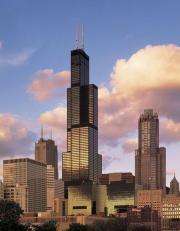
Growing up in the southwest suburbs, Sara Beardsley had a view of the Chicago skyline from her house. Today, she is transforming that skyline, but you won't find her work glorified on a $6 mug or gracing postcards.
Most of her impact is invisible as she attempts to reduce one of the largest carbon footprints in Chicago -- that of Willis Tower. Beardsley, a senior architect at Adrian Smith + Gordon Gill Architecture in Chicago, is managing a $200 million to $300 million project to "green" the tallest building in the Western Hemisphere.
The building was completed as Sears Tower in 1973, the heyday of energy ignorance, which means the skyscraper has single-pane windows that leak around the edges and let in hot air in summer and cold in winter, lights everywhere and inefficient electric heating throughout.
"Each old window is like a car driving around," Beardsley said. "And people don't think of it that way -- it's just a window. But I think maybe we need to start thinking about it that way."
Buildings account for about 70 percent of all Chicago emissions, according to the Chicago Climate Action Plan. If the largest 10 buildings in the Loop were targeted for greening projects, Beardsley said, it would reduce the energy needs of the Loop by more than 10 percent.
In particular, mid-century buildings can average as much as double the energy load of modern buildings and 10 times that of the newest, most energy-efficient buildings, she said. Willis Tower uses enough electricity each year to power 9,000 Chicago homes, despite changes over the years that have reduced the energy load to about 1.5 times a new office building.
With a building as enormous as Willis Tower, the floor space of which is equivalent to 16 city blocks, a change in the direction of the sun can mean that when the temperature outside is 5 degrees, air conditioning is being pumped into one part of the building because so much heat is being collected from the sunlight while the side in shadow is being heated. An experimental green roof (greenery planted on a roof to lower energy costs and offset water runoff) on the 90th floor required metal meshing to prevent sod and plants from blowing away.
"The scale of this is mind numbing," said Nathan Kipnis, principal of Nathan Kipnis Architects Inc., a firm specializing in green and sustainable architecture. Kipnis was one of several curious architects and engineers who attended a presentation about the project (held on the 99th floor) originally meant for city docents but later expanded because of interest from the architectural community.
On its face, Kipnis said, greening a building like Willis is like greening any other building -- you look at what goes in and what comes out. But the complicating factors are magnified and the issues are unique.
"Just think of what it takes just to get the food up here," he said.
Since her youth, Beardsley has been fascinated by the world's tallest buildings.
"The skyline was like a compass that always showed me where I was in the city," she said. "When I learned the streets and how to get around, I also learned it visually by looking at the buildings from different angles. But it is surreal to be actually working on the Sears building years later, after seeing it as a part of the iconic skyline as I was growing up."
When Beardsley visits Willis Tower, she sees structure, piping, interacting climates, the competition of forces. Two weeks away from maternity leave, she still frequents the building to check details from basement to ceiling. It's rare, she said, for an architect to actually get to see her design as it comes to fruition.
When she strolls onto the roof of the 90th floor, she doesn't talk about the view_she talks about the elevator decking, the pressure of the wind, the movement of the joints, the grooves that allow the window-washing equipment to move up and down the facade. When she watched "The Dark Knight," the thrill was the Chicago architecture scenes.
Beardsley considered structural engineering but landed at Illinois Institute of Technology's architectural program, and found her niche at the school's high-rise studios, where she was assigned to sketch downtown for inspiration.
She went on to work for Holabird & Root, designer of Soldier Field, collaborator on the designs for Tribune Tower and one of the oldest architectural firms in the city, as well as for Skidmore, Owings & Merrill, one of the largest architectural firms in the world. In her 12 years working at architectural firms, she has worked on buildings from Dubai, United Arab Emirates, to Chicago, including the new Trump International Hotel and Tower.
She joined Adrian Smith + Gordon Gill in 2007, one year after the firm was founded with five employees. Today the firm, which focuses on energy-efficient and sustainable architecture, has grown to more than 150 employees in Chicago and Dubai.
Beardsley has been traveling all over Chicago to present the greening project to everyone from university scholars to city docents, and her firm has been invited to present the project as far afield as China and South Korea. Willis Tower's owners originally approached Adrian Smith + Gordon Gill to design a zero-emissions hotel that is slated to stand about an alley's width from Willis Tower at the closest point. The architecture firm agreed to the project but also pitched the idea of first greening Willis Tower as a way to meet the energy needs of the proposed hotel "many, many times over." They expect to shore up Willis Tower's "skin" with new energy-efficient windows as soon as the last half of 2010. The hotel is still on the horizon.
So far, the only visible sign of what the owners hope to be an environmental model for the world is a pallet of dirt and sedum on the tower's 90th floor roof, the beginnings of a "green roof" so high that only mountain vegetation can grow there.
"As you can see, it's blooming," Beardsley said. "There are actually little lady bugs that come up there on the roof."
In design plans, the "green roof" project would be expanded to the building's multiple roofs, along with wind turbines and solar panels. But those rooftops would be more symbolic than anything else. The real energy savings will be culled from the 16,000 windows that will be replaced and from lighting automation and reduction.
The window project is estimated to be enough to cut heating needs by 50 percent and allow for new, smaller mechanical systems with a significantly lower environmental impact. A plumbing upgrade is expected to reduce water usage by 24 million gallons a year.
"It's enough to power hundreds of homes if you can just get people in Willis Tower to shut off their computers at night," Beardsley said.
All told, the project expects to reduce millions of pounds of carbon dioxide emissions, and while it is hard to calculate how that would affect the region, the idea is to inspire similar greening projects, Beardsley said, which would eventually lead to fewer coal plants needed to generate electricity for the grid.
The greening project is estimated to take 26 years to pay itself back and create jobs equivalent to that of a new 50-story building project, Beardsley said.
"It's no longer about building a building just for the prestige of building the tallest building in the world," said Charles Jackson, executive director of the Illinois Environmental Council in Springfield. "It's about 'How can we build the most sustainable building?' "
The council is awaiting word on half a million dollars in federal money that would help fund efforts to document the project, provide education to the tower's approximately 1.3 million visitors each year and advocate for further green building initiatives, he said.
For Willis' owners, the greening and modernization project, which follows a $22.5 million renovation, is part of a marketing strategy for the building, said Sundee Wislow, director of sustainability for U.S. Equities Realty, the management and leasing firm for the tower.
Willis Tower is seeking a combination of public and private financing for its greening project. Its owners are seeking private funding for the hotel. A spokeswoman for the building's owners, a real estate investment group, said funding is still being finalized and that she could not provide details.
"By the time it's done, the building won't really look that different," Beardsley said.
___
(c) 2009, Chicago Tribune.
Visit the Chicago Tribune on the Internet at www.chicagotribune.com/
Distributed by McClatchy-Tribune Information Services


