Past climate of the northern Antarctic Peninsular informs global warming debate
November 6, 2009
Past climate of the northern Antarctic Peninsular informs global warming debate

Enlarge

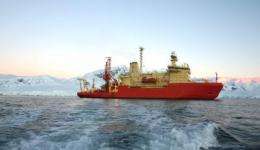
The American icebreaker RV/IB Nathanial B. Palmer is shown off the South Shetland Islands. The drilling rig is clearly seen on the rear deck. Credit: S. Bohaty

The seriousness of current global warming is underlined by a reconstruction of climate at Maxwell Bay in the South Shetland Islands of the Antarctic Peninsula over approximately the last 14,000 years, which appears to show that the current warming and widespread loss of glacial ice are unprecedented.

"At no time during the last 14 thousand years was there a period of warming and loss of ice as large and regionally synchronous as that we are now witnessing in the Antarctic Peninsula," says team member Dr Steve Bohaty of the National Oceanography Centre, Southampton (NOCS), home of the University of Southampton's School of Ocean and Earth Science (SOES)."

The findings are based on a detailed analysis of the thickest Holocene sediment core yet drilled in the Antarctic Peninsula. "By studying the climate history of the past and identifying causes of these changes, we are better placed to evaluate current climate change and its impacts in the Antarctic," says Dr Bohaty.

As part of a 2005 research cruise aboard the American icebreaker RV/IB Nathanial B. Palmer, the scientists drilled down through the sediments at Maxwell Bay, a fjord at the northwest tip of the Antarctic Peninsula. They drilled down as far as the bedrock, obtaining a nearly complete 108.3-metre .

Back in the lab, they performed a battery of detailed sedimentological and geochemical analyses on the core. Radiocarbon dating showed that the oldest sediments at the bottom of the core were deposited between 14.1 and 14.8 thousand years ago, and sedimentation rates at the site varied from 0.7 to around 30 milimetres a year through the Holocene; that is, the geological period that began around 11,700 years ago, continuing to the present.

They conclude that ice was grounded in the fjord during the Last - the height of the last ice age - and eroded older sediments from the fjord. Later, the grounded ice retreated, leaving a permanent floating ice canopy.

The evidence points to a period of rapid glacial retreat from 10.1 to 8.2 thousand years ago, followed by a period of reduced sea-ice cover and warm water conditions occurring between 8.2 and 5.9 thousand years ago. An important finding of the study is that the mid-Holocene warming interval does not appear to have occurred synchronously throughout the region, and its timing and duration was most likely influenced at different sites by local oceanographic controls, as well as physical geography.

Following the mid-Holocene warming interval, the climate gradually cooled over the next three thousand years or so, resulting in more extensive sea-ice cover in the bay. But the researchers find no evidence that the ice advanced in Maxwell Bay during the so-called Little Age in the sixteenth to mid-nineteenth century.

The area has warmed 3°C in the past five decades, with increased rainfall and a widespread retreat of glaciers. "Atmospheric warming trends linked to global are an obvious culprit for the observed regional climate changes," say the researchers.

More information: Milliken, K. T., et al. High-resolution Holocene climate record from Maxwell Bay, South Shetland Islands, Antarctica. Geological Society of America Bulletin 121, 1711-1725 (2009). http://gsabulletin … 1/11-12/1711

Source: National Oceanography Centre, Southampton

2.8 /5 (9 votes)  

Filter


Move the slider to adjust rank threshold, so that you can hide some of the comments.


Display comments: newest first

superhuman
Nov 07, 2009

Rank: 5 / 5 (1)
The seriousness of current global warming is underlined by a reconstruction of climate at Maxwell Bay in the South Shetland Islands of the Antarctic Peninsula over approximately the last 14,000 years, which appears to show that the current warming and widespread loss of glacial ice are unprecedented.

It says nothing about "seriousness of current global warming," those 14000 years cover exit from the last ice age it's hardly surprising there was no period as warm as present day climate, for that one has to look 120 000 years back:
http://www.exo.ne...res1.gif
Rank 2.8 /5 (9 votes)
Relevant PhysicsForums posts
  • Discrepancy between oxygen and carbon-dioxide levels
    created17 hours ago
  • where gems are found in the world
    created21 hours ago
  • Wind Waves in Reservoir ~ Wind run-up and Wind set-up
    createdFeb 08, 2012
  • Balance of oxygen in the atmosphere
    createdFeb 01, 2012
  • The case for a methanol-based economy
    createdJan 30, 2012
  • Weather in a rotating cylinder
    createdJan 25, 2012
  • More from Physics Forums - Earth

More news stories

Humans may have helped the decline of African rainforests 3000 years ago

(PhysOrg.com) -- Large areas of rainforests in Central Africa mysteriously disappeared over three thousand years ago, to be replaced by savannas. The prevailing theory has been that the cause was a change ...

Space & Earth / Environment

created 10 hours ago | popularity 5 / 5 (4) | comments 10 | with audio podcast report

Could Venus be shifting gear?

(PhysOrg.com) -- ESA’s Venus Express spacecraft has discovered that our cloud-covered neighbour spins a little slower than previously measured. Peering through the dense atmosphere in the infrared, the ...

Space & Earth / Space Exploration

created 6 hours ago | popularity 5 / 5 (5) | comments 7 | with audio podcast

Mars Science Laboratory computer issue resolved

(PhysOrg.com) -- Engineers have found the root cause of a computer reset that occurred two months ago on NASA's Mars Science Laboratory and have determined how to correct it.

Space & Earth / Space Exploration

created 7 hours ago | popularity 5 / 5 (5) | comments 3 | with audio podcast

Clam fields found at deep, low-temperature Mariana vents

(PhysOrg.com) -- Scientists have marveled at the unusual life forms thriving at high temperature hydrothermal vents of the deep ocean.

Space & Earth / Earth Sciences

created 7 hours ago | popularity not rated yet | comments 0 | with audio podcast

Two new moons for Jupiter

Advances in technology have lead to the discovery of new planets outside of our Solar System, and now even new moons in our own backyard.

Space & Earth / Space Exploration

created 6 hours ago | popularity not rated yet | comments 4


Complex wiring of the nervous system may rely on a just a handful of genes and proteins

Researchers at the Salk Institute have discovered a startling feature of early brain development that helps to explain how complex neuron wiring patterns are programmed using just a handful of critical genes. ...

The power of estrogen -- male snakes attract other males

A new study has shown that boosting the estrogen levels of male garter snakes causes them to secrete the same pheromones that females use to attract suitors, and turned the males into just about the sexiest ...

Human cognitive performance suffers following natural disasters, researchers find

Not surprisingly, victims of a natural disaster can experience stress and anxiety, but a new study indicates that it might also cause them to make more errors - some serious - in their daily lives. In their upcoming Human Fa ...

New error-correcting codes guarantee the fastest possible rate of data transmission

Error-correcting codes are one of the triumphs of the digital age. They’re a way of encoding information so that it can be transmitted across a communication channel — such as an optical fiber o ...

Both maternal and paternal age linked to autism

Older maternal and paternal age are jointly associated with having a child with autism, according to a recently published study led by researchers at The University of Texas Health Science Center at Houston (UTHealth).

Curry spice component may help slow prostate tumor growth

Curcumin, an active component of the Indian curry spice turmeric, may help slow down tumor growth in castration-resistant prostate cancer patients on androgen deprivation therapy (ADT), a study from researchers ...