Turn On, Tune In, Develop? Researchers Examine How Brain Benefits From Musical Training
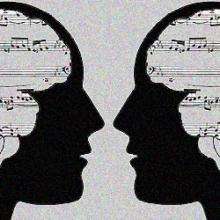
For most people music is an enjoyable, although momentary, form of entertainment. But for those who seriously practiced a musical instrument when they were young, perhaps when they played in a school orchestra or even a rock band, the musical experience can be something more. Recent research shows that a strong correlation exists between musical training for children and certain other mental abilities.
The research was discussed at a session at a recent gathering of acoustics experts in Austin, Texas.
Laurel Trainor, director of the Institute for Music and the Mind at McMaster University in West Hamilton, Ontario, and colleagues compared preschool children who had taken music lessons with those who did not. Those with some training showed larger brain responses on a number of sound recognition tests given to the children. Her research indicated that musical training appears to modify the brain's auditory cortex.
Can larger claims be made for the influence on the brain of musical training? Does training change thinking or cognition in general?
Trainor again says yes. Even a year or two of music training leads to enhanced levels of memory and attention when measured by the same type of tests that monitor electrical and magnetic impulses in the brain.
“We therefore hypothesize that musical training (but not necessarily passive listening to music) affects attention and memory, which provides a mechanism whereby musical training might lead to better learning across a number of domains," Trainor said.
Trainor suggested that the reason for this is that the motor and listening skills needed to play an instrument in concert with other people appears to heavily involve attention, memory and the ability to inhibit actions. Merely listening passively to music to Mozart -- or any other composer -- does not produce the same changes in attention and memory.
Harvard University researcher Gottfried Schlaug has also studied the cognitive effects of musical training. Schlaug and his colleagues found a correlation between early-childhood training in music and enhanced motor and auditory skills as well as improvements in verbal ability and nonverbal reasoning.
The scientists also discovered that different instruments appear to cause a varying modification within the brain. Changes in the brains of singers occur in slightly different locations than those seen for keyboard or string players.
The correlation between music training and language development is even more striking for dyslexic children.
"[The findings] suggest that a music intervention that strengthens the basic auditory music perception skills of children with dyslexia may also remediate some of their language deficits." Schlaug said.
Schlaug reports that tone-deaf individuals often have a reduced or absent arcuate fasciculus, a fiber tract connecting the frontal and temporal lobes in the brain. Reduced or damaged arcuate fasciculus has been associated with various acquired language problems like aphasia and also dyslexia in children.
Still more evidence that formal music training strengthens auditory cortex responses came in a study performed by Antoine Shahin, now at Ohio State University in Columbus, Ohio. Shahin believes that musical training gives an individual the acoustic responsiveness of a child some 2 - 3 years older. In talking about the affect of music on the brain, he said the studies do not necessarily show that musical training leads to enhanced IQ or creativity.
Can larger claims be made for the influence on the brain of musical training? Does training change thinking or cognition in general?
Trainor again says yes. Even a year or two of music training leads to enhanced levels of memory and attention when measured by the same type of tests that monitor electrical and magnetic impulses in the brain.
“We therefore hypothesize that musical training (but not necessarily passive listening to music) affects attention and memory, which provides a mechanism whereby musical training might lead to better learning across a number of domains," Trainor said.
Trainor suggested that the reason for this is that the motor and listening skills needed to play an instrument in concert with other people appears to heavily involve attention, memory and the ability to inhibit actions. Merely listening passively to music to Mozart -- or any other composer -- does not produce the same changes in attention and memory.
Harvard University researcher Gottfried Schlaug has also studied the cognitive effects of musical training. Schlaug and his colleagues found a correlation between early-childhood training in music and enhanced motor and auditory skills as well as improvements in verbal ability and nonverbal reasoning.
The scientists also discovered that different instruments appear to cause a varying modification within the brain. Changes in the brains of singers occur in slightly different locations than those seen for keyboard or string players.
The correlation between music training and language development is even more striking for dyslexic children.
"[The findings] suggest that a music intervention that strengthens the basic auditory music perception skills of children with dyslexia may also remediate some of their language deficits." Schlaug said.
Schlaug reports that tone-deaf individuals often have a reduced or absent arcuate fasciculus, a fiber tract connecting the frontal and temporal lobes in the brain. Reduced or damaged arcuate fasciculus has been associated with various acquired language problems like aphasia and also dyslexia in children.
Still more evidence that formal music training strengthens auditory cortex responses came in a study performed by Antoine Shahin, now at Ohio State University in Columbus, Ohio. Shahin believes that musical training gives an individual the acoustic responsiveness of a child some 2 - 3 years older. In talking about the affect of music on the brain, he said the studies do not necessarily show that musical training leads to enhanced IQ or creativity.
Shahin said that when a person listens to sounds over and over, especially for something as harmonic or meaningful as music and speech, the appropriate neurons get reinforced in responding preferentially to those sounds compared to other sounds. This neural behavior was examined in a study that looked at the degree of auditory cortex responsiveness to music and non-familiar sounds as a child ages.
Shahin's main findings are that the changes triggered by listening to musical sound increases with age and the greatest increase occur between age 10 and 13. This most likely indicates this as being a sensitive period for music and speech acquisition.
Glenn Schellenberg from the University of Toronto directly addressed if musical ability makes a person smarter. Such assessments concerning children are always difficult because of the influence of other factors, such as parental income and education. Nevertheless, he found that passive listening to music seems to help a person perform certain cognitive tests, at least in the short run. Actual music lessons for kids, however, leads to a longer lasting cognitive success.
The effects of musical training on cognition for adults, Schellenberg said, are harder to pin down.
Source: Inside Science News Service, By Phillip F. Schewe