Kepler Mission Update
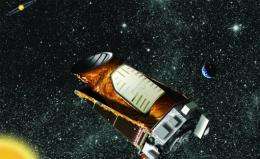
(PhysOrg.com) -- Kepler completed another science data download over October 18-19. In this download, a month's worth of science data was transmitted through the NASA Deep Space Network and into the Science Operations Center at Ames Research Center. After the download was complete, the Kepler spacecraft was returned to its science collection attitude and another cycle of science data collection began.
While the Kepler spacecraft continues in its orbit, and collecting science data, the Kepler team at the Ames Research Center continues its work on the science data processing pipeline software. Their work has allowed for the publication of Kepler’s first science discovery, the occultation associated with previously discovered transiting exoplanet HAT-P7-B. This discovery showed the precision of the Kepler instrument and its ability to detect signals whose sizes are consistent with the transit of an Earth-size planet.
Additionally, results from data taken since operations began on May 12 have allowed the Kepler Science Team to select a number of planetary candidates for follow-up observation and potential confirmation. It is expected that confirmation of a number of planets will be announced by NASA in conjunction with the January 2010 American Astronomical Society (AAS) meeting in Washington DC.
Finding Earth-size planets requires detecting very faint transit signals against the inherent background noise of the measurements. Kepler noise sources come in three broad categories: stellar variability, random noise, and systematic noise.
Stellar variability is the natural fluctuation in the brightness of the stars themselves. Some stars are much more variable than others, and so the Kepler team must examine the light curves and determine which stars are suitably quiet for finding planets. Stars that are too noisy can be replaced on the target list by other stars from the input catalog.
Random noise is present in all measurements and cannot be calibrated out. Therefore, strict requirements were placed on the design of Kepler’s spacecraft systems to limit random noise to a low level. Measurements taken in space confirm that Kepler meets its random noise requirements.
Systematic noise results from the imperfect nature of any measuring device. It represents the instrument’s “finger print” placed upon the measurement, and must be calibrated out of the data in post-processing on the ground. Because systematic noise depends on the specific characteristics of the instrument, the best calibration requires that the noise sources be characterized and modeled based on measurements made in space. The Kepler team has been developing the ground software to calibrate out the various systematic noise sources since launch, and this work will continue for a number of months. As each source of systematic noise is calibrated, fainter transit signals can be detected. Data collected from the spacecraft will be continually reprocessed as the ground software matures, revealing smaller and smaller planets. This is a normal process and has been part of the Kepler plan since before launch. Fortunately for Kepler, the worst sources of systematic noise affect only a small portion of the field of view, so the majority of the field of view will be calibrated earlier, enabling small planets to be detected sooner.
Detecting planets requires at least three transits, which occur only once per orbit. For Earth-like planets orbiting in the habitable zones of sun-like stars it will take three to four years to collect three transits, and so these discoveries are several years in the future. The habitable zones around stars smaller than our sun involve shorter period orbits, so it is likely that Earth-size planets will be found around such low mass stars sooner.
While operations of the Kepler spacecraft continue, the Kepler Science Team is preparing for the January AAS meeting a number of papers and presentations on Kepler and its early results. Also in January, special issues of both Science Magazine and the Astrophysical Journal will publish 3 overview papers in the former and several papers discussing technical aspects of the Mission in the latter journal. As the AAS draws closer, the Kepler project is delighted to report that some of Kepler’s data is closer to being made public. Data collected by the Kepler Mission during commissioning, and during the first six weeks of the science operations, have now been processed and sent to the archive at the Space Telescope Science Institute in Baltimore, MD. From there the data will be available to the Science Team members for their continued investigations. This early data will be released to the public in June 2010.
Provided by JPL/NASA (news : web)


