In a Galaxy Far, Far Away...
November 6, 2009
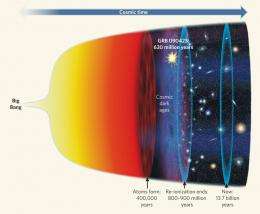
After the big bang, the universe cools rapidly while expanding. This schematic shows the probable location of the most distant object ever found, a gamma ray burst that occurred about 630 million years after the big bang. Credit: Nature, as adapted from Bennett et al. 2005
(PhysOrg.com) -- Astronomers have published the discovery of the farthest known object in the cosmos: a star that exploded when the universe was only 630 million years old -- only 4.6% of its current age. Light from this cataclysm had been traveling towards us for about 13 billion years, finally arriving here last April 23.
It was spotted only because the dying star was bright -- it emitted as much energy in its final moments as the sun emits in about a billion years of life -- and of course because astronomers had been searching for just such activity.
The explosion was from a gamma ray burst (GRB). The brightest events in the known universe, GRBs occur about once a day, randomly, from around the sky; most of them shine for minutes -- relatively short times -- and are found in the midst of galaxies. They are thought to be produced in extreme kinds of supernovae, the explosive deaths of massive stars. Scientists study GRBs not only to understand the nature of these dramatic explosions and the final moments of a giant star's life, but also because GRBs are cosmic beacons that can be seen from very far away.
CfA astronomer Edo Berger is a member of a large team of international scientists who report in this week's Nature on the discovery of the most distant GRB -- and the most distant object of any kind -- that is known. The burst itself was spotted by NASA's Swift satellite, a mission designed specifically to find these fleeting events and to facilitate quick follow-up observations. The team then used five ground-based telescopes with different instruments to stare at the precise location in the sky where the GRB occurred, hoping to detect the aftermath of the explosion. They found nothing in the optical, but they were able to detect a glow at several infrared wavelengths. Such a very red color is characteristic of an object at cosmological distances, and the team's measurements were sufficiently precise that they could locate it, with a formal uncertainty of less than one percent, to a time when the universe was very young.
The results are exciting because they extend our direct knowledge of the early cosmos back into an era that otherwise is rather mysterious. It is not known, for example, whether stars at these early epochs would even produce conventional GRBs or supernovae; they might instead be so unlike stars in our current environment, lacking in many of the chemical elements that were produced over eons of time, that their properties would be strange. The new paper, besides describing the discovery, presents evidence to tentatively suggest that at least this particular star and its dramatic demise do seem to resemble cases found in the more familiar, local universe.
More information: Blast from the Past Gives Clues About Early Universe
Provided by Harvard-Smithsonian Center for Astrophysics (news : web)


"The new paper, besides describing the discovery, presents evidence to tentatively suggest that at least this particular star and its dramatic demise do seem to resemble cases found in the more familiar, local universe."
Could it just be that the universe is the same today as it was yesterday and the observed red-shift is just an optical illusion?
Ethelred
If you can offer a sound procedure which produces this kind of illusion people will discuss your idea.
http://www.scribd...-Physics
Still it is hard to contain myself. The Crankery is stunning. I have never seen anything on this site before that was quite so out of touch.
You actually say:
Which shows that you simply have no clue about heat. None whatsoever.
Heat is NOT contained it particles. It is the KINETIC energy of particles. That is movement of particles. Yet you wrote that as if the movement and heat of particles were two completely separate things.
My jaw dropped on that one.
Yes, my first pass was even less tolerant.
Please take a physics class.
http://en.wikiped...iki/Heat
Ethelred
41 pages of text to explain all four fundamental forces without one single mathematical formula. Gravity is explained by
I'm impressed.
But particles with mass (atoms in this case) can store heat internally in the form of electron energy levels.
And no. Atoms cannot store heat as energy levels. Its not heat under those conditions. Its just energy levels.
If it is not moving particles then it isn't actual heat. It is true that light is often measured in temperature but it is the temperature of the source of the light.
And you are full of it on Plank's Constant as well. And that was after you discussed it only with someone that ran the numbers for you. Numbers you clearly didn't understand.
http://en.allexpe...nd-2.htm
Yes I did a search. You refused to listen or believe evidence as you clearly still think the same way.
It is typical of a Crank to refuse to change his theory when they find evidence to the contrary.
If the theory doesn't fit the evidence then the theory is wrong.
Do yourself a favor. Take some science classes. Don't waste any more money on Vanity Press publications.
Ethelred
"Frequency is directly related to the length of a man-made unit of time, the second. If the length of a second is changed, the momentum and energy a photon contains changes also. This is because there are now more or fewer waves in each second, and this changes the momentum and energy of the photon.All of our arbitrary units of measurement must be measured and conform to the basic units of nature. So how can a photon be a naturally occurring particle? The momentum and energy of a photon conforms to the number of waves in a man-made second. The odds are astronomically against the momentum and energy of a photon of light being exactly equal to the length of a man-made unit of time. If this is true, then a photon cannot be a naturally occurring particle and can only be useful as an energy and momentum measurement of EMR, similar to a foot-pound or watt and other measurements."
It sure speaks for itself doesn't it. Funny how we both saw it. I was skimming and skipping but that one stuck in my head.
You need tenacity to read much of that. I only looked at about ten percent. None of it made sense.
The Standard Model feels clunky to me but it does fit the evidence. MOST of the time. It has those mass problems. It predicts a high mass for vacuum due to virtual particles. I want the LHC to get back to work and find something NEW.
From Not Even Wrong:
http://www.math.c...rdpress/
Next weekend (Nov. 7-8): Second injection test. If sector 67 is ready, beam will travel through this sector (and possibly even through sector 56) as well as the two (sectors 23 and 78) tested during the first injection test.
November 20th: First attempt to circulate beams at the injection energy of 450 GeV
Early December: Collisions at 450 GeV
No more birds please.
http://user.web.c...06b.html
Ethelred
I deliberately choose custard pudding analogy because of its nonlinear resistancecoefficient, slow moving object can pass through it without much resistance, but faster (read high energy particles) will feel its resistance more
Photons don't have any sign of traveling at different speeds dependent on there energy levels. Indeed that is what the gamma ray bursts seem to be confirming. At the least the observation shows that any such differences are very small.
http://www.physor...994.html
As I think about this more IF photons push back on then the increasing number of photons in space could be a if not THE source of the possible acceleration of the expansion of the Universe.
I feel like a Crank saying that.
But it seems to me that if the expansion of Space-Time causes redshift it MUST also be taking energy from the photons as redshift IS a decrease in the energy of the photons. That energy MUST go somewhere.
Ethelred
It will do so, because added space will be the same as current space therefore more space equals more expansion all the time.
This will mean that the universe will be expanding at an ever increasing rate since it started. A constant acceleration if you will. Unless other alternate things are happening at the same time. If there is any form of intrinsic increase in the rate of space creation then the universe will expand at an ever increasing rate of acceleration. In such a case the rate of increase will increase over time as well.
To clarify just in case I was not clear. I would only need to remind everyone of the effect of compound interest. If you think of space as it stands right now as your account balance. Then we think of space expansion as your interest on your investment. We are never making any withdrawals therefore we are earning interest on our interest.
If I my idea and the idea of Dark Energy are wrong then there COULD be enough mass in the Universe to slow down the rate of expansion over time. However the amount of mass, both visible and implied, seems insufficient.
Just adding space doesn't remove gravity. It was thought that space was expanding only from momentum due to the Big Bang. This does not fit the new evidence the rate of expansion is increasing.
Ethelred
We live in extremely interesting times. Observations which increasingly don't fit into respected old theories. A GR which fails on small scales. A particle physics model which fails to integrate gravity. The unsolved hierarchy problem. And the remedy of choice: entia multiplicanda (yes, William of Ockham) - inflation, dark matter, dark energy. Where are the theories that give falsifiable predictions about these entities?
Einstein needs a successor.
Handwaving again. Tired light does not fit the evidence in any case. Especially since it is mostly used by those that try to make the evidence for the expansion of the Universe just go away.
I am perfectly sure that Questions theory is a complete crock.
I know you have no numbers so your ideas cannot be tested. I have pointed that out before. You do not have a theory until you have testable NUMBERS.
Then they aren't theories. They are hypothesis at best. When you have one please let us know.
Ethelred
From Aether theory follows, universe is infinitely old - and infinity is a number as well. It means, we will find well developed, evolving objects even at the farthest observable distance behind Hubble Deep Field. Such prediction can be tested perfectly.
The problem is, we have all indicia available already for many years. Scientists never considered dispersion of light by microwave background seriously. They know about it from 1964 - and what? Did they change their theories about light spreading through vacuum in some corresponding way? No way...
http://en.wikiped...adiation
Generally, in science, a theory is a hypothesis that has passed at least some tests and therefor is no longer considered a mere hypothesis.
Without numbers all you have is a wild assed guess because there is no possible test that has any meaning at all. Something doesn't fit and you engaged in wild hand-waving involving gravitationally bound photos as you did on the gamma ray thread.Quarter, half, full. Those are numbers.Then the Aether WAG is wrong. The Universe is NOT infinitely old. This explains why you pretend that redshift isn't real.So another failure of your theory because we DON'T find that. Indeed we find poorly developed messy looking things in the Deep Field photos.
Ethelred
http://en.wikiped...ed_light
No tired light hypothesis fits all the data.Because it doesn't work. It would cause blurring. Covered on the Wiki above.
And there is nothing on your link that claims the Cosmic microwave background radiation would cause dispersion so I don't even know why you posted that. It doesn't help you in any way.
Just posting a link to something you CLAIM could cause tired light doesn't help if the Link doesn't have a word to support your claim. You do that sort thing a lot.
Is this going to be another of your marathon hand waving sessions with no evidence and the usual links that don't have a thing to do with what you claim they do? Stonewalling like this won't change reality.
However I would like to congratulate on you vastly improved English. Writing a lot improved mine considerably as well.
Ethelred
How do you comment HUDF-JD2?
http://www.astron...;id=3527
This article and the comments which follow are a perfect example - we're speaking about things that science hardly comprehends and yet the braggarts abound with sweeping criticisms.
A bit of humility is always becoming to physics. This is also the heart of its progress.
It's unfortunate, it really makes discussion pointless.
http://www.physor...994.html
In general, metamaterial is basically kind of foam, in which positive and negative curvatures are (nearly) balanced. Observers are choosing such structure of vacuum automatically by observation at large distance, because just this structure remains the least dispersive environment possible.
Don't be naive - this may even be a hidden intention of some individuals here.
Indeed, dense Aether model doesn't rely on interpretation of Big Bang as it has many other predictions & consequences.
The situation of hypothetical observer at water surface or inside of vacuum is analogous to observer of landscape under haze. At distance remote objects will remain always covered by haze, but at proximity they become transparent clear and visible. The experience of distant observer will be exactly as opposite: he would see us in early evolving Universe, while galaxies in his proximity would appear well developed and similar to Milky Way.
Basically it's an extension of famous Copernican principle. At the first glance, this model is indistinguishable from Big Bang theory.
Its covers too few pixels to tell a lot about its shape. Most of the information was from analyzing the light at different frequencies despite there not being enough light to get a spectrum.
Ethelred
Would you, for instance give us a clue as to just what Specifically set off the hostilities.
Don't like the idea of the Big Bang?
Perhaps the age of the Universe offends you?
Maybe you didn't like me pointing out that Questions ideas are totally without physical foundation.
Perhaps you just don't like not knowing as much as others.
Or perhaps you would actually like to discuss things now that you have blown off steam.
It is possible to discuss things politely. To be specific about what is annoying you. To contribute knowledge that others may not have. Perhaps you simply aren't aware of how the information was obtained. How much work and effort was put into it.
Based on some of your other posts you seem to have some problems with science where it may conflict with you preconceptions about how things work in the Universe.
Ethelred
You didn't read the link. It would cause MORE blurring than is the case.
Ethelred
http://cerncourie...rn/29486
We can observe similar situation between primary and secondary rainbows during heavy rain: light is absorbed here - but not dispersed. The trick is, such light is moving in lowest possible speed - which enables us to see space-time foam as huge, as possible, but still quite non-dispersive.
Are you sure about it?
Elliptical galaxies are usually these older ones. It's logical, because tidal forces between stars are destroying flatness of young galaxy gradually.
Compare the Wikipedia article "Most elliptical galaxies are composed of older, low-mass stars"...
http://en.wikiped...l_galaxy
Of course, if you believe, elliptical galaxies are these young ones, you'll get exactly opposite conclusion - but I don't think, your opinion is argument backed.
1. The universe is at least 6 - 7 billion years older than the current 14-15 billion estimate.
2. There may have been no "Big Bang" because the law of "Conservation of Energy" extant in the universe we can observe cannot operate in a "boundless" universe, it must be "closed". Because "conservation of energy" can operate only in a closed space, all objects in that confined space react in reaction to the movements of one another, in other words everything in the finite universe is orbiting something else and when they fail to do so "conservation of energy" dictates they must "collide". This is the reason galaxies collide, they cross orbit one with one another & "conservation of energy" is applied.
This is a place to exchange arguments. This is no championship where we count the number of repetitions.
So then you should be willing to elucidate how the "law of conservation of energy" can be applied to the "brane-string concept" of your inherently leaky universe? For the "brane-string" to operate, enrgy must leak over into 5-8 dimensions of a "universal constant" of some sort, which will require the destruction of energy in the universe we observe. Tell me why this wouldn't happen?
How do you know it doesn't happen?
No. I'm not hypothesizing any cosmological model - I'm favouring certain models. I'm not here to do missionary work. If you think there's something wrong with those models, fine.
You seem to be emotionally challenged ("brane-iac"); I just don't know whether it's due to the models or due to mentioning them.
A favorite sport here. The key to defending yourself against such dubious arguments is to notice when they occur and to not defend a position that you didn't take. Plus of course mentioning the oppositions tendency to go through enough straw to feed the abattoirs of Chicago.
Ethelred