Think twice before you boo your competitor
(PhysOrg.com) -- Next time you watch a heavy weight lifting tournament, tell the person next to you not to boo the person that he doesn't want to win.
A study recently published shows that modifying someone’s arousal level can influence their force production. Arousal refers to a physiological or psychological state of excitability, which in this study was enhanced by eliciting either negative or positive moods.
The research was led by Liane Schmidt and Mathias Pessiglione and aimed to investigate if motivation to exert vigour can be changed by changing the person’s mood.
The study was inspired by major sporting events such as the Olympics, where cheering spectators and cameras follow the athlete’s performance closely. Activities such as the ones involving physical force (e.g., heavy weight-lifting) can be influenced by particular surrounding environment.
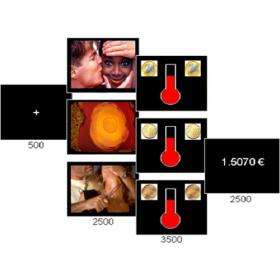
The research team asked if having a positive, neutral, or negative mood changes maximal force production. During the investigation, participants were asked to squeeze a hand device as hard as they could to mimic the challenge of a
heavy weight-lifting competition.
To change their mood, participants were presented with emotional and neutral pictures taken from a widely validated database of images, the International Affective Picture System (IAPS; Lang, Bradley & Cuthbert, 2005). These pictures were presented for several seconds right before participants voluntarily produced their maximal force. The images were either negative (a picture of a gun), neutral (a picture of a piece of furniture), or positive (a picture of a baby smiling). Presenting pictures in this manner is a robust way of eliciting mood changes.
The authors found that seeing an emotional picture boosted force production when compared to seeing a neutral picture. Unexpectedly, however, seeing a negative image, and hence being in a temporarily more negative mood, boosted force in a similar way as a positive mood.
In addition, the researchers also identified a brain region in the frontal cortex called the ventrolateral prefrontal cortex (VLPFC) that is sensitive to the arousal level (negative and positive emotionality) of the images.
To convince the readers further that this effect is unique to arousal, the authors also showed that the signal in the VLPFC significantly explained the variability of the activity in the motor cortex that was directly responsible for the production of force.
It is not yet established what the VLPFC does specifically, as the region responds to both emotional and non-emotional information (Lévesque et al., 2003; Hampshire & Owen, 2006). Nevertheless, the researchers clearly illustrate behavioural and
neural influences of arousal on force production.
The results have several implications in the field of sports psychology. First, this goes against the long tradition in sport psychology, as well as against common sense, which states that athletes should maintain positive thoughts (including mood) before going into a competition.
The study showed that what matters in sports where a sudden production of force is what counts is not whether an athlete is in a positive mood, but how aroused he is.
More importantly, the findings may be incompatible with sports psychological training programs for athletes that emphasise focused concentration. For example, if you’re an athlete, your sport psychologist would train you to have specific body routines
before you start a performance (such as breathe three times, straighten up body, and go) and to practise certain imagery minutes before a competition.
Both techniques involve maintaining a low-to-moderate level of excitability, and are specifically intended to narrow down your attention to facilitate full concentration. This has been thought to improve sporting prowess. The recent findings have shown otherwise, such that by simply increasing excitability, one could enhance maximal hand force.
It will be interesting to determine whether it is possible to find an optimal range of arousal levels that maintain concentration as well as enhance force performance. There is clearly scope for future work.
Note that factors influencing performance in other sports could involve different sensory-motor mechanisms and may receive different effects of heightened arousal than that examined in this study.
For example, a tennis match involves a sequential chain of small wins and losses that build up into the final match outcome. This will give rise to a different set of motivational mechanisms to improve performance which may interact with how excitable an athlete is. In this case, simply boosting one’s alertness may not necessarily improve their racket movement and swing timing.
In summary, the research team led by Mathias Pessiglione showed that heightened arousal increases motivation to exert vigour, in the form of actual force production. The data gives insights into the motivational mechanisms involved in athletic performance, specifically in sports where physical force production is paramount.
More information:
• Hampshire, A. & A.M Owen, ‘Fractioning attentional control using event-related fMRI’, Cerebral Cortex, 16 (2006), 1679- 1689.
• Lang, P., M.M. Bradley, & B. N. Cuthbert, ‘International affective picture system (IAPS): technical manual and affective ratings’, in National Institute of Mental Health Center for the Study of Emotion and Attention. Gainesville, FL: University of Florida, 2005.
• Lévesque J., F. Eugčne, Y. Joanette, V. Paquette, B. Mensour, G. Beaudoin, J.M. Leroux, P. Bourgouin, & M. Beauregard, ‘Neural circuitry underlying voluntary suppression of sadness’, Biological Psychiatry (2003), 53, 502- 510.
• Schmidt, L., M. L. Cléry-Melin, G. Lafargue, R. Valabrčgue, P. Fossati, B. Dubois, & M. Pessiglione, ‘Get aroused and be stronger: emotional facilitation of physical effort in the human brain’, Journal of Neuroscience, 29 (2009), 9450- 9457
Provided by University College London (news : web)


