eStadium application brings multimedia sports features to smartphones
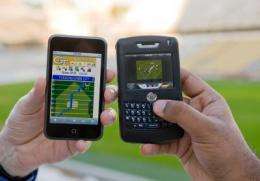
The intimate and spirited quarters of a stadium offer perhaps the most ideal venues to experience an athletic event. Or do they?
No instant replays. On-screen statistics are confined to the JumboTron. Sharing excitement and opinions on the game is often limited to chatting with surrounding strangers.
Yet these amenities, once reserved for the comfort of your living-room couch, will soon be tailored for experience in the stadium via your smartphone.
Professor Ed Coyle, director of the Arbutus Center for the Integration of Research and Education, is unveiling a new application that allows fans sitting in the stands of an athletic event to access video replays, up-to-the-second statistics, player bios, play-by-play analysis and a wealth of other information designed to enhance the thrill of the game.
eStadium debuts on November 7.
Dubbed "eStadium," the application first began as a project in 2001 when Coyle was on the faculty at Purdue University. Personal Digital Assistants (PDA), the precursor to the contemporary smartphone, were still a rare breed at the time and the potential for usage was limited.
Now, with iPhones, Blackberrys and other intelligent devices lining the pockets of millions - and bandwidth evolving to support dense information delivery - the time is ideal to unveil eStadium to Georgia Tech fans hungry for details about the game they're viewing from the stands.
The goal is to go live with the Georgia Tech eStadium at the Wake Forest University-Tech football game on November 7.
"Even if you're in the stands, sometimes you can't figure out what just happened," Coyle said. "This allows you to look at a play as many times as you want."
In addition to the background information and video access, Coyle strongly hints that such future features as user commentary and social networking will allow users to post their thoughts and even find fellow fans in the stands, including former classmates.
"We can develop anything anyone asks us to develop," he said.
The eStadium project has evolved into a joint project with Purdue and is supported by a National Science Foundation (NSF) grant along with a gift from Texas Instruments. Purdue's version of the eStadium has been live since 2003.
Georgia Tech's app, though, will be a far snazzier and detailed presentation.
"This is our phase-one deployment," Coyle said. "Phase two will include more wireless (access) in the stadium and a sensor network that will be able to monitor lines at concession stands and outside restrooms."
Coyle recruited a group of 28 students to help complete the project. Four of these students have been in the announcer's booth during games compiling video, statistics and other information for the mobile site. Access is restricted in certain ways: only those present in the stadium can view video, and 3G networks could possibly get bogged down when many fans clamor for a connection. Plans are under way to add Wi-Fi capabilities and employ 4G networks to ensure the experience is smooth.
"You need a code to watch video, and that will be shared with the people in the stadium," Coyle said.
eStadium will be live for both the November 7 game and the highly anticipated University of Georgia game on November 28. There is also a strong possibility the application will be employed during spring basketball season.
"Eventually, we should be able to do something like this for any sporting event," Coyle said. "Each sport has its own pace, so we'll try to customize it for each."
Coyle and his team have been working closely with Georgia Tech Athletics for more than a year to develop and refine the eStadium. The partnership has been encouraging for all parties.
"I think this is a really fascinating collaboration between athletics and academics," said Wayne Hogan, associate athletic director for Georgia Tech. "These students are bright and we like having them around. It's been a great relationship and something we think will be really well-received by our fans."
Once live, the site will be accessible from any Internet-enabled device, but the eStadium team is also tailoring it for one of today's most popular devices. The iPhone, he said, offers the best user experience, so plans are under way for an app version for that platform.
"This is just the beginning," he said. "The sky's the limit."
Source: Georgia Institute of Technology


