Seattle team wins $900,000 in Space Elevator Games
November 7, 2009 By JOHN ANTCZAK , Associated Press Writer Seattle team wins $900,000 in Space Elevator Games (AP)

Enlarge

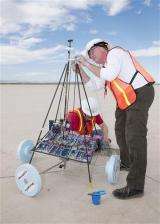
This handout photo from NASA shows David Bashford, right, lead of the LaserMotive team, preparing their robotic climber entry in the $2 million Space Elevator Games at the NASA Dryden Flight Research Center at Edwards Air Force Base, Calif., Wednesday, Nov. 4, 2009. After three years without a winner in a NASA-backed competition to develop the science fiction space elevator concept, the team from Seattle on Friday, Nov. 6, 2009 collected $900,000 after its laser-powered robotic machine raced up more than 2,950 feet (nearly 1 kilometer) of cable dangling from a helicopter. (AP Photo/NASA, Tom Tschida)

(AP) -- A Seattle team has collected a $900,000 prize in a NASA-backed competition to develop the concept of an elevator to space - an idea spurred by science fiction novels.

The team's raced up more than 2,950 feet of cable dangling from a helicopter.

Powered by a ground-based laser pointed up at the robot's photo voltaic cells that converted the light into electricity, the LaserMotive machine completed one of its climbs in about three minutes and 48 seconds, good for second-place money.

The contest is intended to encourage development of a theory that originated in the 1960s and was popularized by Arthur C. Clarke's 1979 novel "The Fountains of Paradise."

Space elevators are envisioned as a way to reach space without the risk and expense of rockets.

Instead, electrically powered vehicles would run up and down a cable anchored to a ground structure and extending thousands of miles up to a mass in geosynchronous orbit - the kind of orbit communications satellites are placed in to stay over a fixed spot on the Earth.

LaserMotive LLC was presented the check by Andy Petro, program manager of NASA's Centennial Challenges, in a ceremony at Dryden Flight Research Facility on Edwards Air Force Base in the Mojave Desert.

The three-day contest required competitors' vehicles to get to the top, with rewards possible for completing climbs at two levels of speed. LaserMotive could have claimed $2 million if its robot had climbed faster.

The two other teams, KC Space Pirates of Kansas City, Mo., and the University of Saskatchewan's Space Design Team, finished out of the money. Neither of their machines made it to the top.

The fourth Games addressed a baby step in the engineering challenging of the concept, not the larger debates of whether physics, materials technology and economics would ever allow one to be built.

"I think it was an ideal Centennial Challenges competition," Petro said in a telephone interview. "We had students, entrepreneurs and independent inventors. It's a very difficult challenge. It's taken the teams four years for anyone to win."

Thomas Nugent, one of the principals of LaserMotive, said the company believed the contest would demonstrate the concept of "power beaming" - transmitting energy by laser over long distances.

Nugent said there are numerous immediate applications such as providing power to remote areas of military bases or operating electrically powered unmanned aircraft for extended periods.

Nugent said he personally doesn't believe a space elevator would work on Earth but may be practical for the moon or Mars.

"It took a lot of years of hard work by just a great team of people who have understanding families," he said.

---

On the Net:

Success in 'space elevator' competition
• NASA Dryden: http://www.nasa.gov/centers/dryden/home/index.html
• Climb videos: http://www.youtube.com/user/SpacewardFoundation

©2009 The Associated Press. All rights reserved. This material may not be published, broadcast, rewritten or redistributed.


print this article email this article download pdf blog this article bookmark this article     Stumble it Digg this share on Facebook retweet share on Reddit add to delicious
Rate this story - 4.5 /5 (17 votes)

Rank Filter

Move the slider to adjust rank threshold, so that you can hide some of the comments.


Display comments: newest first

  • Buyck - Nov 07, 2009
    • Rank: not rated yet
    It was a good competition. I hope by two years we can reach 10 kilometers or more! Lets hope they will improve the technology a lot to make it happen.
  • Temple - Nov 07, 2009
    • Rank: not rated yet
    Space elevator theory does not include placing a mass in geosynchronous orbit. That would degrade and destroy the elevator.

    Instead the mass is to be placed *beyond* geosynchronous orbit, so that tension is applied along the elevator 'line', thus keeping the elevator aloft.

    The added effect of the tension on the mass would serve to keep it stationary over one spot on Earth, but it would not be in the geosynchronous orbit band.
  • cmn - Nov 07, 2009
    • Rank: 1 / 5 (1)
    @Temple

    Technically it would still be in geosynchronous orbit, just not kept there by the earth's gravity. ;) And, there would still be decay in it's orbit, as it would eventually be "winded in" by the earth's angular momentum, regardless of whatever initial tensions was placed on the line.
  • Husky - Nov 07, 2009
    • Rank: not rated yet
    Thats good money for suspending a shoppingcart in midair, but probably cheaper then having the design done by bureaucratic nasa itself, so yeah, competitions are the way to go.
  • Truth - Nov 08, 2009
    • Rank: 4 / 5 (1)
    There remain so many problems to figure out: Emergency escape systems in case the line breaks (that would be a thrill!), oxygen breathing equipment, cosmic ray protection, micro-meteorites, space debris, wind gust factors, cable stretching, precession, wear and tear on the cable, cable anchoring stresses, load-carrying limitations, etc., that it seems by the time they get it all worked out to some reasonable degree, other space access systems will already be in place. Luckily, the amount of money awarded is just a drop in the bucket to the government, so the loss will be minimal when the plug is pulled on this well-meaning but rather implausible idea.
  • Keno_Dan - Nov 08, 2009
    • Rank: 1 / 5 (1)
    I am all for innovation and creativity in getting man into the biggest obstacle, LEO, but this looks to me like just another NASA publicity stunt and financed by you and me, the American taxpayer. Daniel Sterling Sample http://www.cyrus-...stem.com

November 7, 2009 all stories

Comments: 6

4.5 /5 (17 votes)
  • Stumble this up

  • Digg this

  • share this

  • hide
  • Related Stories

  • Success in 'space elevator' competition (Update 3)
    created Nov 05, 2009 | popularity not rated yet | comments 0
  • No winner in 'space elevator' competition
    created Oct 24, 2005 | popularity not rated yet | comments 0
  • NASA and X Prize Announce Winners of Lunar Lander Challenge
    created Nov 03, 2009 | popularity not rated yet | comments 0
  • NASA to announce module name on 'Colbert Report'
    created Apr 11, 2009 | popularity not rated yet | comments 0
  • Fla.-bound space shuttle Discovery stops in La.
    created Sep 20, 2009 | popularity not rated yet | comments 0


  • hide
  • Relevant PhysicsForums posts

  • Sidreal Year: 20 Minutes?
    created 2 hours ago
  • Telescope Recommendations Anyone?
    created 15 hours ago
  • Uranus' satellite Miranda question
    created Dec 07, 2009
  • black dwarf sun
    created Dec 06, 2009
  • More from Physics Forums - General Astronomy

Other News

UAF chooses shipyard to build Alaska Region Research Vessel

UAF chooses shipyard to build Alaska Region Research Vessel

Space & Earth / Earth Sciences

created 54 minutes ago | popularity 4 / 5 (1) | comments 0

More than three decades ago, marine scientists in the United States first identified the need for a research vessel capable of bringing scientists to Alaska's icy northern waters.


Mars Reconnaissance Orbiter

Mars Reconnaissance Orbiter Spacecraft Out of Safe Mode

Space & Earth / Space Exploration

created 2 hours ago | popularity 5 / 5 (1) | comments 0

(PhysOrg.com) -- NASA's Mars Reconnaissance Orbiter today has been taken out of the precautionary 'safe mode' it had been in since August.


A NASA satellite image of iceberg B17B (C), some 19 kilometres (12 miles) long, floating off West Australia

Giant iceberg spotted south of Australia

Space & Earth / Earth Sciences

created 7 hours ago | popularity 4.6 / 5 (7) | comments 10

A monster iceberg nearly twice the size of Hong Kong island has been spotted drifting towards Australia in what scientists Wednesday called a once-in-a-century event.


XMM-Newton celebrates decade of discovery

XMM-Newton celebrates decade of discovery

Space & Earth / Space Exploration

created 2 hours ago | popularity 5 / 5 (1) | comments 0

(PhysOrg.com) -- ESA's XMM-Newton X-ray observatory is celebrating its 10th anniversary. During its decade of operation, this remarkable space observatory has supplied new data for every aspect of astronomy. ...


Mars

Life on Mars theory boosted by new methane study

Space & Earth / Space Exploration

created 23 hours ago | popularity 4.8 / 5 (24) | comments 7

Scientists have ruled out the possibility that methane is delivered to Mars by meteorites, raising fresh hopes that the gas might be generated by life on the red planet, in research published tomorrow in Earth an ...