Dinosaur prints found on NZealand's South Island
November 7, 2009 70 million-year-old dinosaur footprints have been found in various locations in New Zealand

Enlarge

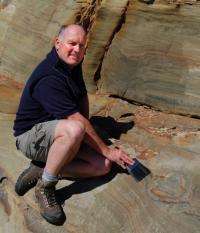
Scientist Greg Browne sits next to one of six 70 million-year-old footprints found in various locations in the Nelson region. They are the first dinosaur footprints found in New Zealand although bones, mostly vertebrae, have been found in two North Island locations. Browne, a sedimentologist, believes the footprints belonged to sauropods -- plant-eating dinosaurs.

Scientists have discovered the first evidence that dinosaurs roamed the South Island of New Zealand with 70-million-year-old footprints found in six locations.

They are the first dinosaur footprints found in the country although bones, mostly vertebrae, have been discovered in two North Island locations.

The footprints were found by scientist Greg Browne in the remote Whanganui Inlet in the northwest of Nelson at the top of the South Island.

They are spread over 10 kilometres and in one area there are up to 20 footprints, Browne said.

Browne, a sedimentologist, believes the footprints belonged to sauropods -- plant-eating which were among the largest animals to have lived, growing up to six metres (yards) in length and weighing several tonnes.

He said he carefully considered all possible geological and biological explanations for the features in the rock and was able to rule them out one by one.

His investigation included comparisons with dinosaur footprints in similar-aged rocks in other parts of the world.

The footprints were made in beach sands and were probably quickly covered and preserved by mud from subsequent tides.

"What makes this discovery special is the unique preservation of the footprints in an environment where they could easily have been destroyed by waves, tides, or wind," Browne said.

As with much of New Zealand, northwest Nelson was largely submerged between 70 and 20 million years ago and the footprints would have been covered by hundreds of metres of marine sediments.

However, after the country was uplifted and northwest Nelson emerged from the sea, the overlying sedimentary has been eroded away over the past 20 million years to expose the again, Browne said.

(c) 2009 AFP


print this article email this article download pdf blog this article bookmark this article     Stumble it Digg this share on Facebook retweet share on Reddit add to delicious
Rate this story - 4 /5 (7 votes)


November 7, 2009 all stories

Comments: 0

4 /5 (7 votes)
  • Stumble this up

  • Digg this

  • share this

  • hide
  • Related Stories

  • Dino footprints enter record books
    created Oct 06, 2009 | popularity not rated yet | comments 0
  • Earliest evidence for reptiles
    created Oct 17, 2007 | popularity not rated yet | comments 0
  • Dinosaur tracks attract a crowd
    created Jan 15, 2008 | popularity not rated yet | comments 0
  • British boy spots dinosaur tracks
    created Feb 24, 2008 | popularity not rated yet | comments 0
  • Will a footprint rewrite the history books?
    created Jul 05, 2005 | popularity not rated yet | comments 0


  • hide
  • Relevant PhysicsForums posts

  • Super quick question about Starling forces?
    created 11 hours ago
  • Questions about diffusion
    created 17 hours ago
  • Human Leukocyte Antigen (HLA) typing
    created 23 hours ago
  • Breeding program
    created Nov 20, 2009
  • More from Physics Forums - Biology

Other News

Researcher: Faint writing seen on Shroud of Turin (AP)

Researcher: Faint writing seen on Shroud of Turin (Update)

Other Sciences / Archaeology & Fossils

created Nov 20, 2009 | popularity 2.2 / 5 (26) | comments 27

(AP) -- A Vatican researcher has rekindled the age-old debate over the Shroud of Turin, saying that faint writing on the linen proves it was the burial cloth of Jesus. Experts say the historian may be reading ...


Museum: Galileo's fingers, tooth are found (AP)

Museum: Galileo's fingers, tooth are found

Other Sciences / Archaeology & Fossils

created Nov 21, 2009 | popularity 4 / 5 (1) | comments 6

(AP) -- Two fingers and a tooth removed from Galileo Galilei's corpse in a Florentine basilica in the 18th century and given up for lost have been found again and will soon be put on display, an Italian museum ...


Maya

New insights into the life of the Maya

Other Sciences / Archaeology & Fossils

created Nov 16, 2009 | popularity 4.6 / 5 (15) | comments 7

(PhysOrg.com) -- Ancient artifacts are almost always concerned with rich and powerful religious and political leaders, but new excavations of an ancient Maya site have unearthed a pyramid decorated with murals ...


Three of a kind

Three of a kind: Revealing language’s universal essence

Other Sciences / Social Sciences

created Nov 20, 2009 | popularity 4.1 / 5 (13) | comments 6

(PhysOrg.com) -- On the surface, English, Japanese, and Kinande, a member of the Bantu family of languages spoken in the Democratic Republic of Congo, have little in common. It is not just that the vocabularies ...


Only tax increase can cure Illinois budget woes, study says

Other Sciences / Economics

created Nov 18, 2009 | popularity 1 / 5 (1) | comments 3

Tax increases are the only solution to a widening budget crisis that a new study says has landed Illinois among the nation's most financially troubled states, a soon-to-be-released report by a team of University of Illinois ...