China sends panda expert to Taiwan to aid breeding
November 8, 2009 W. Africa's last giraffes make surprising comeback (AP)

Enlarge

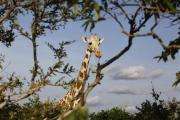
In this Aug. 1, 2009 photo, a giraffe from Africa's most endangered giraffe subspecies stands in the bush near Koure, Niger. By all accounts, they should be extinct. Instead, their numbers have quadrupled to 200 since 1996, an unlikely boon experts credit to the concurrence of an impoverished government keen for revenue that has enacted laws to protected them, a conservation program that encourages people to support them, and a rare harmony with humans who have accepted their presence. (AP Photo/Rebecca Blackwell)

(AP) -- Nothing like a little time apart to rekindle the affections that could lead to a baby panda.

So says a panda expert sent by China to Taiwan to advise on how to encourage mating by the pair given by Beijing last December to mark the two sides' growing friendship.

After inspecting the at the Taipei Zoo on Sunday, Chinese panda expert Zhang Hemin suggested a separation of a month or two might boost the feeling of attraction needed to reproduce.

"They may have more interest toward each other after a brief separation," said Zhang, a researcher at the Wolong Natural Reserve in western Sichuan province where the pandas are from.

China presented Tuan Tuan and Yuan Yuan, which together mean "reunion," to Taiwan last December amid warming ties between the mainland and the island, which split amid civil war in 1949.

They have proved popular and many Taiwanese now wish to see them produce a baby in their new home.

Zhang said the environment at the Taipei Zoo was natural enough and would not hamper their breeding, but the animals may have become too used to each others' presence.

Zhang also suggested that to prepare the male, Tuan Tuan, for the vital mating act, the zookeepers should set up more wooden racks so he can climb around and strengthen his hind legs.

If all works, the much anticipated act could come during the pandas' brief mating season in February, Zhang said.

Pandas are threatened by a low reproduction rate. Females in the wild normally have a cub once every two to three years, and the fertility of captive giant pandas is even lower, experts say.

Only about 1,600 pandas live in the wild, mostly in China's Sichuan province. An additional 120 are in Chinese breeding facilities and zoos, and about 20 live in zoos outside China.

China initially offered the pandas to Taiwan in 2005, but the then pro-independence government of Chen Shui-bian rejected the gift as propaganda to push for unification. After Ma Ying-jeou of the rival Nationalist Party was inaugurated in May last year, he accepted the offer.

©2009 The Associated Press. All rights reserved. This material may not be published, broadcast, rewritten or redistributed.


print this article email this article download pdf blog this article bookmark this article     Stumble it Digg this share on Facebook retweet share on Reddit add to delicious
Rate this story - not rated yet


November 8, 2009 all stories

Comments: 0

not rated yet
  • Stumble this up

  • Digg this

  • share this

  • hide
  • Related Stories

  • Pandas to return to famous China reserve in 2012
    created Sep 20, 2009 | popularity not rated yet | comments 0
  • China announces first panda from frozen sperm
    created Jul 24, 2009 | popularity not rated yet | comments 0
  • U.S. and China study giant pandas
    created Nov 27, 2005 | popularity not rated yet | comments 0
  • Pandas mate with help at the National Zoo
    created Mar 24, 2008 | popularity not rated yet | comments 0
  • Roundworms killing China's wild pandas
    created Dec 06, 2007 | popularity not rated yet | comments 0


  • hide
  • Relevant PhysicsForums posts

  • Breeding program
    created 2 hours ago
  • How does a concentration gradient provide energy?
    created 6 hours ago
  • Eyesight and Neural Damage from Electronics
    created Nov 19, 2009
  • Quick question about the Golgi Apparatus?
    created Nov 19, 2009
  • More from Physics Forums - Biology

Other News

Atomic-level Snapshot Catches Protein Motor in Action (w/ Video)

Atomic-level Snapshot Catches Protein Motor in Action (w/ Video)

Biology / Cell & Microbiology

created 3 hours ago | popularity 4.5 / 5 (2) | comments 0

(PhysOrg.com) -- The atomic-level action of a remarkable class of ring-shaped protein motors has been uncovered by researchers with the Lawrence Berkeley National Laboratory using a state-of-the-art protein ...


Termite creates sustainable monoculture fungus-farming

Termite creates sustainable monoculture fungus-farming

Biology / Plants & Animals

created 2 hours ago | popularity not rated yet | comments 0

(PhysOrg.com) -- Food production of modern human societies is mostly based on large-scale monoculture crops, but it now appears that advanced insect societies have the same practice. Our societies took just ...


Sponges against cancer

Biology / Cell & Microbiology

created 4 hours ago | popularity not rated yet | comments 0

Deep under the sea, there's a battle of life and death going on, with no holds barred. Sponges and other marine animals which cannot move around might seem to be defenceless against predators. Yet nothing is further from ...


We're off then: the evolution of bat migration

We're off then: The evolution of bat migration

Biology / Plants & Animals

created 4 hours ago | popularity not rated yet | comments 0

(PhysOrg.com) -- Not just birds, but also a few species of bats face a long journey every year. Researchers at Princeton University in the U.S. and at the Max Planck Institute for Ornithology in Radolfzell, ...


Dutch researchers make breakthrough in bioethanol production from agricultural waste

Biology / Cell & Microbiology

created 5 hours ago | popularity not rated yet | comments 0

With the introduction of a single bacterial gene into yeast, researchers from Delft University of Technology in the Netherlands achieved three improvements in bioethanol production from agricultural waste material: 'More ...