Deep creep means milder, more frequent earthquakes along Southern California's San Jacinto fault
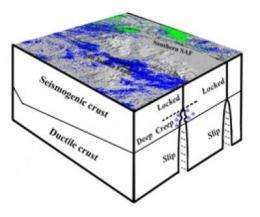
With an average of four mini-earthquakes per day, Southern California's San Jacinto fault constantly adjusts to make it a less likely candidate for a major earthquake than its quiet neighbor to the east, the Southern San Andreas fault, according to an article in the journal Nature Geoscience.
"Those minor to moderate events along the San Jacinto fault relieve some of the stress built by the constantly moving tectonic plates," said Shimon Wdowinski, research associate professor at the University of Miami's Rosenstiel School of Marine and Atmospheric Science.
Previous estimates may have overstated the likelihood of a major event on the 140-mile long San Jacinto fault, which begins between Palm Springs and Los Angeles and runs south toward the Salton Sea east of San Diego. The US Geological Survey (USGS) is forecasting a 31 percent chance that an earthquake with a magnitude of 6.7 or higher on the Richter Scale will occur on the San Jacinto fault in the next 30 years. Only the San Andreas fault, with a 59 percent chance, is more likely to have a major event during the same period.
"Thirty-one percent is a high probability, when it comes to earthquake forecasting—the second highest in Southern California," said Wdowinski. "Our data show that the next significant event for the San Jacinto fault would probably be between 6.0 and 6.7. It doesn't sound like much, but in earthquake terms it is the difference between a major earthquake and a moderate event."
A magnitude 6.0 earthquake may be felt for dozens of miles from the epicenter, but building damage especially in California, due to strict building codes, would be minimal. As the magnitude approaches and passes 7.0, which is ten times stronger than an earthquake with a magnitude of 6.0, more serious property damage and loss of life may occur.
Wdowinski feels that the San Jacinto fault is not as dangerous as predicted, because "deep creep" releases elastic strain of the moving plates approximately six to ten miles beneath the surface. As a result, the accumulation of strain along the fault occurs in the upper six miles of crust, which may be released by more frequent, moderate earthquakes. However a major event can still occur on the San Jacinto fault, but with lower probability, if two segments of the fault rupture simultaneously.
By contrast, the more famous Southern San Andreas fault to the east is locked some 10 miles down, throughout the entire seizmogenic crust. It has had very few earthquakes to release that strain but promises to release much more energy—a major earthquake—when a rupture occurs.
"It's like bending a stick," said Wdowinski. "You can bend it until it breaks and releases the energy. The San Jacinto fault [on the left in the figure below] is like a stick that has a cut in it. When you begin bending it and it breaks, less energy is released. Deep creep—evidenced by those small, more frequent earthquakes—in effect forms that small cut that reduces the release of energy when the rupture finally occurs. We are less likely to have the big energy release of a major earthquake because the energy is not allowed to build up."
The Southern San Andreas fault to the east is like a thicker stick without any stress-relieving cuts, which will snap with much greater force. USGS predicts that the San Andreas fault has a 59 percent chance of a major earthquake (greater than a magnitude of 6.7) in the next 30 years.
Aside from earthquakes, Wdowinski's primary research interest at the University of Miami is hydrology and water flow in wetlands and the Florida Everglades, in particular. The link between desert earthquakes and swamps is geodesy, the study of the earth's size, shape, orientation, gravitational field, and their variations over time. He uses satellite imaging and the Global Positioning System (GPS) to measure those slight changes.
"These are the new tools of geodesy," said Wdowinski, who co-authored a May 2009 paper in the journal Eos, Transactions, a publication of the American Geophysical Union. The article highlighted "Geodesy in the 21st Century", a look at how technological advances are benefiting the field and are applicable to many important societal issues, such as climate change, natural hazards, and water resources.
Source: University of Miami Rosenstiel School of Marine & Atmospheric Science


