Of Mutants and Mechanisms: Researching Growth-Regulation Proteins That Underlie Cancer
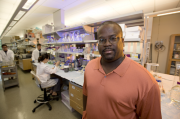
(PhysOrg.com) --A University of Arkansas researcher will study potential cancer-causing mutants of a protein involved in cell growth regulation, thanks to a supplemental grant from the National Institutes of Health.
Paul Adams, assistant professor of chemistry and biochemistry, has received $108,000 over two years as part of the American Recovery and Reinvestment Act to hire two postdoctoral associates who will perform detailed studies of two different mutants of a protein involved in cell growth regulation.
“One of the hallmarks of cancer is that the cell does not turn off - it keeps growing,” Adams said. “Our goal is to find ways to eradicate this behavior.”
Adams studies a member of the Ras family of proteins that is involved in turning the growth of a cell on and off. His research team has created genetically engineered mutants of the protein with interesting results.
“If you engineer chemical differences in what you think are important regions of a protein, you can determine how vital these regions really are to the function of the protein,” Adams said. “This allows you to determine the important aspects of proteins that need to be targeted for therapeutic purposes.”
The first new study will be based on a finding in Adams’ laboratory - that a single mutation in the Ras protein decreases the flexibility of an important interaction. The new study will focus on simple experiments to determine how the decreased flexibility interferes with the protein’s ability to do its job.
“We made a mutation in an important region of our Ras protein known to be vital for the proper interaction of cell signaling regulatory proteins, and the mutation seemed to reduce the flexibility of the protein,” Adams said. “We have preliminary data that shows that this one mutation causes a decrease in an important protein-protein interaction,” one that interferes with the protein’s ability to properly signal between its active and inactive state - thus, the cell cannot turn growth on and off.
The second new study facilitated by the NIH supplement will be based on work in Adams’ laboratory, which characterized the molecular details of a mutation that highlighted how the protein, which normally cycles between active and inactive states, existed in a permanently active state, also known as a “fast-cycling mutant.” The new research will help determine if a mutation alone generates the fast-cycling state dictated by the nature of a bound nucleotide, or if an important protein-protein interaction is also disturbed, helping to cause the Ras protein to be permanently active. To do this, the researchers have created a mutant that destabilizes the binding region of the Ras protein.
“If Ras proteins are in an over-active state, this facilitates oncogenic activity,” Adams said.
“Our long-term goal in the laboratory is to use the information gained from our studies on the molecular details of these mutations in the subsequent design of drugs to change protein interactions that may cause oncogenic cell signaling,” Adams said.
Provided by University of Arkansas (news : web)


