Squeak, squeak -- can you hear me now?

What do you get when you cross a mouse with poor hearing and a mouse with even worse hearing? Ironically, a new strain of mice with "golden ears" - mice that have outstanding hearing as they age.
The work by one of the world's foremost groups in age-related hearing loss, or presbycusis, marks the first time that scientists have created the mouse equivalent of a person with "golden ears" - people who are able to retain great hearing even as they grow older. The research at the University of Rochester Medical Center was published online recently in the journal Neurobiology of Aging.
The new mouse is expected to offer clues about how these lucky folks are able to retain outstanding hearing even through old age. Researchers estimate that approximately 5 percent of people, mainly women, fall into this category. The new mice created in the laboratory of Robert Frisina, Ph.D., embody many of the same traits of human "golden ears" because of an astute cross of two types of mice long popular with researchers.
For years, the most prized mice in Frisina's lab have been those whose hearing diminishes slowly with age, just like the people he tries to help. But they don't take to breeding very well; their libido wanes along with their hearing.
To create a thriving colony of mice for his work on hearing loss, Frisina's group introduced some virility into the mix, mating the poor breeders with mice known both for their solid breeding habits and also their accelerated age-related hearing loss. They may not hear well, but they breed well.
The result was a new breed of mice that both breed well and hear well in old age.
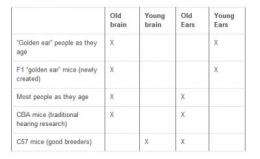
Diminished hearing as we age is the result of several factors. One that is nearly universal is the degenerating brain, a problem that affects just about everyone, including those people known as golden ears. But those lucky few differ from others in a crucial way: Their ears stay healthy throughout their lifetime, unlike most people whose ears gradually lose the ability to detect sounds as well as they once did.
"It's very hard to find someone who has no complaints whatsoever about speech or hearing over the age of 60," said Frisina. "But there are a few who seem resistant to the normal aging process, at least in their ears."
Frisina's group studies these patients for clues about maintaining good hearing while aging. Simultaneously, the group conducts studies in rodents, trying to mirror processes observed in people, and then applies its findings in an effort to help their human patients.
In this study, the team set out to create a mouse that mirrored the phenomenon seen in humans with golden ears - an organism with young, good ears but an older, aging brain. The team started with the rodent gold standard of age-related hearing loss, CBA mice, which lose their hearing much like aging people do, with both the ears and the brain degenerating in sync. Then the team added C57 mice, not only for their breeding abilities but because they experience hearing loss in a different way, at an even younger age. By crossing the two, the team was able to create a mouse with an aging brain but with good, young ears - the mouse equivalent of golden ears.
The team studied 55 mice, using the same two sophisticated hearing tests given routinely to babies suspected of having serious hearing difficulties. The tests were administered when the mice were young, middle-aged, and older, in the same way they're given to babies. A small speaker and microphone was placed in the ear, and scientists recorded the emissions or echoes from the ear, as well as brain activity, in response to sounds made in the ears.
All three groups had great hearing when they were young. By middle age, as expected, the CBA mice were losing their hearing at a rate much like middle-aged people, while the loss was even more marked in the C57 mice. By old age, both the CBA and the C57 mice had significant hearing loss, but their offspring, known as F1 mice, had very little loss.
The mouse also gives researchers a new tool to explore protective factors that allow some organisms to retain outstanding hearing for their whole lives, rather than focusing on the factors that contribute to hearing loss.
"This allows us to really take a detailed look at good hearing in old age," said Frisina. "Which chemical pathways are most active, for instance? This is about what goes right with age, not what goes wrong. These mice have the hearing of a young adult. Understanding why should help us understand more about how a person's hearing changes as he or she ages.
"This new mouse also opens up a new, clear window into the aging brain," added Frisina, who is professor of Otolaryngology, Biomedical Engineering, and Neurobiology and Anatomy. "It really allows us to look at the auditory systems in the brain in a very pure way, without distortion from the ear."
Source: University of Rochester Medical Center (news : web)


