New discovery allows scientists for the first time to experimentally annotate genomes
November 9, 2009
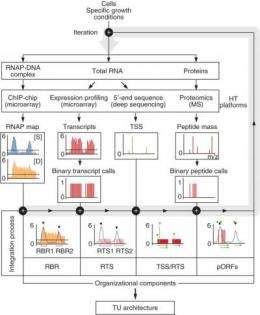
The flow chart above shows how UCSD bioengineers used high-throughput data generated from cells grown under different conditions to form the basis for elucidation of the transcription unit architecture of the E. coli genome. Credit: UC San Diego
Over the last 20 years, the sequencing of the human genome, along with related organisms, has represented one of the largest scientific endeavors in the history of mankind. The information collected from genome sequencing will provide the raw data for the field of bioinformatics, where computer science and biology meet.
Since the publication of the first full genome sequence in the mid-1990s, scientists have been working to identify the genomic location of all the gene products involved in the complex biological processes in a single organism. However, they have only been able to identify a fraction of those locations. Until now. Bioengineers at UC San Diego have made a breakthrough development that will now allow scientists to perform full delineation of the location and use of genomic elements. The researchers have discovered that multiple simultaneous genome-scale measurements are needed to identify all gene products, and to determine their cellular locations and interactions with the genome.
In a recent Nature Biotechnology paper, "The transcription unit architecture of the Escherichia coli genome," the researchers describe a four-step systems approach that integrates multiple genome-scale measurements on the basis of genetic information flow to identify the organizational elements and map them onto the genome sequence. The bioengineers have applied this approach to the E. coli genome to generate a detailed description of its transcrip¬tion unit architecture.
"What's important about this paper is it now enables us to experimentally annotate genomes," said Bernard Palsson, a UCSD bioengineering professor and co-author of the paper. "All this information gives us a fine resolution of the contents of a genome and location of its elements. This is a fine blueprint of a genetic makeup of the genome. We have been able to use genome scale computational models that have been developed at UCSD under the systems biology program, which have enabled us to compute organism designs with higher resolution or better accuracy, which has not been possible before. It takes a lot of the guesswork out of making an organism. Currently there is extensive trial and error in gene sequencing procedures. Hopefully this 'metastucture' of a genome that we have developed will eliminate that trial and error and will enable us to reach new metabolic designs faster with lower failure rates."
Palsson said there are many significant implications of this new finding, such as enhancing metabolic engineering (such as the engineering of microorganisms to make fuels and commodity chemicals).
The UCSD bionengineers combined several computation methods with information mapping in this research. "There are several high throughput methods developed recently like deep sequencing and micro array systems that we used," said Byung-Kwan Cho, a project scientist in the UCSD bioengineering department and the lead author of the Nature Biotechnology paper. "We wanted to integrate all the information into one format to describe the genome. We have genome sequences but we don't know what all of them are. When we sequenced the Human Genome we thought we knew everything but actually we don't know everything. There are lots of data generation techniques and a huge amount of data available. So we were able to map all of this information into one genome sequence.
"So far, scientists have been able to make chemicals to kill pathogenic strains but we haven't been as successful as we have wanted to be," Cho added. "By using this newly discovered information we may be able to design better drugs or medicines to kill pathogenic strains. That's the important point of this research - there is a huge amount of applications for this. The E. coli bacteria is just the beginning."
-
Beyond the DNA: Chemical signatures reveal genetic switches in the genome
Feb 05, 2007 |
not rated yet |
0
-
Human chromosome 3 is sequenced
Apr 27, 2006 |
not rated yet |
0
-
454 Life Sciences and Baylor College of Medicine complete sequencing of DNA pioneer
Jun 01, 2007 |
not rated yet |
0
-
New genome sequencing targets announced
Jul 24, 2006 |
not rated yet |
0
-
Scientists develop strategy to rapidly describe outbreak strains with next-generation DNA sequencing
Apr 11, 2008 |
not rated yet |
0
-
Engineers build first sub-10-nm carbon nanotube transistor
Feb 01, 2012 |
4.9 / 5 (33) |
30
-
Something old, something new: Evolution and the structural divergence of duplicate genes
Jan 31, 2012 |
4.6 / 5 (7) |
1
-
The hidden nanoworld of ice crystals: Revealing the dynamic behavior of quasi-liquid layers
Jan 30, 2012 |
5 / 5 (4) |
1
-
Stock market network reveals investor clustering
Jan 27, 2012 |
3.9 / 5 (23) |
8
-
Of microchemistry and molecules: Electronic microfluidic device synthesizes biocompatible probes
Jan 26, 2012 |
5 / 5 (2) |
0
-
Factors affecting beet root cell membrane
8 hours ago
-
Stem cell question.
Feb 10, 2012
-
Protease cleavage
Feb 10, 2012
-
Pertubance in a model
Feb 10, 2012
-
Cancer drugs and Alzheimer's, Oh my!
Feb 09, 2012
-
Squishing cells
Feb 09, 2012
- More from Physics Forums - Biology
More news stories
A mitosis mystery solved: How chromosomes align perfectly in a dividing cell
Although the process of mitotic cell division has been studied intensely for more than 50 years, Whitehead Institute researchers have only now solved the mystery of how cells correctly align their chromosomes during symmetric ...
4 hours ago |
5 / 5 (5) |
0
|
The proteins ensuring genome protection
Researchers from the University of Geneva (UNIGE), Switzerland, have discovered the crucial role of two proteins in developing a cell 'anti-enzyme shield'. This protection system, which operates at the level of molecular ...
4 hours ago |
5 / 5 (2) |
0
|
Researchers find extensive RNA editing in human transcriptome
In a new study published online in Nature Biotechnology, researchers from BGI, the world's largest genomics organization, reported the evidence of extensive RNA editing in a human cell line by analysis of RNA-seq data, demons ...
4 hours ago |
5 / 5 (3) |
0
|
Entire genome of extinct human decoded from fossil
(PhysOrg.com) -- In 2010, Svante Pääbo and his colleagues presented a draft version of the genome from a small fragment of a human finger bone discovered in Denisova Cave in southern Siberia. The ...
Feb 07, 2012 |
4.7 / 5 (59) |
48
|
Why are there so few fish in the Earth's oceans?
(PhysOrg.com) -- A Stony Brook University researcher has found that, contrary to popular belief, there are not plenty of fish in the sea.
Feb 08, 2012 |
4.2 / 5 (18) |
27
|
Overeating may double risk of memory loss
New research suggests that consuming between 2,100 and 6,000 calories per day may double the risk of memory loss, or mild cognitive impairment (MCI), among people age 70 and older. The study was released today and will be ...
Google might launch Drive for cloud storage soon
(PhysOrg.com) -- Google's next big move, according to the Wall Street Journal, is a cloud storage service called Drive. Hardly first to the plate, Google is simply catching up to introducing its cloud reposi ...
Scientists discover molecular secrets of 2,000-year-old Chinese herbal remedy
For roughly two thousand years, Chinese herbalists have treated Malaria using a root extract, commonly known as Chang Shan, from a type of hydrangea that grows in Tibet and Nepal. More recent studies suggest that halofuginone, ...
New method to examine batteries -- MRI from the inside
There is an ever-increasing need for advanced batteries for portable electronics, such as phones, cameras, and music players, but also to power electric vehicles and to facilitate the distribution and storage of energy derived ...
Lab study raises questions over nano-particle impact
Tests involving chickens have raised questions about the impact on health from engineered nano-particles, the ultra-fine grains commonly used in drugs and processed foods, scientists said on Sunday.
Injured boomers beware: Know when to see doctor
(AP) -- It happened to nurse Jane Byron years after an in-line skating fall, business owner Haralee Weintraub while doing "men's" push-ups, and avid cyclist Gene Wilberg while lifting a heavy box.