Ice cream researchers making sweet strides with 'functional foods' (w/ Video)
November 9, 2009 Ice cream researchers making sweet strides with 'functional foods'

Enlarge

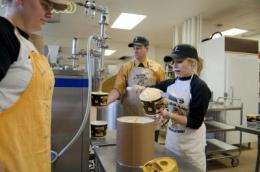
Laura Ortinau (left), a graduate student in food sciences at the University of Missouri helps Rick Linhardt, coordinator of research operations and manager of Buck’s Ice Cream store, and Jessica Roland, a junior in food science and nutrition, make a batch of Tiger Stripe Ice Cream. MU researchers are working on ways to make ice cream not only tastier, but healthier as well. Credit: Pinar Istek/University of Missouri

A comfort food, a tasty treat, an indulgence - ice cream conjures feelings of happiness and satisfaction for millions. Ice cream researchers at the University of Missouri have discovered ways to make ice cream tastier and healthier and have contributed to ice cream development and manufacturing for more than a century. Today, MU researchers are working to make ice cream into a functional food, adding nutrients such as fiber, antioxidants and pro-biotics to premium ice cream.

"The idea of putting a functional ingredient into a food instead of just using the nutrients found in the food naturally takes a multi-functional approach," said Ingolf Gruen, MU professor of and researcher in the College of Agriculture, Food and Natural Resources. "Food provides calories and comfort - people want to indulge. We're working on making ice cream satisfying and healthy."

FLV player

MU researchers describe how they are working to make ice cream good for you. Credit: University of Missouri News Bureau

Adding nutrients such as pro-biotics, which are already found in some dairy products, and fiber to ice cream can improve digestive health. Many diseases are caused by that starts in the intestines, Gruen said. Improving digestive health with functional foods might reduce that inflammation. Although functional foods have health benefits, there are many challenges to adding nutrients to ice cream.

"Our major challenges are texture, flavor and psychological acceptance," Gruen said. "The nutrients we add often have bitter tastes and affect the texture of ice cream that we have to mask. Flavors like chocolate are easier to work with because the flavor is so strong that it can overcome other flavors from the nutrients. Another challenge is determining whether people would be upset that we're 'tampering' with a comfort . We need to know if they would be more willing to pay for ice cream with added nutritional benefits."

Gruen and his research team are looking at using the açai berry and remnants from grapes in wine-making to add to ice cream. They hope to have a prototype ready for tasting in the next six months.

Source: University of Missouri-Columbia (news : web)


print this article email this article download pdf blog this article bookmark this article     Stumble it Digg this share on Facebook retweet share on Reddit add to delicious
Rate this story - not rated yet


November 9, 2009 all stories

Comments: 0

not rated yet
  • Stumble this up

  • Digg this

  • share this

  • hide
  • Related Stories

  • Dutch chocolate ice cream recalled
    created Feb 21, 2008 | popularity not rated yet | comments 0
  • Private Selection-brand ice cream recalled
    created Apr 14, 2008 | popularity not rated yet | comments 0
  • Edible 'antifreeze' prevents unwanted ice crystals in ice cream and frozen foods
    created Jan 14, 2008 | popularity not rated yet | comments 0
  • Some Kahlua-brand ice cream is recalled
    created Oct 18, 2007 | popularity not rated yet | comments 0
  • Mislabeled Winn-Dixie ice cream recalled
    created Oct 09, 2007 | popularity not rated yet | comments 0


  • hide
  • Relevant PhysicsForums posts

  • why oxygen, cannot act as a pi-donor while NO can?
    created 15 hours ago
  • Aspirin
    created Nov 19, 2009
  • antibonding orbitals
    created Nov 19, 2009
  • Affect of adjacent amino acids on pKa values
    created Nov 19, 2009
  • More from Physics Forums - Chemistry

Other News

GE Scientists Developing Wearable RFID Sensors to Detect Airborne Chemical Agents

GE Scientists Developing Wearable RFID Sensors to Detect Airborne Chemical Agents

Chemistry / Analytical Chemistry

created 22 hours ago | popularity not rated yet | comments 0

GE Global Research, the technology development arm for the General Electric, today announced a $2 million award from the National Institute of Environmental Health Sciences to develop wearable RFID sensors ...


Accidental discovery produces durable new blue pigment for multiple applications

Accidental discovery produces durable new blue pigment for multiple applications

Chemistry / Biochemistry

created Nov 16, 2009 | popularity 4.5 / 5 (30) | comments 6

An accidental discovery in a laboratory at Oregon State University has apparently solved a quest that over thousands of years has absorbed the energies of ancient Egyptians, the Han dynasty in China, Mayan ...


Ethanol

Microbes to Take Over Ethanol Production?

Chemistry / Biochemistry

created Nov 20, 2009 | popularity 3.8 / 5 (5) | comments 0

(PhysOrg.com) -- Not too long ago, it seemed that ethanol production was the wave of the future. The use of trash, wood chips or different types of plants -- usually grass or corn -- to make ethanol was considered ...


One word: bioplastics

One word: bioplastics

Chemistry / Materials Science

created Nov 17, 2009 | popularity 4.5 / 5 (10) | comments 4

(PhysOrg.com) -- Every year, more than 250 billion pounds of plastic are produced worldwide. Much of it ends up in the world's oceans, a fact that troubles MIT biology professor Anthony Sinskey.


New on-off 'switch' triggers and reverses paralysis in animals with a beam of light

New on-off 'switch' triggers and reverses paralysis in animals with a beam of light (w/ Video)

Chemistry / Biochemistry

created Nov 18, 2009 | popularity 5 / 5 (4) | comments 3

In an advance with overtones of Star Trek phasers and other sci-fi ray guns, scientists in Canada are reporting development of an internal on-off "switch" that paralyzes animals when exposed to a beam of ultraviolet ...