Implantable Glucose Sensor Could Spell Relief for Millions of Diabetics (w/ Video)
(PhysOrg.com) -- UConn researchers have developed a tiny wireless device that can be inserted under a patient?s skin to monitor blood glucose levels over a period of several months.
A team of researchers in chemistry, pharmaceutics, and engineering is developing a long term implantable biosensor that could dramatically change the way of life for millions of people diagnosed with diabetes.
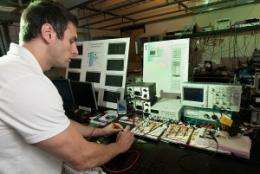
Inside the laboratories of Board of Trustees distinguished professor of pharmaceutics Diane Burgess, chemistry professor Fotios Papadimitrakopoulos, and engineering professor Faquir Jain, teams of graduate students and postdoctoral fellows are helping develop a miniaturized wireless device that will monitor blood glucose levels for three months or more after being inserted under a patient’s skin.
Wireless Prototype
Prototypes of the device are smaller than a grain of rice yet embedded with an array of highly sensitive, microscopic electronic chips, sensors, and transmitters.
The device would be injected into a diabetic patient subcutaneously using a hypodermic needle. Patients would then wear a special watch-like monitor that would receive transmissions from the sensor so they could track their blood sugar level throughout the day.
The researchers hope to make the device adaptable so that Type 1 diabetics can wirelessly connect the glucose monitor to a portable insulin pump that would automatically infuse insulin into their body as needed. Type 2 diabetics would use the device to monitor their body’s reactions after they eat particular foods or before or after exercise. It would replace the more common finger prick blood sugar test that is both painful and time-consuming.
“In my opinion, this device will be a dream come true for diabetics,” says Papadimitrakopoulos, associate director of the University’s Institute of Materials Science and an expert in nanotechnology. “It is not only going to improve their standard of living but it will also help educate people on how to go about living with this disease.”
Postdocs and doctoral students from the College of Liberal Arts and Sciences, the Institute of Materials Science, and the Schools of Engineering and Pharmacy who are working on the sensor research include: Santhisagar Vaddiraju, Yan Wang, Upkar Bhardwaj, Jacqueline Morias, Liangliang Qiang, Vincent Ustach, Fuad Al-Amoody, Robert Croce, Mukesh Gogna, and Supriya Karmakar.
Currently about 23.6 million children and adults in the United States, or 7.8 percent of the population, are living with diabetes, according to the American Diabetes Association. The overwhelming majority of those individuals have Type 2 diabetes, which results from the body failing to properly use insulin, combined with insulin deficiency. Complications from diabetes can lead to kidney disease, blindness, and limb amputation.
Minimizing Tissue Damage
Although other glucose sensors have been developed, scientists have been stymied by their inability to produce a product that is at once small enough for implantation, wireless, and able to operate under the skin for prolonged periods of time. Previous devices have been as large as a watch face and viable for only five to seven days at a time, Burgess says.
“When we went about developing this device, we wanted to make it very small to minimize damage to tissue,” she says. “Imagine having a splinter in your finger. The body responds with pain, redness, and swelling, and entombs the object though fibrosis or scar tissue, which ultimately interferes with the sensor’s readings.”
To combat that reaction, the research team has been working for more than 10 years on developing a biocompatible coating for the sensor that allows certain fluids to flow into and out of the device, yet reduces the chances of inflammation and fibrosis while under the skin.
The team has developed a polymer hydrogel loaded with “microspheres” - which are like tiny, microscopic beads - filled with anti-inflammatory medication. As the gel gradually breaks down around the sensor, it releases the protective drugs and prevents an immune reaction for months at a time. The coating has proven successful in preventing infection and inflammation for more than three months in initial laboratory trials.
Catalytic Reaction
The biggest challenge for Papadimitrakopoulos and Jain was finding a way to translate the body’s internal metabolic functions into electrical charges that could be recorded and monitored by a small external device.
Working in UConn’s Nanobionics Device Fabrication Facility, Papadimitrakopoulos’ research team was able to create special inner polymer membranes for the enzymatic sensory component of the device. These enzymes create a catalytic reaction when they come in contact with glucose in the blood, and an electrical signal is generated. As blood glucose concentration goes up or down, the scientists found it can be detected by the device and recorded graphically over time, like a chart in the stock market.
“Our lab is involved in the overall system design architecture,” says Jain, a specialist in microelectronics, electrical, and computer engineering. “We are working to integrate all of the chips together - the sensor chip, the power chip, the signal processing chip … and we’ve developed a method so that all of the chips are protected from water, while only the sensor chip is exposed to bodily fluids.”
The miniature biosensor is not limited to glucose monitoring, the researchers say. It can be modified to monitor other metabolic functions, such as cholesterol levels and lactic acid levels. But for now, the team is focused on glucose and diabetes.
“We’re at the pre-clinical testing stage right now and hope to go into clinical testing in two to three years,” Burgess says, “with entry into the market predicted in maybe four to seven years.”
Provided by University of Connecticut (news : web)


