Switching Gears to Greener Transportation
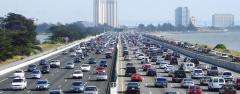
Automakers around the world continue to slowly infuse their cars and trucks with greener, more efficient technology, but researchers at Rensselaer Polytechnic Institute contend that technology alone will not solve the puzzle of sustainable transportation. Through incentives for nighttime deliveries, real-time traffic reporting, and improved safety, professors William Wallace and José Holguín-Veras are seeking to address the critical human elements of where, when, and how we drive.
“Sustainability is a multifaceted monster that we simply cannot tackle from any one single perspective. The problem is so vast, and so complex, that solving it is going to require a comprehensive, systematic, holistic approach. And at the end of the day, we’re going to have to do more with less,” said Holguín-Veras, professor of civil and environmental engineering at Rensselaer. “The importance of the transportation sector in terms of energy and the environment is undeniable.”
Take, for example, the statistics that show transportation accounts for nearly 30 percent of the total energy consumed in the United States, and up to 54 percent of emissions of different greenhouse gasses. Pair this information with Holguín-Veras’ research findings that current freight practices are highly inefficient and, on average, delivery trucks utilize only 20 percent of their cargo space - and one-fourth of trucks you see driving around are completely empty. The need for change, and the rampant waste of fuel and energy, Holguín-Veras said, are readily apparent.
But now frame these snapshots with the fact that 18 million Americans work in freight or freight-related activities, and the nation’s nine million registered midsize and large trucks deliver about $5.5 trillion worth of goods to homes and businesses every year. This complicates the equation immensely and raises the question of how to green the transportation industry and be more efficient without impacting commerce or competitiveness. After all, truckers are mostly independent contractors who have virtually no say in what or where they deliver. Freight companies that hire truckers likely don’t necessarily want to send out partly filled trucks, but need to fulfill the demand of their customers, who are business owners and have their own clientele - with their own set of expectations - to worry about.
Efficiency seems to get lost in the shuffle, but Holguín-Veras said this doesn’t necessarily have to be the case.
“This is a major challenge that requires not only new technology, but whole new perspectives on transportation,” he said. “We need to change our behavior, which is not always easy to do and usually requires new policy and laws that take years to embed themselves in the public consciousness. Think of recycling, which was sort of a big, new thing in the 1980s but today, for most people, is completely second nature. We need strong policy to enact that kind of behavioral change in the transportation and freight sectors.”
Holguín-Veras is in the midst of leading a $1.9 million U.S. Department of Transportation study to evaluate different incentives, including cash payments and tax breaks, for encouraging business owners to accept evening and overnight deliveries on a permanent or long-term basis. It’s the receivers, not the deliverers, who are the key decision makers and need to be targeted, he said. Imposing higher tolls for driving on New York City streets only puts additional pressure on truckers without addressing the heart of the problem.
The pilot program is currently under way in Manhattan, and involves around 25 freight firms and 20 business owners, who are each receiving $2,000 per location to receive off-hour deliveries for a month. Following the test, Holguín-Veras will conduct surveys, interviews, and other data that will inform his study.
Shifting even a small percentage of delivery truck traffic from business hours to off-hours, between 7 p.m. and 6 a.m., should help noticeably alleviate downtown New York’s infamous congestion and boost its economic performance, Holguín-Veras said. Keeping traffic moving in Manhattan will result in a greater influx of shoppers and tourists to downtown
locations - as well as reduced automotive emissions and more breathable air.
Keeping traffic flowing at a steady beat in a safe manner is also a priority for Wallace, the Yamada Corporation Professor at Rensselaer and a member of the Department of Decision Sciences and Engineering Systems.
“It’s clear that safety and efficiency go hand-in-hand,” Wallace said. “We want to keep drivers moving at a constant speed. Acceleration and deceleration are where you use the most energy, and where you’re the least efficient. Accidents, which are already horrible for the people involved, also affect the rest of us by causing congestion, making us late, and ultimately wasting a lot of energy.”
Wallace is working on both theoretical models and applied devices for supplying drivers with reliable, real-time, in-car traffic updates. The devices use GPS technology and complex analytics to identify where traffic is backed up, alert drivers well before they reach the congested area, and then seamlessly direct drivers toward the most appropriate and efficient alternative route. Wallace tested a prototype of such a system, which included several solar-powered sensors on the site of the road to collect data, in New York’s Capital Region as well as outside Syracuse during the 2007 and 2008 New York State Fair. The study was funded by a $3.9 million grant from the Federal Highway Administration.
In addition to day-to-day rush hour traffic, Wallace said the in-car devices will also be particularly useful for decreasing congestion and providing travel time estimates in construction zones, at special events, and during emergency evacuations.
“With a little political will, and the appropriate funding, you could start rolling out this technology right away, and see quick, real results in alleviating congestion around the country,” Wallace said. “But it’s tough. New transportation technology, everything from cars to manufacturing equipment, is usually pushed through the private sector, whereas transportation systems and transit are the province of the public sector. It’s surprisingly difficult to marry the two.”
Wallace agreed with Holguín-Veras that making transportation greener and more sustainable is a critical yet severely difficult endeavor, which needs to be approached from a systems engineering perspective. He cited ethanol, a fuel additive derived from corn, as an example of how unforeseen consequences can arise when not looking at the big picture when rolling out new technology and policy. Federal regulations in recent years called for an increase in the production of ethanol, which in turn provoked a spike in the price of corn and corn byproducts that reverberated through the economy.
“The ethanol situation was a huge misstep, which someone did not think through all of the way,” he said. “Hopefully it taught us something. There are a lot of great ideas out there right now, like biomass and using algae as a power source, but we need to consider all of the different ecological and biological systems that will be affected by the mass planting or harvesting of biofuels. Plus we need to think about the energy it takes to do it, to make sure we’re still realizing a net energy savings and net greenhouse gas reductions.”
At the end of the day, Wallace and Holguín-Veras said that land use - the speed, method, and patterns of how we grow our towns and cities - is the central battleground for sustainability on a national level. Population density affords important critical mass that coaxes higher efficiencies from train travel and public transportation, but this will never be realized as long as municipalities have economic incentives to keep growing.
“Growing your town means getting a higher tax base, but it also leads to a host of other issues like congestion, longer travel times, and inefficiency,” Holguín-Veras said. “Without changing the land-use paradigm, it will be near impossible to slow suburban sprawl. We need to create new ways of incentivizing smart and sustainable growth, rather than just growth.”
Source: green@rensselaer, Rensselaer Polytechnic Institute, by Michael Mullaney


