Swift, XMM-Newton satellites tune into a middleweight black hole
November 10, 2009 by Francis Reddy Swift, XMM-Newton satellites tune into a middleweight black hole

Enlarge

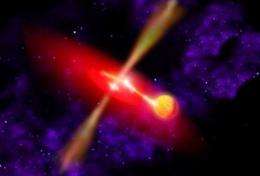
Swift X-ray observations of galaxy NGC 5408 indicate its ultraluminous X-ray source undergoes periodic changes every 115.5 days. This cycle, astronomers suspect, is linked to the orbit of a donor star around a middleweight black hole, as shown in this artist's view. Credit: NASA

(PhysOrg.com) -- While astronomers have studied lightweight and heavyweight black holes for decades, the evidence for black holes with intermediate masses has been much harder to come by. Now, astronomers at NASA's Goddard Space Flight Center in Greenbelt, Md., find that an X-ray source in galaxy NGC 5408 represents one of the best cases for a middleweight black hole to date.

"Intermediate-mass contain between 100 and 10,000 times the sun's mass," explained Tod Strohmayer, an astrophysicist at Goddard. "We observe the heavyweight black holes in the centers of and the lightweight ones orbiting stars in our own galaxy. But finding the 'tweeners' remains a challenge."

Several nearby galaxies contain brilliant objects known as ultraluminous X-ray sources (ULXs). They appear to emit more energy than any known process powered by stars but less energy than the centers of active galaxies, which are known to contain million-solar-mass black holes.

"ULXs are good candidates for intermediate-mass black holes, and the one in galaxy NGC 5408 is especially interesting," said Richard Mushotzky, an astrophysicist at the University of Maryland, College Park. The galaxy lies 15.8 million light-years away in the constellation Centaurus.

Using the European Space Agency's orbiting XMM-Newton observatory, Strohmayer and Mushotzky studied the source -- known as NGC 5408 X-1 -- in 2006 and 2008.

detected what the astronomers call "quasi-periodic oscillations," a nearly regular "flickering" caused by the pile-up of hot gas deep within the accretion disk that forms around a massive object. The rate of this flickering was about 100 times slower than that seen from stellar-mass black holes. Yet, in X-rays, NGC 5408 X-1 outshines these systems by about the same factor.

Based on the timing of the oscillations and other characteristics of the emission, Strohmayer and Mushotzky conclude that NGC 5408 X-1 contains between 1,000 and 9,000 solar masses. This study appears in the October 1 issue of The Astrophysical Journal.
Swift, XMM-Newton satellites tune into a middleweight black hole
Enlarge

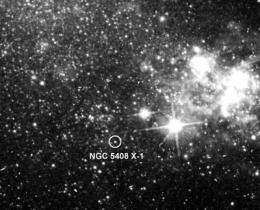
This archival image taken by the Hubble Space Telescope shows the location of NGC 5408's unusually luminous X-ray source (circled). The irregular-type galaxy lies 15.8 million light-years away in the constellation Centaurus. Credit: NASA/ESA/C. Lang, P. Kaaret, A. Mercer (Univ. of Iowa), and S. Corbel (Univ. of Paris)

"For this mass range, a black hole's event horizon -- the part beyond which we cannot see -- is between 3,800 and 34,000 miles across, or less than half of Earth's diameter to about four times its size," said Strohmayer.

If NGC 5408 X-1 is indeed actively gobbling gas to fuel its prodigious X-ray emission, the material likely flows to the black hole from an orbiting star. This is typical for stellar-mass black holes in our galaxy.

Strohmayer next enlisted the help of NASA's Swift satellite to search for subtle variations of X-rays that would signal the orbit of NGC 5408 X-1's donor star. "Swift uniquely provides both the X-ray imaging sensitivity and the scheduling flexibility to enable a search like this," he added. Beginning in April 2008, Swift began turning its X-Ray Telescope toward NGC 5408 X-1 a couple of times a week as part of an on-going campaign.

Swift detects a slight rise and fall of X-rays every 115.5 days. "If this is indeed the orbital period of a stellar companion," Strohmayer said, "then it's likely a giant or supergiant star between three and five times the sun's mass." This study has been accepted for publication in a future issue of The Astrophysical Journal.

The Swift observations cover only about four orbital cycles, so continued observation is needed to confirm the orbital nature of the X-ray modulation.

"Astronomers have been studying NGC 5408 X-1 for a long time because it is one of the best candidates for an intermediate-mass black hole," adds Philip Kaaret at the University of Iowa, who has studied the object at radio wavelengths but is unaffiliated with either study. "These new results probe what is happening close to the black hole and add strong evidence that it is unusually massive."

Source: NASA/Goddard Space Flight Center


print this article email this article download pdf blog this article bookmark this article     Stumble it Digg this share on Facebook retweet share on Reddit add to delicious
Rate this story - 4.7 /5 (3 votes)

Rank Filter

Move the slider to adjust rank threshold, so that you can hide some of the comments.


Display comments: newest first

  • yyz - Nov 10, 2009
    • Rank: 5 / 5 (1)
    Observations of this object certainly make a strong case for intermediate-mass black holes. The authors note that many of these bright ULX sources like NGC 5048 X-1 are likely accreting binary systems, although little is known about any putative partners. The paper was posted on the arXiv site here: http://arxiv.org/...39v1.pdf .

November 10, 2009 all stories

Comments: 1

4.7 /5 (3 votes)
  • Stumble this up

  • Digg this

  • share this

  • hide
  • Related Stories

  • Scientists pioneer technique for 'weighing' black holes
    created May 16, 2007 | popularity not rated yet | comments 0
  • X-Rays signal presence of elusive intermediate-mass black hole
    created Mar 22, 2005 | popularity not rated yet | comments 0
  • A new way to weigh giant black holes
    created Jul 16, 2008 | popularity not rated yet | comments 0
  • New Massive Black Hole Smashes Record
    created Oct 30, 2007 | popularity not rated yet | comments 0
  • Star Cluster Holds Midweight Black Hole, VLA Indicates
    created May 28, 2007 | popularity not rated yet | comments 0


  • hide
  • Relevant PhysicsForums posts

  • geographic location determination
    created 8 hours ago
  • Earth's emission spectrum
    created 16 hours ago
  • "That's one small step for man; one giant leap for mankind."
    created Nov 28, 2009
  • Some help with a X-Ray astronomy question please!
    created Nov 27, 2009
  • Help with Images and Optical Instrument Question..
    created Nov 26, 2009
  • Redshift as a distance indicator
    created Nov 26, 2009
  • More from Physics Forums - General Astronomy

Other News

Caltech scientists explain puzzling lake asymmetry on Titan

Scientists explain puzzling lake asymmetry on Titan

Space & Earth / Space Exploration

created 7 hours ago | popularity 4.7 / 5 (6) | comments 0

Researchers at the California Institute of Technology (Caltech) suggest that the eccentricity of Saturn's orbit around the sun may be responsible for the unusually uneven distribution of methane and ethane ...


Leaders say momentum building on climate change (AP)

Leaders say momentum building on climate change

Space & Earth / Environment

created 8 hours ago | popularity 3.6 / 5 (5) | comments 4

(AP) -- Leaders of the Commonwealth countries called Saturday for a legally binding international agreement on climate change and a global fund with billions of dollars to help poor countries meet its mandates.


Venezuela turns to cloud-seeding to battle drought (AP)

Venezuela turns to cloud-seeding to battle drought

Space & Earth / Earth Sciences

created 8 hours ago | popularity not rated yet | comments 0

(AP) -- Hugo Chavez says he is starting to "bombard" clouds now that Cuba has provided Venezuela with cloud-seeding help in an effort to produce rain and alleviate the effects of a severe drought.


Humanity would need five Earths to create the resources needed if everyone lived as like Americans, a report has stated

Mankind using Earth's resources at alarming rate

Space & Earth / Environment

created Nov 24, 2009 | popularity 3.4 / 5 (21) | comments 63

Humanity would need five Earths to produce the resources needed if everyone lived as profligately as Americans, according to a report issued Tuesday.


Is global warming unstoppable?

Space & Earth / Environment

created Nov 23, 2009 | popularity 3.5 / 5 (48) | comments 68

In a provocative new study, a University of Utah scientist argues that rising carbon dioxide emissions - the major cause of global warming - cannot be stabilized unless the world's economy collapses or society builds the ...