Climate studies to benefit from 12 years of satellite aerosol data
November 10, 2009 Climate studies to benefit from 12 years of satellite aerosol data

Enlarge

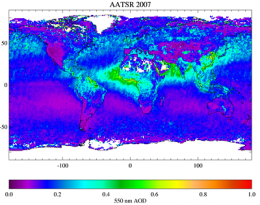
An example of a GlobAerosol product: aerosol optical depth for the year 2007, derived from Envisat AATSR data. Credits: ESA

Aerosols, very small particles suspended in the air, play an important role in the global climate balance and in regulating climate change. They are one of the greatest sources of uncertainty in climate change models. ESA's GlobAerosol project has been making the most of European satellite capabilities to monitor them.

Using data from the Along Track Scanning Radiometer-2 on the ERS-2 satellite, the Advanced Along Track Scanning and the Medium Resolution Imaging on Envisat and the Spinning Enhanced Visible & InfraRed Imager (SEVIRI) instrument on the Meteosat Second Generation, GlobAerosol has produced a global aerosol dataset going back to 1995. The full dataset is available on the GlobAerosol website.

Some occur naturally, originating from sea-spray, wind-blown dust, volcanic eruptions and biochemical emissions from oceans and forests, while others are produced through emissions from industrial pollution, fossil-fuel burning, man-made forest fires and agriculture.

FLV player

An animation of the 550 nm aerosol optical depth from GlobAerosol, as measured by the SEVIRI instrument onboard Meteosat Second Generation. The animation covers June, July and August 2004, during which time several large dust storms can be observed coming off the Sahara Desert and travelling across the Atlantic Ocean towards Central America. Credits: GlobAerosol, EUMETSAT

They are important because they strongly affect Earth's energy balance in two ways: they scatter and absorb sunlight and infrared emission from Earth's surface, and act as condensation nuclei for the formation of cloud droplets. According to the Intergovernmental Panel on , these effects tend to cool the planet to almost the same degree as carbon dioxide emissions warm it. These estimates are uncertain, however, so more data are needed.

Satellite data can provide essential information on the global distribution of aerosols to help understand the impact of these processes for the purposes of predicting weather and climate as well as for monitoring the transport of industrial pollution.

To investigate the usefulness of the dataset, pilot studies were carried out by six atmospheric modelling groups from the European Centre for Medium-Range Weather Forecasts, the Laboratoire des Sciences du Climat et l'Environnement, the University of Leeds, the University of Edinburgh, the Max Planck Institute for Meteorology, and the Netherlands Organisation for Applied Scientific Research (TNO). Comparing the satellite data with the model predictions showed differences that helped to highlight deficiencies in both.

Results of the pilot studies were presented during ESA's Atmospheric Science Conference held in Barcelona, Spain, in September. Maria Grazia Frontoso, working on the development of the GLOMAP aerosol model at the University of Leeds in the UK said: "GlobAerosol seems to be a very useful tool to address uncertainties in global models."

Arjo Segers from TNO in the Netherlands compared GlobAerosol data with model predictions of desert dust and forest fires over the Iberian peninsular. "The results of this study suggest that the GlobAerosol SEVIRI dataset is especially useful for investigating aerosol levels over water."

Still, more work is needed to address the problems highlighted in the intercomparison study of the models, and to improve the overall accuracy of the satellite aerosol data. The valuable feedback obtained from the users will help to lay the foundation for the development of more accurate satellite-based aerosol measurements as part of ESA's new Climate Change Initiative.

Source: European Space Agency (news : web)


print this article email this article download pdf blog this article bookmark this article     Stumble it Digg this share on Facebook retweet share on Reddit add to delicious
Rate this story - 1 /5 (1 vote)


November 10, 2009 all stories

Comments: 0

1 /5 (1 vote)
  • Stumble this up

  • Digg this

  • share this

  • hide
  • Related Stories

  • Report calls aerosol research key to improving climate predictions
    created Jan 17, 2009 | popularity not rated yet | comments 0
  • Pollution dims skies as well as befouling the air
    created Mar 12, 2009 | popularity not rated yet | comments 0
  • The insides of clouds may be the key to climate change
    created Feb 17, 2007 | popularity not rated yet | comments 0
  • NASA Satellites Help Lift Cloud of Uncertainty on Climate Change
    created Dec 12, 2007 | popularity not rated yet | comments 0
  • World fire maps now available online in near-real time
    created May 24, 2006 | popularity not rated yet | comments 0


  • hide
  • Relevant PhysicsForums posts

  • HadleyCru data hacked
    created Nov 20, 2009
  • Younger Dryas Caused by Ice Dam Collapse?
    created Nov 17, 2009
  • Modeling rainfall and flooding
    created Nov 15, 2009
  • Is there any scientific explanation for increasingly violent natural disasters?
    created Nov 14, 2009
  • More from Physics Forums - Earth

Other News

Astronauts gear up for 2nd spacewalk of mission (AP)

Astronauts gear up for 2nd spacewalk of mission

Space & Earth / Space Exploration

created 1hour ago | popularity 5 / 5 (1) | comments 0

(AP) -- An astronaut is gearing up for the first spacewalk of his career while awaiting the imminent birth of his daughter.


Cassini's Big Sky: The View from the Center of Our Solar System

Cassini's Big Sky: The View from the Center of Our Solar System

Space & Earth / Space Exploration

created 23 hours ago | popularity 4.7 / 5 (10) | comments 1

(PhysOrg.com) -- When NASA's Cassini spacecraft began orbiting Saturn five years ago, a dozen highly-tuned science instruments set to work surveying, sniffing, analyzing and scrutinizing the Saturnian system.


More than 18 million cubic metres of sand are set to be poured onto the new coastal band of dunes until 2011

Dutch build more dunes against rising seas

Space & Earth / Environment

created 18 hours ago | popularity 4.3 / 5 (6) | comments 0

On the beach at Monster, bulldozers painstakingly turn sand dredged from the bottom of the North Sea bed into dunes in an ambitious effort to safeguard the Netherlands from flooding.


New Method to Measure Snow, Soil Moisture With GPS May Benefit Meteorologists, Farmers

Space & Earth / Earth Sciences

created 18 hours ago | popularity not rated yet | comments 1

(PhysOrg.com) -- A research team led by the University of Colorado at Boulder has found a clever way to use traditional GPS satellite signals to measure snow depth as well as soil and vegetation moisture, a technique expected ...


Astronauts await word of baby girl on Earth (AP)

Astronauts await word of baby girl on Earth

Space & Earth / Space Exploration

created 19 hours ago | popularity 5 / 5 (1) | comments 0

(AP) -- Atlantis' astronauts anxiously awaited word on the birth of one crewman's daughter Friday, as they moved more supplies into the International Space Station and geared up for another spacewalk.