Vatican searches for extra-terrestrial life
November 10, 2009
The Vatican gathered leading scientists to discuss astrobiology

Enlarge

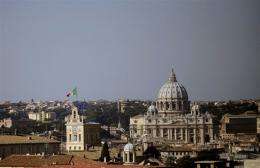
This picture taken from a terrace in Rome on October 19, 2009 shows a view of Saint Peter's Basilica at The Vatcian. Is there life on other planets? The Vatican has asked that age-old question over the past five days during a "study week" on astrobiology gathering leading scientists from around the world.

Is there life on other planets? The Vatican has asked that age-old question over the past five days during a "study week" on astrobiology gathering leading scientists from around the world.

"The questions of life's origins and of whether life exists elsewhere in the universe are very suitable and deserve serious consideration," said the chief papal , Father Jose Gabriel Funes.

Although the questions "offer many philosophical and theological implications," the gathering of about 30 leading astronomers, geologists, biologists, physicists and other scientists "focused on the scientific perspective," Funes said, according to the Vatican news service.

The event hosted by the Pontifical Academy of Sciences was held to mark the International Year of Astronomy.

"There is a palpable expectation that the universe harbours life, and there is hope that the first discovery is only a few years away," said Chris Impey of the University of Arizona.

"It is appropriate that a meeting on this frontier topic is hosted by the Pontifical Academy of Sciences," Impey said. "The motivations and methodologies might differ, but both and posit life as a special outcome of a vast and mostly inhospitable universe."

Technological breakthroughs have led to the discovery of more than 400 planets beyond the solar system, he noted.

His colleague Athena Coustenis of the Paris-Meudon Observatory, told AFP she thought that if life exists "we will find it soon," and most likely within our solar system.

In astrobiology, "we realise every day that reality goes beyond fiction," she said.

The participants hoped to publish their conclusions in a book, Funes said.

The Jesuit priest broached the question of extraterrestrial in an interview last year, when he said the search for aliens did not contradict belief in God.

"As an astronomer I continue to believe that God is the creator of the universe," Funes told the mouthpiece, the Osservatore Romano.

The possibility raises a difficult theological question concerning redemption from the original sin, which by Christian tradition occurred in the Garden of Eden when Adam and Eve ate the forbidden fruit of a particular tree.

Funes told the Osservatore Romano: "If other intelligent beings exist, it's not certain that they need redemption."

(c) 2009 AFP

4.8 /5 (4 votes)  

Filter


Move the slider to adjust rank threshold, so that you can hide some of the comments.


Display comments: newest first

Truth
Nov 15, 2009

Rank: 1 / 5 (1)
What this development means is that religion, at least the Catholic religion, is finally and blessedly going through its own evolution, just like biological organisms, slowly but surely shedding past cumbersome structures and adapting new, more efficient ideas. I am extremely happy to see that the Vatican is interested in the Universe and the abundant life that it surely harbors. Finally, no more "we are the center of the universe" or "we are the only beings ever created". What a refreshing change in the weather! By showing scientific curiousity and healthy open-mindedness, the Vatican is poised to become the prime example of vibrant and exciting intellectual inquiry, showing the way for the rest of the world's religions, many of which unfortunately remain stuck in 12th. century darkness and bias.
Rank 4.8 /5 (4 votes)
Related Stories
Relevant PhysicsForums posts

More news stories

Study shows global glaciers, ice caps, shedding billions of tons of mass annually

Earth's glaciers and ice caps outside of the regions of Greenland and Antarctica are shedding roughly 150 billion tons of ice annually, according to a new study led by the University of Colorado Boulder.

Space & Earth / Earth Sciences

created 2 hours ago | popularity 5 / 5 (1) | comments 2 | with audio podcast

Building mountains in a bottle

(PhysOrg.com) -- Scientists are preparing to launch a 10-year project to study water resources, gas exchange and carbon cycling in three man-made landscapes built in a half-acre laboratory at the University ...

Space & Earth / Environment

created 6 hours ago | popularity 4 / 5 (1) | comments 0 | with audio podcast

VLT takes most detailed infrared image of the Carina Nebula

(PhysOrg.com) -- ESO's Very Large Telescope has delivered the most detailed infrared image of the Carina Nebula stellar nursery taken so far. Many previously hidden features, scattered across a spectacular ...

Space & Earth / Astronomy

created 7 hours ago | popularity 5 / 5 (5) | comments 3 | with audio podcast

NASA looking for more space taxis

NASA is looking for more ways to get astronauts to the International Space Station. The space agency put out a call today for commercial space companies to submit bids as part of the latest round of the Commercial ...

Space & Earth / Space Exploration

created 5 hours ago | popularity 4.3 / 5 (4) | comments 3

When stars play planetary pinball

Many of us remember playing pinball at the local arcade while growing up; it turns out that some stars like it as well. Binary stars can play tug-of-war with an unfortunate planet, flinging it into a wide ...

Space & Earth / Astronomy

created 5 hours ago | popularity 4 / 5 (1) | comments 0


Short fasting cycles work as well as chemotherapy in mice

Man may not live by bread alone, but cancer in animals appears less resilient, judging by a study that found chemotherapy drugs work better when combined with cycles of short, severe fasting.

Physicists build highly efficient 'no-waste' laser

A team of University of California, San Diego researchers has built the smallest room-temperature nanolaser to date, as well as an even more startling device: a highly efficient, "thresholdless" laser that ...

Study shows how DNA finds its match

It's been more than 50 years since James Watson and Francis Crick showed that DNA is a double helix of two strands that complement each other. But how does a short piece of DNA find its match, out of the millions ...

Transparent iron? For the first time, an experiment shows that atomic nuclei can become transparent

At the high-brilliance synchrotron light source PETRA III, a team of DESY scientists headed by Dr. Ralf Röhlsberger has succeeded in making atomic nuclei transparent with the help of X-ray light. At the ...

'Explorers,' who embrace the uncertainty of choices, use specific part of cortex

Life shrouds most choices in mystery. Some people inch toward a comfortable enough spot and stick close to that rewarding status quo. Out to dinner, they order the usual. Others consider their options systematically ...

Scientists delve into the brain roots of hunger and eating

Synaptic plasticity – the ability of the synaptic connections between the brain's neurons to change and modify over time -- has been shown to be a key to memory formation and the acquisition of new learning behaviors. ...