Scientist develops lab machine to study glacial sliding related to rising sea levels
November 10, 2009 Iowa State scientist develops lab machine to study glacial sliding related to rising sea levels

Enlarge

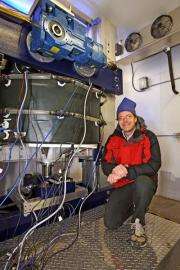
Neal Iverson, an Iowa State professor of geological and atmospheric sciences, worked with a team of Ames Laboratory engineers to develop a machine that can simulate how glaciers slide across their beds. At the bottom of the machine is a hydraulic press that can create pressures equal to those beneath a glacier 1,300 feet thick. Credit: Photo by Bob Elbert/Iowa State University.

Neal Iverson opened his laboratory's walk-in freezer and said the one-of-a-kind machine inside could help scientists understand how glaciers slide across their beds. And that could help researchers predict how glaciers will react to climate change and contribute to rising sea levels.

Iverson is an Iowa State University professor of geological and atmospheric sciences. He's worked for three years on his big new machine, which is over nine feet tall, that he calls a glacier sliding simulator.

At the center of the machine is a ring of ice about eight inches thick and about three feet across. Below the ice is a hydraulic press that can put as much as 170 tons of force on the ice, creating pressures equal to those beneath a glacier 1,300 feet thick. Above are motors that can rotate the ice ring at its centerline at speeds of 100 to 7,000 feet per year. Either the speed of the ice or the stress dragging it forward can be controlled. Around the ice is circulating fluid - its temperature controlled to 1/100th of a degree Celsius - that keeps the ice at its melting point so it slides on a thin film of water.

As Iverson starts running experiments with the simulator this month, he'll be looking for data that help explain glacier movement.

"For a particular stress, which depends on a glacier's size and shape, we'd like to know how fast a glacier will slide," Iverson said.

Glacier sliding is something that matters far from the ice fields. As the climate warms, Iverson said glaciers slide faster. When they hit coasts, they dump ice into the ocean. And when those icebergs melt they contribute to .

But there's a lot about the process researchers still don't know.

"We can't predict how fast glaciers slide - even to a factor of 10," Iverson said. "We don't know enough about how they slide to do that."

And so Iverson came up with the idea of a glacier in a freezer that allows him to isolate effects of stress, temperature and melt-water on speeds of glacier sliding.

The project is supported by a $529,922 grant from the National Science Foundation. While Iverson had a rough design for the simulator, he said a team of three engineers from the U.S. Department of Energy's Ames Laboratory - Terry Herrman, Dan Jones and Jerry Musselman - improved the design and turned it into a working machine.

Iverson said the machine won't simulate everything about glacier sliding.

"The fact is we can't simulate the real process," he said. "We can only simulate key elements of the process. The purpose of these experiments will be to idealize how the system works and thereby learn fundamentals of the sliding process that can't be learned in the field because of the complexity there."

Iverson, who also does field studies at glaciers in Sweden and Norway, said glaciology needs work on the ground and in the lab. But it's been decades since anybody has attempted the kind of laboratory simulations he'll be doing.

"There hasn't been a device to do this," Iverson said. "And so there haven't been any experiments."

To change that, Iverson is pulling on a coat, hat and gloves and working in his lab's freezer. He has rings to build. Equipment to calibrate. And experiments to run.

Source: Iowa State University (news : web)


Rate this story - 5 /5 (1 vote)


November 10, 2009 all stories

Comments: 0

5 /5 (1 vote)

  • hide
  • Related Stories

  • Melting glacier worries scientists
    created Jul 25, 2005 | popularity not rated yet | comments 0
  • Alaska glacier speed-up tied to internal plumbing issues
    created Jan 15, 2008 | popularity not rated yet | comments 0
  • Scientists expect increased melting of mountain glaciers
    created Jan 20, 2006 | popularity not rated yet | comments 0
  • Rapidly accelerating glaciers may increase how fast the sea level rises
    created Nov 14, 2005 | popularity not rated yet | comments 0
  • Fastest glacier in Greenland doubles speed
    created Dec 08, 2004 | popularity not rated yet | comments 0


  • hide
  • Relevant PhysicsForums posts

  • Carbon Dioxide emissions question
    created Feb 08, 2010
  • Photosynthesis vs. carbonization
    created Feb 07, 2010
  • Sheep's footprints
    created Feb 05, 2010
  • How did Victorians estimate the ages of fossils?
    created Feb 03, 2010
  • More from Physics Forums - Earth

Other News

Rho Ophiuchus cloud

Professor: We have a 'moral obligation' to seed universe with life

Space & Earth / Astronomy

created 15 hours ago | popularity 3.3 / 5 (22) | comments 43 | with audio podcast report

(PhysOrg.com) -- Eventually, the day will come when life on Earth ends. Whether that’s tomorrow or five billion years from now, whether by nuclear war, climate change, or the Sun burning up its fuel, the last ...


A new 3-D map of the interstellar gas within 300 parsecs from the sun

A new 3D map of the interstellar gas within 300 parsecs from the Sun

Space & Earth / Astronomy

created 7 hours ago | popularity 5 / 5 (3) | comments 0 | with audio podcast

(PhysOrg.com) -- Astronomy & Astrophysics is publishing new 3D maps of the interstellar gas in the local area around our Sun. A French-American team of astronomers presents new absorption measurements toward ...


38 percent of world's surface in danger of desertification

38 percent of world's surface in danger of desertification

Space & Earth / Environment

created 1hour ago | popularity 2.3 / 5 (3) | comments 4

A team of Spanish researchers has measured the degradation of the planet's soil using the Life Cycle Assessment (LCA), a scientific methodology that analyses the environmental impact of human activities, and ...


Climate 'Tipping Points' May Arrive Without Warning, Says Top Forecaster

Space & Earth / Environment

created 4 hours ago | popularity 3 / 5 (4) | comments 5 | with audio podcast

(PhysOrg.com) -- A new University of California, Davis, study by a top ecological forecaster says it is harder than experts thought to predict when sudden shifts in Earth's natural systems will occur -- a worrisome finding ...


URI researcher calls for global effort to monitor marine pollutants

Space & Earth / Environment

created 5 hours ago | popularity 3 / 5 (2) | comments 1

A University of Rhode Island researcher who studies chemical pollutants in the marine environment has called on colleagues around the world to establish a global monitoring network to verify that the chemicals banned by the ...