The Stars My Destination
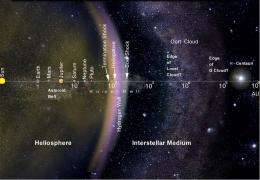
The Voyager spacecraft are now in the outermost layer of the heliosphere, traveling toward interstellar space - the first man-made spacecraft to travel such a vast distance from Earth.
In Alfred Bester’s classic novel, The Stars My Destination, Gully Foyle, anti-hero of the future, is picked up after spending almost six months drifting alone in the outer reaches of the solar system. As he puts it, “One hundred and seventy days dying and not yet dead…” This summer, two intrepid American spacecraft are celebrating a mind-boggling thirty-two years alone in the interplanetary darkness.
At the time Alfred Bester wrote his story in 1956, the notion that we would one day explore the vastnesses of the outer solar system was literally the stuff of science fiction. The first Earth-orbiting satellite - the Soviet Union’s Sputnik 1- was still a year away from launch. The space race got underway with a vengeance after Sputnik, and in January 1958 America put their first artificial satellite, Explorer 1, into orbit. Only a few years later, President John F. Kennedy committed America to putting a man on the moon before the end of the 1960s.
The 1970s saw the launch of arguably the most ambitious robotic deep space mission of all time, the launch of the Voyager 1 and 2 spacecraft.
The Voyagers flew to the edge of the solar system, visiting Jupiter, Saturn, Uranus and Neptune and a myriad of moons. Now, although the two sister craft are literally worlds apart, they are both engaged in the Voyager Interstellar Mission (VIM) - an official NASA extension to the original mission that nobody on the team thought was possible when the spacecraft slipped the surly bonds of Earth back in 1977.
The VIM is planned to extend through to 2012 and currently has a budget of $4.7 million each year. Staff numbers have been drastically cut since the glory days of the planetary encounters, but even so there are still less than forty staff members - full and part time - involved with the mission.
The Boundary of the Bubble
Our Sun and the planets that orbit it are caught in a sort of bubble as we travel through the galaxy. Called the heliosphere, this bubble, produced by the solar wind, is a plasma that is mainly ionized hydrogen and helium from the solar atmosphere. It forms a tenuous barrier between our solar system and the interstellar medium. The Voyager spacecraft are now travelling through the very outer layer of this bubble.
“This is the first time that any spacecraft have been in this final frontier of the solar system - the heliosheath - where the solar wind has abruptly slowed down from supersonic to subsonic,” says Ed Stone, Project Scientist for the Voyager mission. “The [solar] wind is deflected as it interacts with the interstellar wind beyond. What we're trying to do is to understand that interaction.”
Voyager 2 crossed the termination shock, the point where the solar wind slows down to subsonic speed, in 2007. Voyager 2 actually crossed this boundary five times, because the termination shock fluctuates due to changes in solar activity.
Voyager 1 had crossed the termination shock in 2004, heading in a completely different direction from Voyager 2 due to the different routes they had taken within the solar system. Scientists already knew the termination shock and the heliosphere was not symmetrical “east to west.” One of the first surprises that came out of the passages of the Voyager spacecraft through the termination shock was the discovery that it is not symmetrical from top to bottom, either. The southern margin is approximately 1.5 billion kilometers closer to the Sun than the northern boundary.
To Stone, this indicates that something outside the termination shock is pressing more strongly on the southern edge than the northern. Stone believes it is the local interstellar magnetic field generated by our Milky Way galaxy.
There were other surprises too. Numerical models assumed that the solar wind would heat up from 10,000 degrees to 1,000,000 degrees Celsius as it crossed the termination shock and became subsonic. Instead the temperature of the wind after the shock only rose to 100,000 degrees C.
“Most of the energy had gone somewhere else rather than heating the solar wind itself,” says Stone. “We now believe that that energy went into heating some ions that came in from interstellar space.”
The interstellar medium itself though cannot be measured directly until the Voyager spacecraft reach the outer edge of the heliosheath - the heliopause, an invisible surface where the pressures of the interstellar wind and the solar wind balance. Beyond lies the interstellar medium, and the spacecraft will have finally exited our solar system’s protective bubble. Stone estimates that passage across that final frontier could occur within the next five or six years.
How will we know when Voyager 1 or 2 has reached interstellar space? Stone thinks that there will be changes in the direction of the magnetic field and speed of the wind and an increase in energetic particles from the Milky Way galaxy hitting the craft. "The radiation environment will be much more intense,” he says.
Reaching For the Stars
The Voyager missions provide lessons for us when we consider the challenge of leaving our home solar system and reaching for the stars.
“When Voyager was launched, the space age itself was only twenty years old and no one had experience designing and building a spacecraft that would fly for twelve years to get to Neptune,” notes Stone. “So [first,] we built in redundancy. Second, because radiation has a rapid aging effect on spacecraft, we had to use parts that were very radiation tolerant. Having survived the intense radiation belts around Jupiter [the spacecraft] really had a lot [of life] left. The third and most important thing is power. There is much less sunlight out there, so we had radioisotope thermoelectric generators (RTG) with a Plutonium 239 heat source that has a half life of eighty-eight years. That is what has given us the long lifetime and will continue to do so for many more years if nothing breaks.”
Larger RTGs could have extended the lifetime of the spacecraft, but they would have weighed more. Larger RTGs also weren’t necessary to accomplish the original mission length of four years - just long enough to travel to Saturn.
The cameras and other planetary measurement instruments on the spacecraft are no longer needed and have been switched off to conserve power. Currently five instruments are running on each of the Voyager spacecraft, sending back data on the strength of the local magnetic field in addition to the speed, temperature and density of the solar wind, the presence of low frequency radio waves, and the intensity of energetic ions and cosmic rays. Tom Krimigis, Emeritus Head of Space Science at Johns Hopkins University, says that by sharing power among the various systems and switching off more instruments, the Voyager RTGs can last even longer.
“We will have two or three [instruments] on at any one time, and we would simply rotate power between the instruments,” says Krimigis. “In that way we can probably extend the useful life of the mission to at least 2026.”
To Stone, the continuing life of the Voyager probes is a huge bonus. As for the future, he says, “The challenge is going much faster than Voyager’s million miles per day, so we can journey ever more deeply into space. I hope that when Voyager finally reaches interstellar space, it will have led the way for future missions of exploration and discovery.”
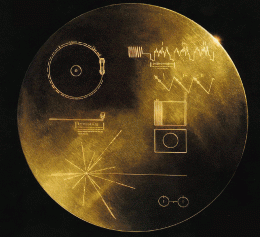
Each Voyager probe carries a golden disc inscribed with the sights and sounds of our lonely planet upon it. “It was really our message saying we as a civilization now can do this,” says Stone. “We can send a message to interstellar space. To carry it there. That's really a first…” He pauses and then adds quietly, “I mean, these will be the first interstellar spacecraft ever.”
Source: Astrobio.net, by Richard Corfield


