The 2009 Leonid Meteor Shower
November 10, 2009 by Dr. Tony Phillips The 2009 Leonid Meteor Shower

Enlarge

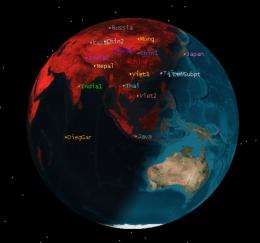
This side of Earth will be facing the Leonid debris stream at the time of the Nov. 17th outburst. Observers in India, China and Indonesia are favored with dark, pre-dawn skies. Image credit: Danielle Moser of the NASA Meteoroid Environment Office.

This year's Leonid meteor shower peaks on Tuesday, Nov. 17th. If forecasters are correct, the shower should produce a mild but pretty sprinkling of meteors over North America followed by a more intense outburst over Asia. The phase of the Moon will be new, setting the stage for what could be one of the best Leonid showers in years.

"We're predicting 20 to 30 per hour over the Americas, and as many as 200 to 300 per hour over Asia," says Bill Cooke of NASA's Environment Office. "Our forecast is in good accord with independent theoretical work by other astronomers."

Leonids are bits of debris from Comet Tempel-Tuttle. Every 33 years the comet visits the and leaves a stream of dusty debris in its wake. Many of these streams have drifted across the November portion of Earth's orbit. Whenever we hit one, meteors come flying out of the constellation Leo.

"We can predict when Earth will cross a debris stream with pretty good accuracy," says Cooke. "The intensity of the display is less certain, though, because we don't know how much debris is in each stream." Caveat observer!

The first stream crossing on Nov. 17th comes around 0900 UT (4 a.m. EST, 1 a.m. PST). The debris is a diffuse mix of particles from several old streams that should produce a gentle display of two to three dozen meteors per hour over North America. Dark skies are recommended for full effect.

"A remarkable feature of this year's shower is that Leonids will appear to be shooting almost directly out of the planet Mars," notes Cooke.

It's just a coincidence. This year, Mars happens to be passing by the Leonid radiant at the time of the shower. The Red Planet is almost twice as bright as a first magnitude star, so it makes an eye-catching companion for the Leonids: sky map.

The next stream crossing straddles the hour 2100-2200 UT, shortly before dawn in Indonesia and China. At that time, Earth will pass through a pair of streams laid down by Comet Tempel-Tuttle in 1466 and 1533 AD. The double crossing could yield as many as 300 Leonids per hour.

"Even if rates are only half that number, it would still be one of the best showers of the year," says Cooke.

The Leonids are famous for storming, most recently in 1999-2002 when deep crossings of Tempel-Tuttle's debris streams produced outbursts of more than 1000 meteors per hour. The Leonids of 2009 won't be like that, but it only takes one bright Leonid streaking past Mars to make the night worthwhile.

Enjoy the show.

Source: Science@NASA, by Dr. Tony Phillips


print this article email this article download pdf blog this article bookmark this article     Stumble it Digg this share on Facebook retweet share on Reddit add to delicious
Rate this story - 4.8 /5 (4 votes)


November 10, 2009 all stories

Comments: 0

4.8 /5 (4 votes)
  • Stumble this up

  • Digg this

  • share this

  • hide
  • Related Stories

  • Return of the Leonids
    created Dec 05, 2008 | popularity not rated yet | comments 0
  • Return of the Leonids
    created Nov 14, 2006 | popularity not rated yet | comments 0
  • Lunar Leonid Strikes
    created Dec 04, 2006 | popularity not rated yet | comments 0
  • Orionids Meteor Shower Lights Up the Sky
    created Oct 21, 2009 | popularity not rated yet | comments 0
  • The 2004 Perseid Meteor Shower is Promising to Be Unusually Good
    created Aug 10, 2004 | popularity not rated yet | comments 0


  • hide
  • Relevant PhysicsForums posts

  • Sideral question
    created 2 hours ago
  • Doppler shifted blackbody spectrum
    created 5 hours ago
  • Earth v. Moon
    created 7 hours ago
  • help me with coordinates and orbits
    created 7 hours ago
  • More from Physics Forums - General Astronomy

Other News

Atlantis astronauts take 2nd spacewalk of mission (AP)

Atlantis astronauts take 2nd spacewalk of mission

Space & Earth / Space Exploration

created 4 hours ago | popularity 5 / 5 (1) | comments 0

(AP) -- An astronaut anticipating the birth of his daughter at any moment embarked on the first spacewalk of his career Saturday, tackling a load of maintenance work outside the International Space Station.


More than 18 million cubic metres of sand are set to be poured onto the new coastal band of dunes until 2011

Dutch build more dunes against rising seas

Space & Earth / Environment

created 21 hours ago | popularity 4.3 / 5 (6) | comments 0

On the beach at Monster, bulldozers painstakingly turn sand dredged from the bottom of the North Sea bed into dunes in an ambitious effort to safeguard the Netherlands from flooding.


New Method to Measure Snow, Soil Moisture With GPS May Benefit Meteorologists, Farmers

Space & Earth / Earth Sciences

created 21 hours ago | popularity not rated yet | comments 1

(PhysOrg.com) -- A research team led by the University of Colorado at Boulder has found a clever way to use traditional GPS satellite signals to measure snow depth as well as soil and vegetation moisture, a technique expected ...


Astronauts await word of baby girl on Earth (AP)

Astronauts await word of baby girl on Earth

Space & Earth / Space Exploration

created 22 hours ago | popularity 5 / 5 (1) | comments 0

(AP) -- Atlantis' astronauts anxiously awaited word on the birth of one crewman's daughter Friday, as they moved more supplies into the International Space Station and geared up for another spacewalk.


Commuters wait on the platform shrouded by fog in London

Climate change not man-made, say majority of Britons: poll

Space & Earth / Environment

created Nov 15, 2009 | popularity 3.3 / 5 (15) | comments 43

Less than half of Britons believes that human activity is to blame for global warming, according to a poll carried out for The Times newspaper and published on Saturday.