Noise Evidence Could Expand Hurricane Record
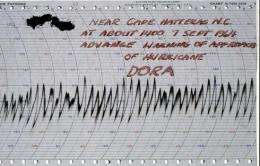
As sea-surface temperatures rise across the globe, some scientists believe that hurricane frequency and intensity may increase. A fresh technique offers promise to generate new data from long-dead storms, which could improve researchers' forecasts and make them more accurate.
Carl Ebeling, a geophysicist at Northwestern University in Evanston, Ill., demonstrated a method to uncover the power of historic hurricanes by looking at how oceans churned by the storms transferred energy into the ground. His efforts could improve the understanding of historical hurricane patterns, filling in gaps in the hurricane record.
Ebeling's method is based on the realization that weather transfers energy into the ocean, where the water in turn pumps some of that energy into the ocean floor. That energy travels along the ocean floor and is eventually recorded by land-based seismographs, the same machines that detect earthquakes.
Ebeling knew about this process because he spent seven years working for the Comprehensive Nuclear-Test-Ban Treaty Organization in Vienna, Austria. He was responsible for evaluating the ability of potential seismic monitoring stations to detect clandestine nuclear weapons tests, and in doing that work he noticed strange seismic patterns in Antarctica.
"It appears that this was really well correlated with a really large storm in the South Atlantic," said Ebeling. "That's what started me thinking down this particular path."
Ebeling took seismic records from stations in Massachusetts and Puerto Rico and analyzed them for evidence of Hurricane Andrew, a Category V storm that devastated Florida in 1992.
Seismic records show the motion of the ground, regardless of the cause. While earthquakes are the most common source of seismic events, bomb blasts, building demolition and a host of other events -- including violent weather -- can be recorded on sensitive seismographs.
Typically, scientists monitoring seismographs for earthquake activity disregard signals caused by human activity or by weather as "noise." But it is in the noise generated by hurricanes that Ebeling is finding his data.
"I'm changing that paradigm a little bit," said Ebeling. "Earthquakes for me are noise."
Before high-altitude surveillance aircraft and satellites, meteorologists could not track hurricanes at sea. In fact, if storms didn't make landfall, they might not be recorded at all unless the storm crossed an unlucky ship's path. For these reasons, complete historical hurricane records begin only in the 1960s, which is a short timeframe in which to find meaningful patterns.
Ebeling presented his research in October at the annual meeting of the Geological Society of America.
"We generally know which seasons during this period were active or inactive, but it's nice to know that this data might help to confirm this," said Phil Klotzbach, an atmospheric scientist at Colorado State University in Fort Collins. "If you look at data for 1933, which had 21 named storms, no tracks of tropical cyclones extend east of [50 degrees West Longitude, or roughly 2,000 miles east of Washington, D.C.]. I'm sure there were storms out there, but nobody was there to measure them!"
Ebeling said he needs to increase the number of hurricanes in his database. "I've really only looked at Andrew and a few other ones," he said. "Ultimately what I'd like to be able to do ... is to go back and digitize analog seismograms that existed since the 1930s at stations near Harvard, Mass., and San Juan, Puerto Rico."
That work will allow Ebeling and others to discern information about hurricanes that happened decades ago, but are not listed in current records. "One of the questions [atmospheric scientists are] grappling with right now is whether rising sea surface temperatures are contributing to hurricane frequency," said Ebeling.
Adding decades of observations to the Atlantic hurricane record should greatly improve scientists' ability to answer that timely question.
© 2009 Inside Science News Service