Skunk's Strategy Not Just Black and White
November 10, 2009
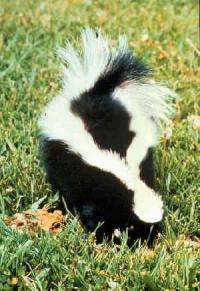
Striped skunk. Image: Wikipedia
Predators with experience of skunks avoid them both because of their black-and-white coloration and their distinctive body shape, according to UC Davis wildlife researcher Jennifer Hunter. The study was published online Oct. 21 in the journal Behavioral Ecology.
Hunter wanted to know how predators know a skunk is a skunk. Biologists had assumed that the distinctive black-and-white color scheme was a marker saying, "keep away."
Hunter prepared taxidermy mounts of skunks and of gray foxes, an animal about the same size but a distinctly different shape. Some of the stuffed skunks she dyed gray, and some of the foxes she dyed black-and-white. She then placed the animals at 10 sites around California -- in locations where skunks were abundant as well in areas where they were uncommon -- and monitored them with infrared video cameras.
In locations where wild skunks were not commonly found, predators such as bears, mountain lions, bobcats and coyotes would approach, lick, roll on or attempt to drag away the stuffed skunks as well as the stuffed foxes. But in places where skunks were common, potential predators gave anything skunk-like, either in shape or color, a wide berth.
"They wouldn't go near them," Hunter said.
The results suggest a much stronger learning component in prey recognition than was previously thought, Hunter said. She was also surprised to find that body shape, not just color, was important. Previous studies, mostly conducted in the laboratory rather than in the wild, had suggested that animals have an inbuilt tendency to avoid brightly colored or multicolored prey.
The study also raises the question: Does anything actually eat skunks? Possibly not, Hunter thinks.
While numbers of most animals are controlled by predators above them in the food chain, skunks may be a rare example where the main check on their numbers comes from disease, food supply or lack of habitat -- factors that depend mainly on the number of skunks themselves.
-
Skunk Deaths Not Due to Rabies or Distemper, Tests Show
Apr 03, 2008 |
not rated yet |
0
-
The case of the snuggling skunks -- Is it better to brave winter alone or in a group?
Dec 19, 2006 |
not rated yet |
0
-
Study: Foxes can't outfox coyotes
May 25, 2006 |
not rated yet |
0
-
Study to monitor bears and hunters by GPS
Nov 22, 2005 |
not rated yet |
0
-
Will lemmings fall off climate change cliff?
Apr 20, 2007 |
not rated yet |
0
-
Engineers build first sub-10-nm carbon nanotube transistor
Feb 01, 2012 |
4.9 / 5 (31) |
30
-
Something old, something new: Evolution and the structural divergence of duplicate genes
Jan 31, 2012 |
4.6 / 5 (7) |
1
-
The hidden nanoworld of ice crystals: Revealing the dynamic behavior of quasi-liquid layers
Jan 30, 2012 |
5 / 5 (3) |
1
-
Stock market network reveals investor clustering
Jan 27, 2012 |
3.9 / 5 (23) |
8
-
Of microchemistry and molecules: Electronic microfluidic device synthesizes biocompatible probes
Jan 26, 2012 |
5 / 5 (1) |
0
-
Mitosis
58 minutes ago
-
Stem cell question.
2 hours ago
-
Protease cleavage
8 hours ago
-
Pertubance in a model
15 hours ago
-
Cancer drugs and Alzheimer's, Oh my!
23 hours ago
-
Squishing cells
Feb 09, 2012
- More from Physics Forums - Biology
More news stories
The power of estrogen -- male snakes attract other males
A new study has shown that boosting the estrogen levels of male garter snakes causes them to secrete the same pheromones that females use to attract suitors, and turned the males into just about the sexiest ...
13 hours ago |
4.8 / 5 (5) |
1
|
Grass to gas: Researchers' genome map speeds biofuel development
Researchers at the University of Georgia have taken a major step in the ongoing effort to find sources of cleaner, renewable energy by mapping the genomes of two originator cells of Miscanthus x giganteus, a large perenn ...
10 hours ago |
3.8 / 5 (5) |
0
|
Experts reveal how plants don't get sunburn
(PhysOrg.com) -- Experts at the University of Glasgow have discovered how plants survive the harmful rays of the sun.
13 hours ago |
4.7 / 5 (3) |
0
|
Miami battling invasion of giant African snails
No one knows how they got there. But an invasion of African giant snails has southern Florida in a panic over potential crop damage, disease and general yuckiness surrounding the slimy gastropods.
17 hours ago |
4 / 5 (1) |
4
Protein libraries in a snap
(PhysOrg.com) -- A Rice University undergraduate will depart with not only a degree but also a possible patent for his invention of an efficient way to create protein libraries, an important component of biomolecular ...
16 hours ago |
4.8 / 5 (4) |
0
|
Google users warned of threat to smartphone wallets
Users of Google smartphone wallets were being warned on Friday that there is a way to crack pass codes intended to thwart thieves from going on illicit shopping sprees.
Anonymous knocks CIA website offline (Update)
The website of the Central Intelligence Agency was inaccessible on Friday after the hacker group Anonymous claimed to have knocked it offline.
New error-correcting codes guarantee the fastest possible rate of data transmission
Error-correcting codes are one of the triumphs of the digital age. Theyre a way of encoding information so that it can be transmitted across a communication channel such as an optical fiber o ...
Complex wiring of the nervous system may rely on a just a handful of genes and proteins
Researchers at the Salk Institute have discovered a startling feature of early brain development that helps to explain how complex neuron wiring patterns are programmed using just a handful of critical genes. ...
Humans may have helped the decline of African rainforests 3000 years ago
(PhysOrg.com) -- Large areas of rainforests in Central Africa mysteriously disappeared over three thousand years ago, to be replaced by savannas. The prevailing theory has been that the cause was a change ...
New power source discovered
(PhysOrg.com) -- Researchers at the Massachusetts Institute of Technology (MIT) and RMIT University have made a breakthrough in energy storage and power generation.
Nov 10, 2009
Rank: not rated yet
Oh and one more thing... they STINK! A whole article and not one mention of the odor. Weird.
Nov 10, 2009
Rank: not rated yet
Skunks generally don't stink if left alone. They take great pains to keep their musk off themselves, because they don't like the smell any more than anything else does. A skunk dyed gray wouldn't deter a predator looking only for color cues until it actually sprayed.
Nov 10, 2009
Rank: not rated yet
Nov 10, 2009
Rank: not rated yet
I think the "predators with experience of skunks" statement meant that already. What other known experience could predators have with skunks? Hypnotize them to nausea with a wiggly waggly black and white color?
It just means (since am already spelling it out) since the predators had experience with skunks (i.e. their odor), the next time they "see" the cues of black-and-white and the body shape, they are alerted (i.e. avoid before smelling it again).
You have to give the researcher a credit. She is a "Hunter" after all. (sorry, just had to crack that somehow)