Hydrogen milestone moves energy independence one step forward
November 10, 2009 by Brett Stone Hydrogen milestone moves energy independence one step forward

Enlarge

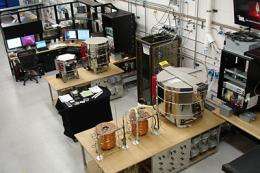
Pure hydrogen produced in INL's high-temperature electrolysis laboratory could provide a more efficient means for upgrading low-quality crude oils into petroleum.

(PhysOrg.com) -- Big things often come in small packages. That's certainly the case with the potential created by recent successes in hydrogen research at Idaho National Laboratory.

Steve Herring, technical director of the High Temperature Electrolysis Nuclear Initiative, holds in his hand a solid-oxide electrolysis cell no larger than a standard CD. However, the two electrodes and that make up the cell are almost eight times thinner than a CD at a mere 150 microns.

"That's where we get into the physics and chemistry of what's going on here," said Herring. In that tiny arena, he and his team have been laboring for six years to create options for the U.S. and world to defend against looming problems in world supplies.

During the 1973 oil crisis, cars lined up for miles waiting to fill up with gasoline on even or odd days while prices skyrocketed and the broader economy suffered.

Now, an increasing number of scientists are predicting that similar conditions could exist with the peaking of world . That peak, they project, could come within a generation or so. A 2007 report by the Government Accountability Office compiled studies to produce a conservative estimate that oil production would peak by 2040.

A world after oil production peaks will be inherently different from what happened in the 1973 crisis, though. Instead of slowly rebounding, oil production would instead slowly taper off, according to the study, and require global restructuring on a phenomenal scale.

But the researchers at INL think they may have at least part of the solution. The first thing that comes to the minds of many when they hear "hydrogen" is fuel-cell-powered vehicles. However, INL's team is focused on a more strategic priority.

Currently, "gasoline and actually have a lot of hydrogen that has been added to them, and that's one thing that a lot of people don't recognize," said Herring. "Next to a refinery, there's often a plant making hydrogen that is used for upgrading the petroleum."

In the near future, those refineries will likely begin to require more and more hydrogen as oil producers are forced to turn to lower quality sources for petroleum. "Particularly," said Herring, "what are called heavy crude oils, that have a lot of sulfur or that are tar-like."

Hydrogen, when added to petroleum, breaks apart the long chains of hydrocarbon molecules, creating a more flammable substance. Experts say that upgrading these reserves of lower-grade petroleum could prove to be one of the best defenses against cataclysmic economic implications brought on by peaking oil production.

But producing hydrogen requires large amounts of electricity to power the electrolysis process that splits water into its hydrogen and oxygen components, which is precisely why the work of Herring and his team is so promising.

By improving the efficiency and increasing the life span of the electrolytic cells, Herring and team aim to make the use of oil sands, biomass and other sources a viable option for transportation fuel.

And with recent successes, they have reason to be hopeful. The latest batch of electrolytic cells tested included modified electrodes that were designed to resist internal separation caused by oxygen bubble formation that had degraded performance in previous tests.

It worked. The new cells more than doubled the lifetime of their predecessors by lasting 2,583 hours with an average degredation rate of 8.2 percent for 1,000 hours, more than twice the previous best performance of 21 percent degredation per 1,000 hours.
Hydrogen milestone moves energy independence one step forward

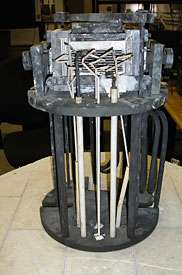
The 10-cell stack just prior to the start of the test.

"It means that they're closer to commercial viability," said Herring. But even before the test had cooled down from its 800-degree Celsius operating temperature, the team was already planning on making the cells even better.

"I'm very much encouraged that it will be able to operate for longer periods of time," said Herring. "We'll have to take these cells apart and investigate what has happened inside them, and then change the way that they're fabricated so they can last longer."

That analysis will involve splitting up the work with partners like the Massachusetts Institute of Technology (MIT) researchers who will examine the edges of the cell using "Auger spectroscopy." They'll also use scanning tunneling and transmission electron microscopes that allow them to identify the electric fields surrounding individual atoms in the cell. In this way, they can identify what elements are building up in certain areas of the cell and begin to engineer electrolytic cell adjustments to further increase efficiency and longevity.

"It's been a lot of work by a number of people here, particularly Carl Stoots, Jim O'Brien, Keith Condie and Lisa Moore-McTeer," Herring said. "They've really worked hard in putting this all together over the last five or six years. And then keeping it running, that's always a real challenge."

Speaking of the progress that's been made since research began in 2003, Herring said, "It's the same sort of physics that occurs in electronics. That, too, was a process that took many years and a lot of trial and error to get devices that would last for a long time."

The lab is also taking other steps to advance hydrogen research, including building an experiment that will allow them to produce hydrogen and carbon monoxide for the synthesis of hydrocarbons. The idea, with electrolytic cells creating hydrogen on one end of the lab and a fuel synthesizer on the other, is to model the embryo of a future fuel synthesizing plant.

In cooperation with several manufacturers of ceramic cells, including Ceramatec and Materials and Systems Research Inc. of Salt Lake City, the NASA Glenn Research Center and the French firm St. Gobain, INL is also investigating new, thinner cell designs. Some of the new designs have electrolytes only 10 microns thick, or a quarter the thickness of a common human hair.

All these efforts, Herring hopes, can help the U.S. avoid the precarious cliff of peaking world oil production. "That's why we're doing this research," he said.

Provided by Idaho National Laboratory (by Brett Stone)


print this article email this article download pdf blog this article bookmark this article     Stumble it Digg this share on Facebook retweet share on Reddit add to delicious
Rate this story - 3.9 /5 (12 votes)

Rank Filter

Move the slider to adjust rank threshold, so that you can hide some of the comments.


Display comments: newest first

  • ac04605 - Nov 10, 2009
    • Rank: 2.8 / 5 (4)
    "By improving the efficiency and increasing the life span of the electrolytic cells, Herring and team aim to make the use of oil sands, biomass and other sources a viable option for transportation fuel."

    I am confused by this article. Is it saying that by increasing the productivity of these cells we will be able to better utilize low quality oil? If so I believe the title to be misleading; how will this technology make us energy independent?
  • probes - Nov 11, 2009
    • Rank: 1.7 / 5 (3)
    I think the authors are trying to point out that this is a technology milestone. Like the VASIMR engine.
  • rgw - Nov 11, 2009
    • Rank: 4.5 / 5 (4)
    All knowledge is progress. Any advance is hope. All discoveries are primitive. Deal with it!
  • jerryd - Nov 11, 2009
    • Rank: 4 / 5 (2)

    Even if they get H2 100% eff it still doesn't come anywhere near as close to battery electric vehicles in cost or range per unit of energy. One can go 4x's as far on the same energy in an EV vs a H2 oe fossil fueled car.

    For instance my EV can go 100+ miles on the electric used to make 1 gal of gasoline or diesel.

    If we want to become energy independent, we need to start making lightweight, aero EV's using composite bodies/chassis and forklift EV drive tech with lead or lithium batteries for cars, some trucks.

    For other trucks, semi's use NG hybrid drives.

    In 5 yrs we could be completely independent of imported oil if we did those and made much higher mileage ICE cars.
  • DozerIAm - Nov 12, 2009
    • Rank: 1 / 5 (1)
    This sounds promising. Certainly every step we take to get more miles from the same unit of raw petrolium is an improvement.

    Jerryd I have to disagree with your assessment. I'm not in a position to argue your numbers (too lazy to look up what I suspect are hinky statistics) but even if one accepts your premise and numbers, the costs of everyone in 5 years having a vehicle as you described would cripple long haul over road transportation, clobber our already clobbered economy, and become a safety hazard to anyone who gets in an accident in one of these small, brittle vehicles. Unless you plan to lower the max speed limit down to 40mph to reduce overall force?

    My thought is, improve efficiencies as the article says, build a pile of nuke plants and use breeder reactors to recycle the spent fuel, open up ANWR and anywhere else we suspect ther may be oil to drilling, plant wind farms off the Kennedy compound in Mass, and in general attack this problem from many directions.
  • Lord_jag - Nov 13, 2009
    • Rank: not rated yet
    Brittle? A carbon fiber frame would have 1/4 of the weight and twice the strength as a cheap steel frame. It just costs more.... A cost that in my mind is well worth it.

    Don't fool yourself. There are plenty of materials that aren't all that expensive that are far stronger and far lighter than steel.

    Batteries a safety hazard? How about a tank of explosive gasoline? Batteries can at least be contained and won't burst into a fireball if there are sparks nearby. A little spray of battery acid will barely itch unless it gets in your eyes. A spray of burning fuel is almost guaranteed to kill. It won't melt your face in seconds like in the movies.

    Everyone is so quick to condemn the safety factors of batteries, but you're so accustomed to the extreme dangers of having an explosive liquid in your car, you've forgotten about it completely.
  • mgenest001 - Nov 14, 2009
    • Rank: 4 / 5 (1)
    "Hydrogen milestone moves energy independence one step forward"

    Ho-hum. More like one micron forward.

    Pandering to big oil is not going to solve this. We are long past peak oil. It's time to stop flogging a dead horse and really turn up the juice on hydrogen research.

    Do it right. Stop wasting time trying to find ever creative ways to use dirtier and dirtier technologies. Hydrogen is only viable if it provides an alternative to hydrocarbons. Otherwise, what's the point.

    Its like using solar voltaic technology to heat only your coffee pot. What's the point. The energy could be better used elsewhere.

November 10, 2009 all stories

Comments: 7

3.9 /5 (12 votes)
  • Stumble this up

  • Digg this

  • share this

  • hide
  • Related Stories

  • Hydrogen milestone could help lower fossil fuel refining costs
    created Oct 09, 2009 | popularity not rated yet | comments 0
  • Researchers meet major hydrogen milestone
    created Sep 18, 2008 | popularity not rated yet | comments 0
  • Major milestone in hydrogen research
    created Dec 07, 2004 | popularity not rated yet | comments 0
  • Automobile fuel cells from sunflower oil
    created Aug 26, 2004 | popularity not rated yet | comments 0
  • New fuel cell drives around hydrogen economy roadblocks
    created Apr 01, 2005 | popularity not rated yet | comments 0


  • hide
  • Relevant PhysicsForums posts

  • Aspiring Engineering major looking for general answers
    created 21 hours ago
  • Calculating max load of square tube (steel)
    created Nov 19, 2009
  • Passive Chemical Heating
    created Nov 19, 2009
  • Shortening Boat Trailer
    created Nov 18, 2009
  • Strain Gage Test Advice
    created Nov 17, 2009
  • How Could I do This? Motor to open and close doors on a timer??
    created Nov 17, 2009
  • More from Physics Forums - General Engineering

Other News

Suit over search-engine keywords tries new angle

Technology / Internet

created 4 hours ago | popularity 2.5 / 5 (2) | comments 0

(AP) -- A lawsuit in Wisconsin is bringing a fresh challenge to the practice of paying for keywords on Google and other search engines to boost one company's link over a rival's.


Screen of a computer featuring a search of the word "edition" on the home page of Google's website

Google books hearing set for February 18

Technology / Internet

created 6 hours ago | popularity not rated yet | comments 0

A US judge set February 18 for a hearing on the revised legal settlement between Google and US authors and publishers that would allow the Internet giant to scan and sell millions of books online.


Newspapers are displayed at a newsstand

US newspaper ad revenue down nearly 28 percent

Technology / Business

created 4 hours ago | popularity not rated yet | comments 0

US newspaper advertising revenue fell by nearly 28 percent in the third quarter, continuing a slide which has led to layoffs, bankruptcies and the closure of several dailies.


Trust Linux!

Trust Linux!

Technology / Software

created 10 hours ago | popularity 4.3 / 5 (3) | comments 0

(PhysOrg.com) -- A team of researchers has implemented support for 'trusted computing' in a commercially available version of the open source operating system Linux, breaking new ground in the global drive ...


Cisco has released a Web security app for iPhone

Cisco releases Web security app for iPhone

Technology / Software

created 6 hours ago | popularity 4.5 / 5 (2) | comments 0

Cisco on Friday announced the release of a free iPhone application for anyone who wants to stay on top of the latest trojans, worms, or other threats marauding on the Internet.